This thread has been locked.

If you have a related question, please click the "Ask a related question" button in the top right corner. The newly created question will be automatically linked to this question.

LPV542: PSPICE Model

Part Number: LPV542

I'm trying to simulate the LPV542 model in LTSpice and I'm getting these error messages:

WARNING: Node u1:10 is floating.
ERROR: Node u1:7 is floating and connected to current source u1:xu14:G1
ERROR: Node u1:xu15:outx is floating and connected to current source u1:xu15:GRESP

Any idea what might be causing it or how to fix this?

  • It's difficult to comments on the source of the errors without seeing schematic.

  • Here is the circuit:

    The errors are for the internal parts of the LPV542 model, not the external circuit. Maybe LTSpice doesn't interpret the model's script correctly?

    Despite the errors, the simulation does run. I'm just not sure whether I'm getting correct results.

    If I'm testing Bode using this circuit:

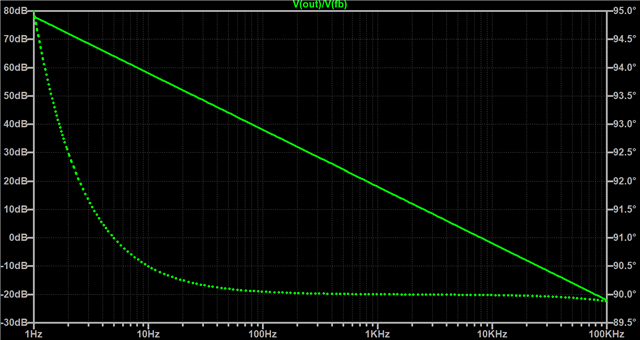
    I'm getting this result:

    The gain is okay but the phase looks different than in the datasheet. 

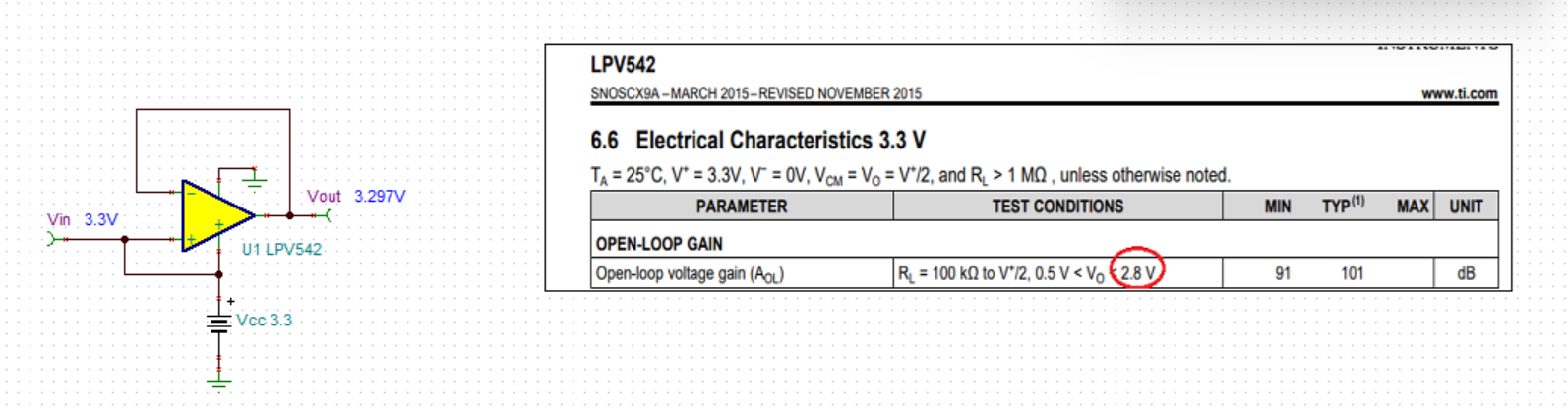
  • The circuit works fine in Tna-TI but LTSpice might not be able to converge because connecting the input to its positive supply (Vcc) in a follower configuration drives the output all the way to its rail, which violates LPV542 output voltage linear range as specified in the condition column of open-loop gain (AOL) - see below:  for 3.3V supply output voltage linear range is 0.5V<Vout<2.8V, thus for 3V supply 0.5V<Vout<2.5V and not 3.0

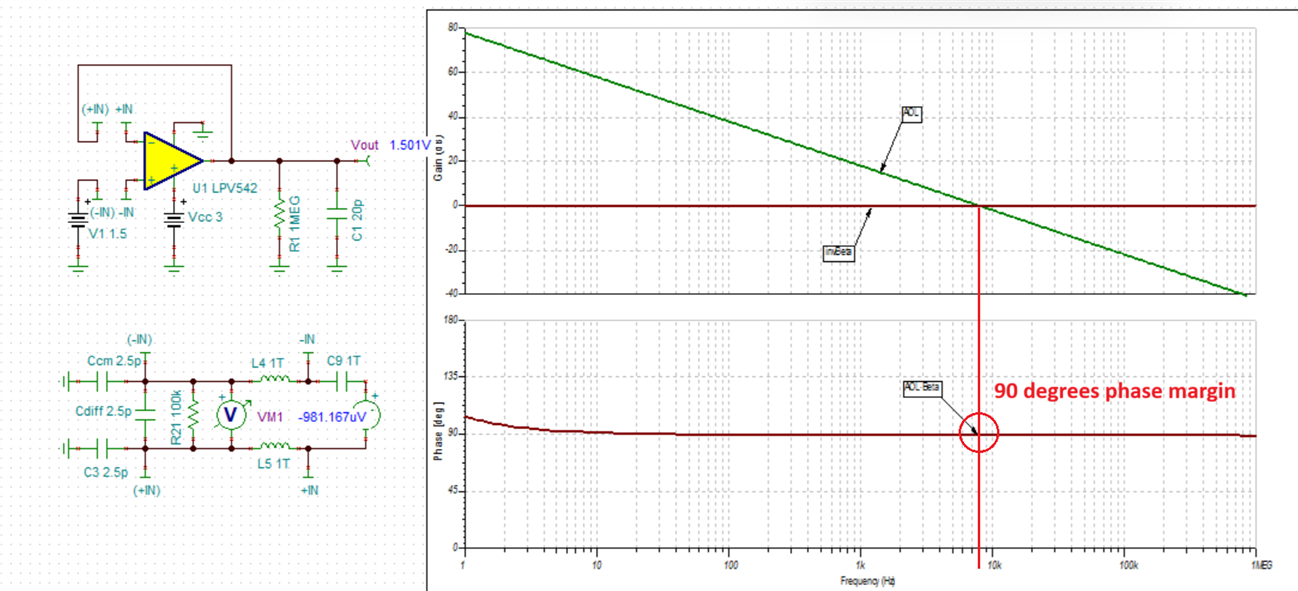
    In the second circuit you have moved the input to Vcc/2=1.5V, which  is within the LPV542 linear range, thus your results look correct showing very stable system with 90 degrees phase margin - see below.

    LPV542 AC Stability.TSC

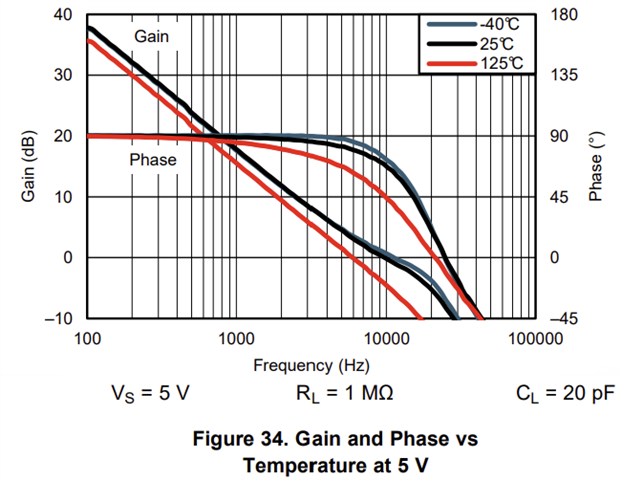
  • But that's not how it's supposed to look like. This is the chart from the datasheet:

    There is clearly a drop in the phase after 10KHz. The model does not capture this. If I use for stability analysis I might get wrong results, don't you agree?

  • You are correct that this old LMP542 macro-model  doesn't seem to include high-frequency poles , which should bring the phase margin above 10kHz down from 90 degrees.  For this reason it's not good for conducting stability analysis but based on Fig 34 I would expect it to drive at least 100pF in G=1.