This thread has been locked.

If you have a related question, please click the "Ask a related question" button in the top right corner. The newly created question will be automatically linked to this question.

INA701: INA701 current sensing larger error than expected

Part Number: INA701
Other Parts Discussed in Thread: TI-SCB

Hi!

I'm using the INA701 EVM board (with TI-SCB) to evaluate the INA701 for a customer. I'm testing in the following setup:

Lab power supply positive connected to current input of calibrated DMM (GW-Instek GDM-9601)
Output of DMM to to IN+
Load simulated by resistor connected to IN- and GND of power supply
GND of EVM board connected to GND of power supply. 

In the range 100mA to 1A, there is an error of over 3% between the current sensed by the INA and the current sensed by the DMM. This seems a lot larger to me than the INA701 specs suggest. 

Any idea what could be causing this? 

Thanks, Martin

  • Hey Martin,

    Your setup seems generally correct, so this is most likely a an issue with how the DMM is configured compared to the INA701. Here are a few things to check or try:

    • Compare the averaging of the DMM with the INA.
      • You can increase averaging and conversion time on the INA to get more stable result. If the DMM is doing a lot of averaging, and the INA is not, then if the current if fluctuation, then you will have a large discrepancy between the DMM and the INA
    • Make sure the DMM is in a good range for the current. 
      • You mentioned the error is between 100mA and 1A. If the error goes away above 1A, then it is possible that the DMM is auto switching scales/ranges, which could be part of the problem
    • Make sure the DMM is calibrated.

    Regards,

    Mitch

  • Hi Mitch,

    Sorry for the delay, been very busy here.

    Some clarification: The DMM is in a fixed range, so range switching won't be causing this. The DMM is calibrated. I just retested with an extra DMM in series and their readouts are well within a 3% margin (in fact below 0.1%).

    Indeed the 3% is in between the 100mA and 1A range, that does not mean that it is only in that range. Below 100mA it becomes significantly larger, this might be down to resolution. I did not measure beyond 1A as the customer is not interested in this. 

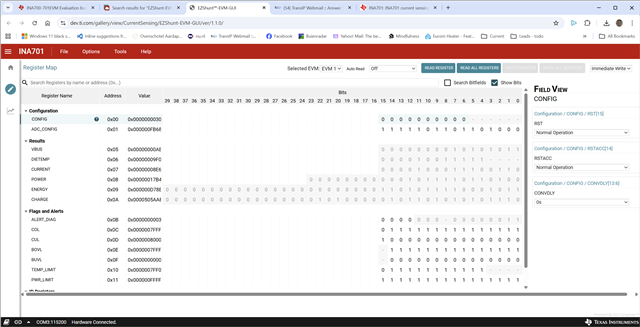
    I've taken 100 samples from the INA702 (see screenshot below for the setup of the EZShunt app), downloaded the CSV and averaged this in a spreadhseet. DMM shows an average well over 100 samples. 

    I'm pretty confident that the DMM is not the problem (since another one in series indicates the same). I'm willing to believe that the INA701 accuracy specs are genuine, yet there is a large discrepancy between the DMM readouts and the EZShunt app readout. 

    I think this could be caused either by:

    - Some error in the setup (which would be interesting since current can't go anywhere in a closed loop)
    - Some error in the EZShunt app and/or incorrect settings. See screenshot below for the settings used during the measurements.

    How can we identify what's going wrong here? 

    Kind Regards,

    Martin Koster
    Sofrides IO

  • Hello Martin,

    Can you try again with the conversion time and averaging settings on the INA701 set to max? Also, make sure there is a good ground between the INA and the supply, DMM, and Load.

    Regards,
    Mitch

  • Hi Mitch,

    Will do, but could you explain what you mean with good ground between DMM and the others? The DMM is part of the current supply on the high side, if I connect one of the sides of the DMM to GND we'd have a shortcut from supply to GND...

    Kind Regards,

    Martin Koster
    Sofrides IO

  • Hey Martin,

    Ya, sorry, I shouldn't have included the DMMs in that list. The important part is to have the load and supply grounds to be the same as the INA ground. It's a common mistake for people to not share the ground of the load with the INA. 

    Regards,

    Mitch

  • Hi Mitch,

    Yes, load and supply grounds should be the same. I already found out in earlier INA projects :-) I guess finite CMRR and infinite CM can lead to interesting problems...

    Setup was connected as you suggested with good GND between load and source. But...

    Meanwhile I've found another clue that might be relevant. So far I've been using the "Collect data" function in the EZCurrent tool, with 100 samples, exported these to CSV using the button and had Excel to calculate the average over said 100 samples. This results in the over 3% discrepancy. 

    Today I ignored that entire graph bit, and read values directly from the register map and converting it, assuming 190uA / LSB conversion factor. Now suddenly the discrepancy very decent, dropping below 0.1% getting towards the 1A range. 

    Looks to me there is a bug in the EZCurrent tool for the current calculation. Bus voltage seemed perfectly OK. If I look at the graphs that the tool shows, I get the same impression. E.g. for a current set at 50 mA, most datapoints shown in the graph are above 50mA, almost none are below. 

    Any suggestion how to confirm this? I don't have source code of EZCurrent of course, so can't check there. Should be relatively easy for you to repeat the test though.

    Another note: INA701 datasheet august 2025 shows two different conversion factors for the current register. In 6.6.1.5 it specifies 480μA/LSB, table 7-4 however specifies 190µA/LSB. The latter seems correct. Is this an error in the datasheet?

    Please advize, and thanks again.

    Kind Regards, 

    Martin Koster
    Sofrides IO

  • Hello Martin,

    I looked into the GUI, and there was an error, it was using 196 instead of 190. Thank you for finding that, I have made the change in the GUI, and it should work correctly now.

    Also, thank you for finding the error in the datasheet. The value is 190 and not 480. I will put in a request to get that corrected.

    Regards,

    Mitch

  • Hmmm, 196 is pretty much a 3% error from 190, isn't it? OK, glad we've sorted this one out, thanks for your time and swift responses!

    Kind Regards,

    Martin Koster
    Sofrides IO

  • You're welcome!