INA821: ABSOLUTE MAX TABLE ISSUES

Part Number: INA821
Other Parts Discussed in Thread: INA630,

We would like to use the INA 821 as a bidirectional precision current sense amp 
with an input common mode range of 0V to +21 V.
 
Since the inputs need to be 2 V away from the rails 
we want to use +24V supply and -5 V supply.
 
The Ref pin will be tied to ground. 
 
Short question …. is this OK ??
 ===
Another way to specify the same problem ...
as a single supply problem.
 
+Vs  is +29V, -Vs is zero volts
Ref is tied to +5V
Input common mode range is +3V to +25V 
is this OK ??
 ===
Longer question ….
 
The ABS MAX  table specifies +/- 20 V max
But there is no ground pin ??   
So WHAT is the reference for all the measurements in the ABS Max table ?????????????
 
Really that table should be redone ...
such that all voltages the voltages in that table are referenced to other pins 
that are ON the device, such as +Vs and -Vs.
Because Ground … is not there !!
  • Hi Jon,

    Welcome to the E2E forms.

    Since the inputs need to be 2 V away from the rails 
    we want to use +24V supply and -5 V supply.
     
    The Ref pin will be tied to ground. 
    +Vs  is +29V, -Vs is zero volts
    Ref is tied to +5V
    Input common mode range is +3V to +25V 
    is this OK ??

    You mentioned two different configurations. I'm going to run calculations on the first one but tell me if that's wrong. 

    I still need to know a few things:

    1. What gain? 
    2. What is your desired output voltage range? 

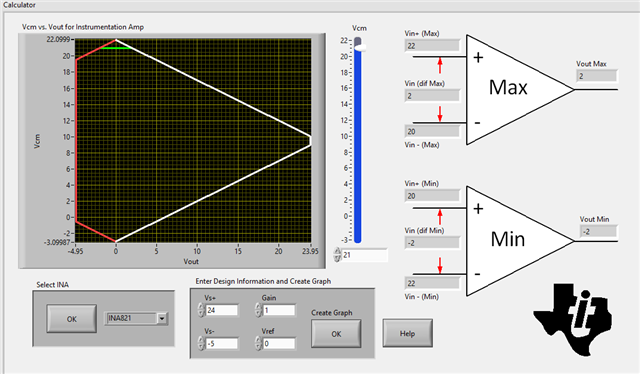
    Using the Analog Engineer's Calculator, I assumed your gain was 1V/V, as well as using the first set of conditions you described. This can easily be changed but it's the starting point I'm going on for right now. 

    Now looking at the input common mode range that you mentioned (0V to 21V) I wanted to look at the two extremes. 

    At Vcm = 0V, the output voltage range is -4.85V and 6V. 

    Moving the Vcm = 21V, we can now see that the output voltage is more limited than before at ±2V. 

    The ABS MAX  table specifies +/- 20 V max
    But there is no ground pin ??   
    So WHAT is the reference for all the measurements in the ABS Max table ?????????????
     
    Really that table should be redone ...
    such that all voltages the voltages in that table are referenced to other pins 
    that are ON the device, such as +Vs and -Vs.
    Because Ground … is not there !!

    When we designed the ABS MAX table, we should have written it like how we did it in the recommended operating conditions where there's a single supply and dual supply. What's important isn't necessarily how far from ground the supply pins are but rather how far from each other they are. 

    We have moved more to referencing the supply pins in newer datasheets like the INA630.

    Let me know if you need any other clarity and don't forget to answer my questions.

    Best Regards,

    Robert Clifton 

  • Hello

    I do not think you fully understand the question.

    If you are not an expert on this device please find and discuss with an expert ...
    ideally the IC designer.

    3 Questions ...
    We would like to use the INA 821 as a bidirectional precision current sense amp
    with an input COMMON mode range of 0V to +21 V. (USB C Current sense.).

    The DIFFERENTIAL input signal will be +50 mV to -15mV and it will have a gain of 100 V/V
    so the output swing will be -1.5V to +5V. (10 mOhm current sense R)

    Since the inputs need to be at least 2 V away from the rails ...
    we wil use +24V supply, and -5 V supply to the INA821.
    The Ref pin will be tied to ground ... zero volts!
    This is the reference for the output.

    So there are three questions.
    1. The Abs max question ... the ref pin is 24 volts away from the V+ rail. Is that legal?
    Likely it is.
    Your Abs max table is messed up!! The voltages are referenced to ground, and there is no ground pin on the part. All the Abs max ratings NEED to be referenced to V+ and V- on a part without a ground pin.

    2a and 2B. When the device does not have an external supply, V+ supply is high impedance (Looking into the cathode of a diode on a boost converter output) and the part has 20 volts common mode on the inputs, Q.. 2A. will currents >500 uA flow into the inputs ??
    I intend to protect against this case with a schottky from the 20 volt input to the unpowered V+ supply of the INA (Cathode to V+ supply of the INA )
    Q..2B Does this look like a good idea, and if not, what do you suggest?

    3. Is the INA821 internally a chopper amplifier. There are a few clues that it is, but the data sheet does not say that it is.

    Thanks for you help with these !!

    JD

  • Hi JD,

    Apologies for not understanding the question! 

    1. It's legal as it's not violating the voltage range of the reference input. 
      1. I agree with you that the abs max ratings should have been referenced to V+ and V- on a part without a ground pin instead of what they/we actually did where only the output pins had the supply voltage reference. I'll look into fixing this. 
    2. See below:
      1. I'm got to get some clarification from the design team on this and get back to you. They are in a different time zone so their response might be delayed. 
      2. Waiting for the design team to determine if this is a feasible idea. 
    3. The INA821 doesn't have an internal chopper circuit. We typically will mention in the datasheet that it's a chopper. 

    Best Regards,

  • Thank you.  I simulated 2 and it seems to work but some validation from the design team would be useful.  Thanks!!

  • Hi Jon,

    That's wonderful to hear and I agree.

    I was about to ping them again since I haven't heard back. When I hear back from them, I will immediately send the information to you!

    Best Regards,

    Robert Clifton 

  • Hi Jon,

    Design team is currently running simulations on it to verify. However they did say "it's a JFET input protection that will dump current to the supplies, and will charge them up unless there is no current path to discharge."

    Will provide more information once I get it. 

    Best Regards,

    Robert Clifton 

  • Hi Jon,

    They got back to me. 

    They confirmed a few things. First, the JFET input is followed by a protection ESD diode connected to the supplies. 

    Whenever you raise the inputs the supply rail will follow with some voltage when not driven. This could lead to supplying the system through the ESD and yes, the circuit would turn on. Thus, the system is supplied but not able to operate meaningfully. 

    2a and 2B. When the device does not have an external supply, V+ supply is high impedance (Looking into the cathode of a diode on a boost converter output) and the part has 20 volts common mode on the inputs, Q.. 2A. will currents >500 uA flow into the inputs ??
    I intend to protect against this case with a schottky from the 20 volt input to the unpowered V+ supply of the INA (Cathode to V+ supply of the INA )
    Q..2B Does this look like a good idea, and if not, what do you suggest?

    With this information, the Schottky diode would likely reduce the current flow of the input's overprotection voltage since the threshold is likely lower on the Schottky diode compared to the ESD diode but would likely turn on the V+ rail through the diode conducting. 

    Hope this helps. 

    Best Regards,

    Robert Clifton