LMH5485-SP: Input/Output Current Overdrive

Part Number: LMH5485-SP
Other Parts Discussed in Thread: UC1707-SP, LM193QML-SP

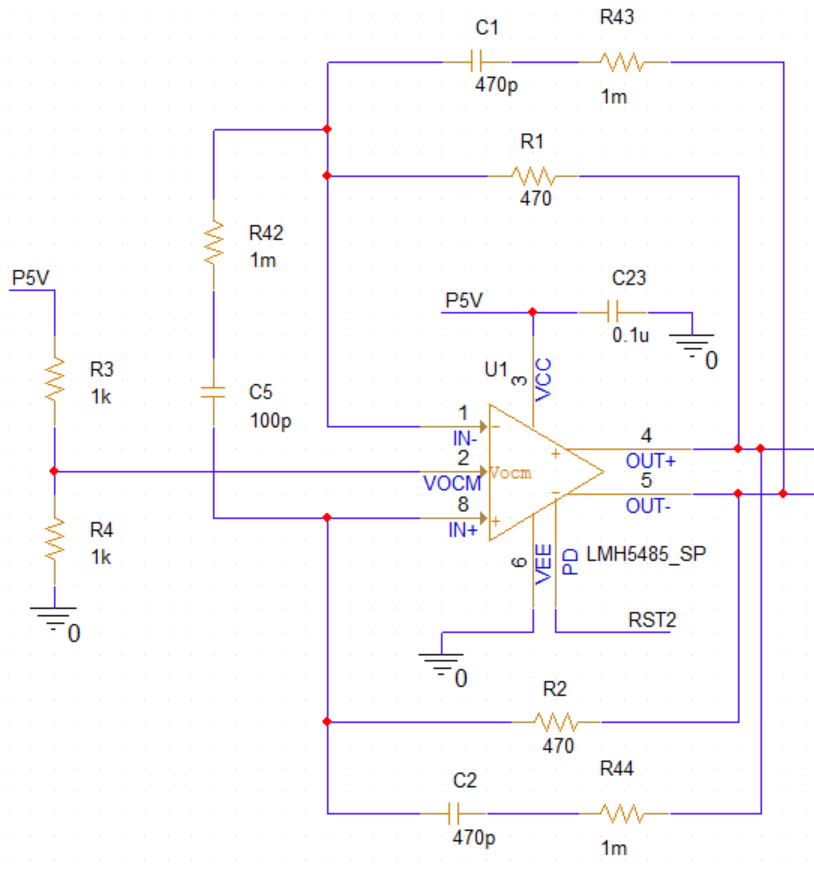
I'm using the LMH5485-SP as a self oscillator (see attached schematic) operating at ~1MHz. Due to the fast edges of the LMH5485-SP and the capacitive feedback, the current in the inputs and outputs have large transients (spice model clips them at 100mA) upon each edge transition. Is this configuration within the normal operating conditions of the LMH5485-SP? Or is this current conducting through internal ESD diodes in which continued operation could degrade the device?
LMH5485.png

  • Hi Sean,

    In this case I think the large currents into the inputs is due to the inputs being ripped apart which is violating the abs max input differential (Vid). This is turning on internal back-to-back ESD diodes between the inputs. Continued operation in this state would degrade the device. 

    Some series resistance for the inputs would help limit the input current, but that doesn't seem to solve the inputs being ripped apart. Putting the device in a gain would help attenuate the input differential from the output back to the inputs. Though I had to put it in a very high gain in simulation.

    However there is probably a better device for this kind of application. Did you choose the LMH5485 because you need differential outputs? I would consider an op-amp without the back-to-back ESD diodes (i.e. a "Mux Friendly" op-amp) with the LMH5485 or a similar FDA as a second stage for the SE to differential conversion.

    Thanks,

    Evan

  • Hi Evan,

    Ahh I see that now, thanks! 

    Yes, chose the FDA due to wanting a low power differential drive to a transformer. 

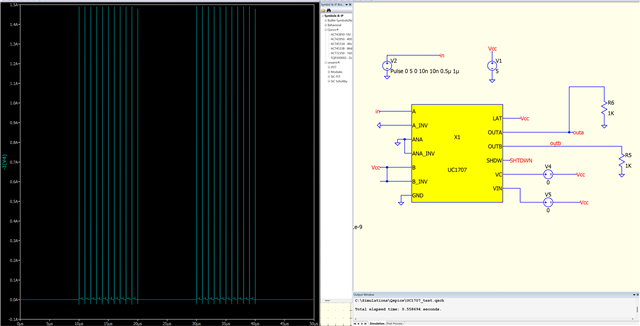
    I had been considering an oscillating comparator setup into UC1707-SP, however, the PSpice model for UC1707-SP seems to have very high cross conduction/shoot through in the totem pole bridge. Which made me move away from that topology. ~1.5A for 40ns. Would you be able to comment on the validity of this? I.e. is this a simulation model artifact or a real behavior. Note: QSpice was used for this simple sim, however, the result is the same in PSpice

    Thanks

  • Hi Sean,

    I'm not familiar with that device. But it seems like something meant to drive the gates of Power FETs and such so I'm not surprised but its output drive. I would ask a separate question to the forum with that device to make sure that it goes to the correct team. 

    Other comparators that might work would be the LM193QML-SP. But asking a separate forum question about oscillator topologies would make sure it goes to the comparator team.

    Thanks,

    Evan