OPA2277: Suppk

Part Number: OPA2277

Hello,

We have an electronic board containig five OPA2277U/2K5. Inthe last batch, we observed an excessive consumtion on these boards, which appears to originate from the OPAs.

The batch contains boarsd with OPAs marked 33CZKV, which are PASS according to our criteria, and other boards with OPAs marked 3CA1EP, which are FAIL.

Do you think the OPAs marked 3CA1EP may be from a specific factory with an issue ?
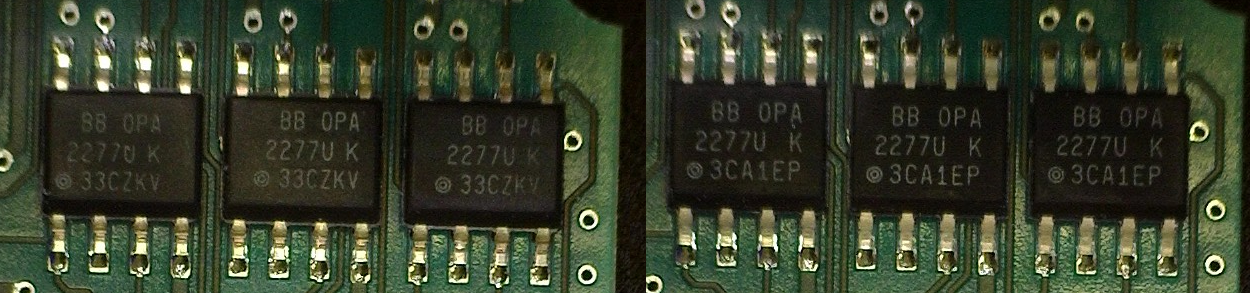
OPA2277 marking.png

  • Sabastian,

    The design, and wafer fab process have both changed (see product change notice PCN below).  The new design/process was developed with the objective to match the device as closely as possible.  However, the old and new designs will not match exactly.  Often, the PCB functional test will highlight differences between old and new versions of the device, but the difference is not a problem for the application.  In these instances, the limits on the PCB functional test are sometimes adjusted.  Can you confirm if your issue is in the application functionality or in the PCB functional test.  If the issue is with the application functionality, I can help understand the issue if you provide a schematic and description of the problem.   Going forward new OPA2277 material will match your latest results, but it is possible that some of the old material will remain at different vendors.

    https://www.mouser.com/PCN/Texas_Instruments_PCN20230928003_20230929185342131.pdf

    Best regards, Art

  • Art,

    The issue lies with the assembly boards during testing. We observed a current consumption of 1.5 mA higher than usual for the entire board, equating to approximately 100–150 µA per amplifier.

    The application appears to function correctly.

    Best regards, Sebastien

  • Sebastien,

    The new device has a typical IQ that is large than the old version/process.  The max limits are still accurate, so your IQ should still be within the specified maximum limit.  From a performance perspective the new device should be close to the performance of the old version, but the typical shifted for some parameters.

    Best regard, Art