Other Parts Discussed in Thread: INA333, OPA333, OPA2333, TL064, OPA227, TL084, INA101, TL074
Hello,
We are working on ECG application of INA333 and OPA333.
This thread has been locked.
If you have a related question, please click the "Ask a related question" button in the top right corner. The newly created question will be automatically linked to this question.
Other Parts Discussed in Thread: INA333, OPA333, OPA2333, TL064, OPA227, TL084, INA101, TL074
Hello,
We are working on ECG application of INA333 and OPA333.
Anish,
I believe that you are probably not biasing the input signal in a linear range of operation for the INA333. Try increasing the common-mode voltage of the input signal to 2.5V. Inspect all waveforms to look for possible distorted AC signals. The INA333 will provide the expected gain when biased and operating properly.
At what frequency are you measuring the gain of the low-pass filter? Perhaps you are nearing the roll-off frequency.
The notch filter appears to be placed in a sensible position in the circuit. Excessive mains noise can probably be attributed to the setup grounding and other factors that cannot be judged by inspecting the circuit diagram.
I'm not sure what you mean by "testing precautions." Again, the setup and grounding and other environmental factors will greatly influence signal quality. This is a tricky signal acquisition situation. You can expect to spend a great amount of time optimizing implementation, setup, grounding, cables, etc. for good signal quality.
I don't have much experience with the right leg drive circuitry, though this is a well-known technique. Much of the operation and optimization depends on the cable connections and electrode interface to the human body. The purpose is to control the common-mode potential of the body to properly bias the inputs and reduce common-mode noise.
I have a suggestion regarding circuit implementation: The gain-set nodes of the INA333 can be sensitive to capacitance and may have a tendency to oscillate. I recommend that R6 and R7 be placed close to the leads of the INA333. Furthermore, I recommend that a 100k resistor be added in series from R6-R7 to IC2B. Place this resistor close to R6 and R7. The purpose is to isolate the input capacitance and stray connection capacitance of IC2B from the gain-setting network of the INA333.
Another comment: IC1A and IC1B seem unnecessary. The INA333 is an instrumentation amplifier intended to function as a front-end signal acquisition component. The input buffers would seem to add no value.
Regards, Bruce.
Hello Bruce,
Thank you very much for the prompt reply! The problem was indeed due to wrong biasing of signals. On biasing to 1.5V common mode voltage,
we were able to observe proper functioning of INA333. Also we were able to verify the gain equations. The whole circuit seems to be working well
with sinewave input. Appreciate your help!
By testing precautions, I meant what should be ideal testing environment, grounding, shielding etc in order to obtain clean ECG waveform.?
I have noted down all of your suggestions and will take care of it in our next circuit.
I am trying to understand the working of RLD circuitry and I have a few questions. Is it possible for anyone else in the e2e community to answer questions regarding RLD?
1. According to the RLD circuit on page 14 of INA333 datasheet, the common mode voltage at output of 1st OPA2333(buffer) will be half of applied voltage.(Vcm/2)
Next OPA2333 will be driven into saturation due amplification factor of -390k/10k=-39. Even if non zero reference is given, situation is the same.
Simulation shows same results. Vo=5V dc + 60nV sinewave (pl refer attachment)
2. What is expected signal at RLD electronically- (AC component/ DC component)?
Thank you ..I will be in touch..
Regards,
Anish
Hello,
Also, one more question-
If buffers are not required for buffering the INA inputs, then what is the advantage of using it on page 15 of datasheet?
Pl explain.
Regards,
Anish
Anish,
I'm pleased to hear that you have made progress.
The RLD circuitry is one that may require careful optimization. We have some information that suggests that an integrator function may provide some advantage over a simple inverting amplifier. As I indicated previously, optimization of this circuitry requires experimentation. Companies that develop this type of equipment spend long months (years!) perfecting the best cabling and circuitry to get best results. We are not experts in this area and can only provide the broadest type of suggestions. You may derive some insight from this article:
http://www.edn.com/design/medical/4368833/Use-Spice-to-analyze-DRL-in-an-ECG-front-end
The author of this article is not available for consultation. With experimentation and study, you may become an expert and know than we do.
The circuit on page 15 combines three signals to derive the RLD. This cannot be accomplished with the two inputs of the INA333 so this is the reason for the added buffers.
One additional comment: The OPA333 may not be well-suited to drive long cables that might be used to body connections. You may need to use other op amps or specially compensate the OPA333 to effectively drive the capacitance of these cables.
Regards, Bruce.
Hello Bruce,
I have tried to implement RLD by referring to various schematics available on the internet.
But I guess, we will have to spend considerable amount of time like you mentioned.
Currently the problem is after connecting the electrodes, we are not able to view any waveform even resembling an ecg.
Pl find attached 'Freq response readings' taken separately by applying 20mV sinewave to our circuit by a function generator.
After connecting the ECG electrodes, it seems like all these filters fail to work and suddenly dominant 50Hz and harmonics start to appear in the output.
There is a LOT of noise on the input and the subsequent filters are apparently not helping. What could be the reason behind this?
We have tried almost everything we could think of. Changed the gains and freq cutoffs of all filters. Also checked all biasing issues of INA.
Awaiting your response,
Thanks and Regards,
Anish
Anish,
I'm sorry that you are having difficulty. This type of signal acquisition can be very tricky. Furthermore, these problems are nearly impossible for me to diagnose remotely.
The frequency plots you provided are with test signals, correct? Do they appear as you expected? Are you sure that your system is working as expected? These responses look rather strange to me.
Regards, Bruce.
Bruce,
Yeah. I know its not possible to solve the issues faced, remotely. You have already helped us a lot! Appreciate all the help!
Actually, we are participating in the TI's Analog Design Contest 2012 India, for which the project is due this month end.
Yes, those plots are for test signal- Sinewave 20mVp-p given as input. We had re-designed the LPFs for 45 Hz plus existing notch at 50Hz.
The final output sort of seems like the expected frequency response.
(Maybe it doesn't seem that way in the document since we have taken very less number of readings)
Current situation is as follows-
-> We have i. Separated AGND, DGND, AVCC, DVCC on the PCB,
ii. Installed decoupling capacitors at each IC and bulk capacitor at supply.
iii. Supply is Li-ion battery(2 x 3.7V) regulated at 5 Volts.
iv. PCB is 2 layer only.
v. Used isolation transformer for DSO to isolate ground loops.
vi. Shield is connected to AGND
vii. Right leg drive is connected to lateral part of abdomen after consultation with doctor.
I understand that the signal acquisition is difficult but If possible, pl give me hints where we could've gone wrong.- for e.g. wiring, shielding, grounding etc.
Thanks and Regards,
Anish
Anish,
Look at the RLD signal. What does it look like? Did you try an integrator for the RLD? Replace the feedback resistor of the RLD amp with a 10nF cap.
What are you using for electrodes? Maybe they have too much resistance.
The filter responses don't look at all correct--uneven and noisy. I'm not convinced that you have a working signal chain. You should plot amplitude on a dB scale to see a recognizable response shape, but still it is not correct.
Regards, Bruce.
Bruce,
RLD signal looks exactly like one of the input signals. I will replace fb resistor of RLD amp and check the waveform.
I will work on this and will get back to you soon with captured waveforms. Also, I will improve the filter design and redo everything if necessary.
I am determined to make this work at any cost.
Thanks a lot for the reply,
Regards,
Anish
Ideally, what should be the cutoff of the filters and what order should be used if we do not want to digitally filter the signal?
Anish,
ECG signal paths generally have BW in the 100Hz range for routine monitoring purposes... 200Hz bandwidth, or so, for diagnostic applications.
My guess is that more aggressive digital filtering is not going to help much.
Regards, Bruce
Hello Bruce,
How much does single/dual supply affect the performance of signals? For dual supply, is there better inherent noise immunity?
I had the chance to view ECG aquisition circuit with dual supply without RLD. In that circuit without any feedback, differential LA & LL-> gave ECG signal.
(with TL064, simple 2nd order filter without Notch)
So, I was wondering if single supply design is more challenging than dual supply..
Regards,
Anish
Anish,
When properly designed and operating, there should be no great difference between single supply and dual supply. A dual supply system is generally easier to implement.
Regards, Bruce.
Hello Bruce,
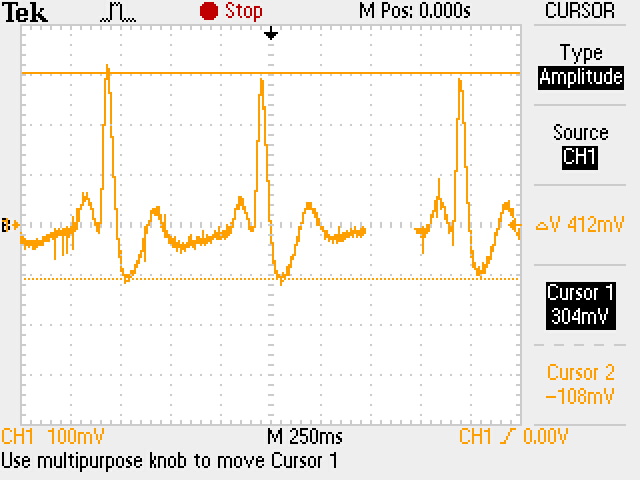
Pl view our ecg waveform finally acquired by the dual supply circuit. Notch filter designed at exactly 50Hz helped remove the AC power line noise.
Also use of precision capacitors(Film) and resistors(1%) helped us get expected filtering of the signal.
Pl do comment on the nature of DSO captured signal.
Thank you for the support!
Regards,
Anish
Anish,
Looks like a pretty clean waveform. Heart rate of about 80 BPM. Looks like the patient is alive. What is the gap in the signal?
Bruce
Hello Bruce,
I apologize for late reply. But the gap in waveform was due to hasty capture of waveform on DSO.
We were quite excited to see the signal. So, I captured the waveform before the horizontal sweep
on the screen was completed. Sorry about that!
Now we are interested in building pulse oximeter by using opa227.
Regards,
Anish
Anish, I have read this thread and is very interesting.
Congratulations for your succes!
Right now Im having some similar difficulties. Would you be so kind to upload the last versión of the circuit schematic?
I would really appreciated.
Best regards,
Alejandro from Argentina
Hello Alejandro,
I don't have the final diagram with me right now.Its with a friend.
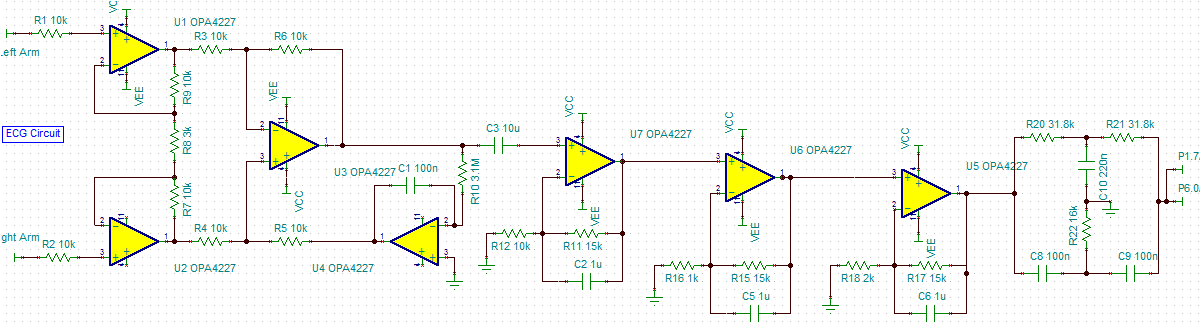
I've attached an intermediate design which we worked on.
You might want to study and implement about terms like "Ac-coupling" , "DC-bias".
Basically we built an instrumentation with 4 amplifiers. (4th one is HPF for dc tracking)
That was followed by 3rd order LPF. You can try alternate designs like Sallen-key 4th order etc.
Then final stage was adding of DC bias (not shown) and then the notch filter.
Try to analyse the AC & DC part of signals separately with gain equations.
PCB quality has some effect. But its possible to get a good ECG signal from a
poor quality PCB and even a bread board.
I hope this helped!
Hint:1. We are using Dual supply Op-amps which simplified our design.
2. You might need to bias the signal at various points in the circuit followed by AC-coupling to next stage.
Regards,
Anish
India
Anish, Thanks a lot for your quick reply.
I will try to implement your suggestions.
By the way, did you try the original circuit with dual supply?
On the last circuit you upload, do you connect the right leg to ground? Why did you decide to eliminate RLD?
We have already implemented a Digital LPF at 45Hz that I guess will do the work of the 3rd order LPF in your circuit.
Bruce,
If you have any comments they will be very welcome.
I liked Anish first design. Do you think that dual supply and no RLD would make the circuit to work better?
I do have OPA2333, is the only OP AMP of this kind that I was able to get in my country. I’m also using long ECG wires. How can I compensate parasite capacitance?
Another question, why is RG from de INA divided in two resistors? do they have to be equal in value?
Thanks to both of you in advance for any help you can give.
Best regards,
Alejandro
Anish,
I forgot 1 question. With U4 you are cancelling DC Bias, is this correct?
Do you think with OPA2333 I can get similar results?
Best regards,
Alejandro
Alejandro,
Yeah we tried the original design in dual supply..unfortunately it had many flaws like gain and cutoffs.
So, we again started from scratch. Designed, simulated and tested all the filters before applying the ecg signal.
I forgot to mention that RLD is connected to ground which is the reference everywhere in the circuit.
We did not find any significant changes with and without the RLD connection.
OPA2333, which you have, is a single supply IC, if I'm not wrong. So, in your case the reference would be some VREF value.
The same would be your RLD-DC value(as a common reference). But I'm not sure about the exact circuitry required.
In our schematic, RG from INA is a single resistor.
(You can check the standard Instrumentation Ampr design using 3 opamps and compare)
U4 is used to eliminate the low freq noise in any ecg signal, typically in the freq range <0.05 Hz.
So basically it acts as a high pass filter with cutoff 0.05Hz and prevents the DC bias from shifting.
Although we have spent considerable amount of time, I don't think we have he perfect circuit.
There are many flaws to be improved. We don't even have the digital filters in place.
If you come up with a better circuit one, pl do post.
Regards,
Anish
We did not have knowledge about circuit design using OPA2333. Hence, it did not give expected results.
We got a better understanding of the signals after designing with dual supply opamp.
I suggest you to go for any locally available dual supply DIP package opamp for testing on breadboard and pcb.
Later you can shift to SMD or single supply.
We used TL064 which was available for Rs20-30. thats less than 50 cents.
Anish
I really appreciate al your help. I do have some TL084, and perhaps will perform to do the job.
I will try this later at home on a bred board with dual supply, and will be back with the news.
Best regards,
Alejandro
Bruce,
I was also able to get a INA101 and not a INA333. Unfortunatly here is very difficult to get those amps.
Do you think is good enough for the project?
Best regards,
Alejandro,
The Rg resistor is split into two equal resistor so that the RLD is derived from the common-mode voltage of the differential input signal--halfway between the two input voltages.
Dual supply circuitry is much easier to implement. Single supply circuitry may be able to provide equal performance but generally requires greater skill and experience to design and optimize the circuitry.
Optimizing input circuitry and RLD for the particular input leads and electrodes used is certainly a major part of the design challenge. We are not authorities on this subject. Optimization comes from knowledge of principles and techniques of grounding and shielding, experience, careful debugging, measurements and experimentation.
INA101 is a BJT-input device and its maximum input bias current is pretty high for this application. Input bias current causes signal artifacts as it flows though the varying electrode resistance--especially with dry electrodes. You are likely to find that a subject cannot move very much without causing loss of signal.
Regards, Bruce.
Hi Anish and Bruce,
It is working, using both of your help. Im still using INA101 but with a TL074 as buffer for both inputs. Using dual supply and RLD, without RLD noise is all I get.
Im still doing some tests, I believe it is possible to have better quality using the components I have. As soon as I have a picture I will share it with you. The idea is to filter digitally with a DSP which is already working and show it in a GLCD which is working together as well.
I will be back soon!
Hello Bruce,
After reading a document on ECG Design Consideration, I can recognise one problem which
arises often(but not regularly) and I don't know the solution for that- Baseline DC instability.
What can be the potenial causes for such noise? It completely distorts the signal.
Pl enlighten me about the causes & solutions.
Thanks, Anish
Anish,
I apologize for the slow response. I apparently missed this posting. For you and others who may read this thread, your question deserves an answer. A wandering or unstable baseline may have several possible causes:
A wandering baseline with short-circuited inputs indicates a faulty signal chain. Probable cause would be an amplifier with too much 1/f (flicker) noise.
Poor baseline performance when connected to a subject has other sources of artifact signals. Electrode potentials (the voltage created at contact with the skin) can vary. This may be due to poor contact or poor electrode preparation. Electrode design is a science of its own. Input bias current of the amplifier reacts with electrode impedance creating a voltage. (FET-input amplifiers minimize this error.) These errors are greatly affected by motion or movement of the subject.
Regards, Bruce.
Hey Bruce,
Thank you for the answer. I think this gives a clearer picture regarding the baseline question.
I think what you said makes sense because when the electrodes were changed or positioned properly the baseline instability was reduced or eliminated. Continuous use of the same electrodes caused the problem to arise again. We were using disposable electrodes so there was no jelly which may have caused the problem.
I haven't tried it for short circuited inputs. So no way to check that.
Anyway thanks for your feedback..!
Regards, Anish