This thread has been locked.

If you have a related question, please click the "Ask a related question" button in the top right corner. The newly created question will be automatically linked to this question.

How to replace OPA1632 with a low-power OPA?

Other Parts Discussed in Thread: OPA1632, ADS1281, ADS1282, THS4531

Hi,

I am trying to design an 8-ch A/D logger.

So I am reading the guide which is ADS1281EVM and ADS1281EVM-PDK User's Guide.

In the circuit, it use OPA1632 for a buffer.

But I notice that the power consumption is very high. (high current)

In my application, it will causes a short life-cycle.

The power consumption is my top priority.

The performance can be decreased a little bit.

If possiable, please give me some suggestions.

Thank you.

Regards,

YHH

  • I think it is hard to find a low-power FDA with ±10V power supply.

    The input range of differential signal are known.

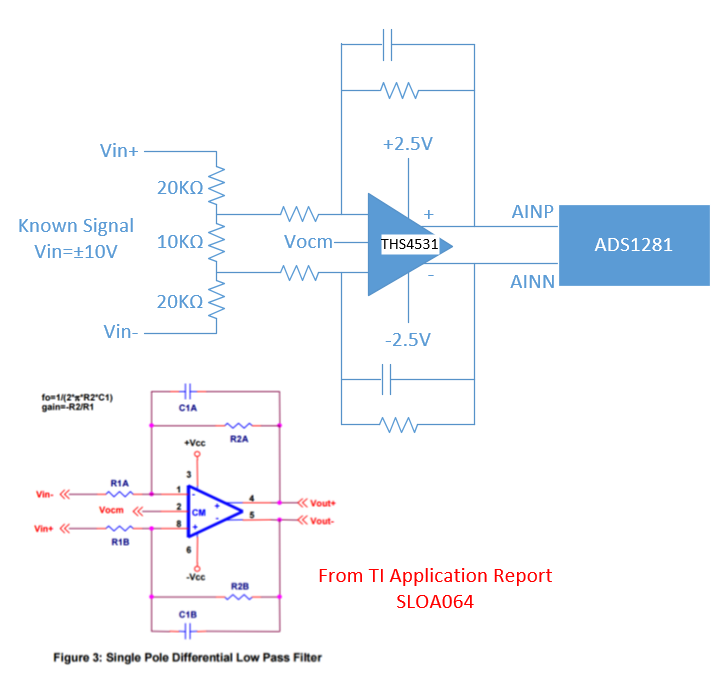
    if I use a voltage divider and LPF like following. (Vin = ±10V to ±2V)

    Will it work in practice ?

  • Hi Yu-Hung,

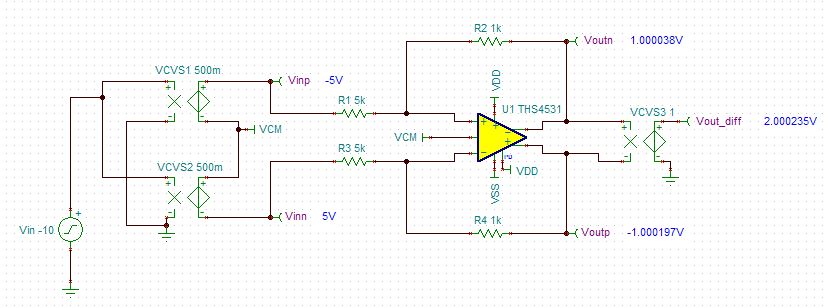
    That may be a possible solution! You could try configuring the FDA to have an inverting gain of 0.2 V/V, like such:

    Here is the TINA file: THS4531.TSC

    Also, what about using the ADS1282 instead of the ADS1281? You would still need to use a resistor divider, but you would have an integraged low-power PGA.

    Best Regards,
    Chris

  • Hi Chris,

    Can you explain what the VCVS part is in the real circuit?

    I have no idea. :)

    I want to design a 8-ch synchronized logger.

    But the two analog input channels(AIN1, AIN2) are not synchronized in ADS1282.

    It means only one channel I can use, the size and power consumption are almost double.

    I don't care the cost, but I care the power consumption.(Ocean Bottom Seismometer System)

    The other hand, the Gains of PGA are 1,2,4,8,16,32,64. (no gain=0.2)

    If I adjust the input voltage range with gain 0.2 V/V to +/-2V in the pre-amplifier, why PGA needs?

    Or does PGA has some functions or usages I don't know?

    Regards,

    Yu-Hung

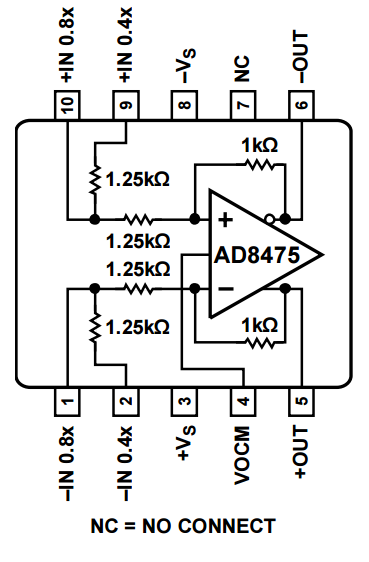
  • You could possibly use the AD8475 funnel amplifier from Analog Devices. The applications section shows a 20Vpp signal converted to 4Vpp with a level shift to 2.5V for example.

    regards

    Steve

  • Hi Steve,

    A. The Quiescent operating current/ch of THS4531 is 330uA(max).

    B. The supply current of AD8475 is 3.2mA(max).

    I have no idea how to compare them to know which one is low-power.

    PS.  The same kind of IC components(eq. ADC) have different spec. description, even in same manufacturer!!!

    This lets me confuse until now. :(

    The interesting thing is the functional block diagram inside AD8475 is similar with Chris's given.

    Especially the reference application is useful.

    Thanks.

    Regards,

    Yu-Hung

  • Hi Yu-Hung,

    The Voltage-Controlled Voltage-Sources (VCVS) are ideal voltage buffer/amplifiers components. They are  used in the simulation to convert the single-ended voltage source into a differential signal, and then later to measure back the differential signal as a single-ended signal.

    Yes, there is only one ADC in the ADS1282 so the input channels are MUX'ed - as opposed to simultaneously sampled inputs which require multiple ADCs in the same package. One benefit of the ADS1282 is that the PGA and ADC are both in the same package, so it would save PCB space. Unfortunately there is not a 0.2 V/V gain, as this device is intended to connect to a geophone or hydrophone, which typically has a much smaller output signal. Are you connecting to an active sensor or seismometer with an already amplified/buffered output?

    If you plan to build an external attenuation stage, than there shouldn't be a need to use the ADS1282 - the ADS1281 would work just fine. In general, delta-sigma ADCs require some kind of buffered stage to prevent large gain errors because the ADC's input impedance is relatively low. 

    One thing to keep in mind with the THS4531 is the feedback resistor size. With smaller resistors, the input source will have to drive a larger current. With larger resistors, the bandwidth and phase margin will be lowered. There is a section in the THS4531 data sheet on page 34 that describes this trade-off.

    I'd also recommend checking out this related E2E thread:

    Best Regards,
    Chris

  • Hi Chris,

    I think the output signal of my sensors have been amplified.

    For example, my sensors:

    A. Bartington Mag-03 Three-Axis Magnetic Field Sensors.

    Electrical Spec:
    Supply voltage ±12V to ±17V
    Current consumption +30mA, -10mA (+1.4mA per 100μT for each axis)
    Power supply rejection ratio 5μV/V (-106dB)
    Analogue output ±10V (±12V supply) swings to within 0.5V of supply voltage (unbalanced, single ended ref. 0V)*
    Output impedance 10 Ω

    B. Guralp CMG-40T Triaxial Broadband Seismometer.

    Electrical Spec:
    Supply voltage 10 – 36 V using internal 12 V DC/DC converter
    Current consumption at 12 VDC 48 mA
    Differential output ± 10 V
    Output impedance 47 Ω

    Thanks, the E2E thread is helpful, I will keep reading.

    He had the sample problem!!

    Regards,

    Yu-Hung