This thread has been locked.

If you have a related question, please click the "Ask a related question" button in the top right corner. The newly created question will be automatically linked to this question.

OPA140 Common Mode Range Behavior

Other Parts Discussed in Thread: OPA140, OPA376, OPA320

Hello,

I have an application where my input range is 0-2.5V.  I want to keep my supply voltage as low as possible, thus I will use 6V or more to get around the Vs-3.5 input common mode range of the OPA140.  However, I have to handle a situation where the input to a sensor may get disconnected; in this case, I need to be able to predict the OPA140's reaction and know that it will recover once re-connected.
During this time, the (+) input would rise to 4.3V (or Vs-1.7).  The (-) input would remain <2.5V, thus (+ in) > (- in) and (+ in) > than common mode range, but (- in) within common mode range.
What is the expected response of the OPA140?  

I know it has phase reversal protection, so does this just mean it will respond in the predictably positive direction and not necessarily linearly (maybe like a comparator?).

Best regards,

Glen

  • Glen,

    Why do you intend on using high voltage op amp like OPA140 for a low-voltage application.  How about instead using OPA320 or OPA376?

    Also, are you using the op amp in an open-loop configuration where +in=4.3V and -in=2.5V?  If you use it in a close-loop configuration, the negative feedback will bring the inverting input within a virtual short of non-inverting input even when you violate the input-commonon mode voltage by 1.8V (+in=Vss-1.7V).


  • Hi Marek,

    This is a very low frequency application.  Noise in the 0.01 - 10Hz region is critical, without compromise.  The OPA140 is the best R2R amp that I have found for noise in the range of interest (and I have tried many parts).  Actually, there is a better one (different brand) but the CMR does not go to 0 V input.

    Being a JFET input, the OPA140 also passes our EMC susceptibility tests quite well (evaluated against some ADI and Linear Tech parts).
    Either of the parts you suggest are inferior to the OPA140, and if I were to change parts, my next choice (for VLF noise & R2R) would be outside of TI's portfolio.  So you don't want that, right?

    Also, my sensor needs a bit more headroom than a 5V rail.  It has a certain impedance and requires a minimum power related to the laws of physics, so there is no re-negotiating that one.  I am trying to avoid having something like a 9V rail or having to clamp the input of the op amp (also can be a noisy proposition in my world).

    As for your question, yes, there would be feedback (essentially unity),  Thus, I guess, you are confirming that the OPA140 won't go off into the weeds with the errant condition that I described.

    Thanks

    Glen

  • Glen,

    Yes, if you are concerned about 1/f noise, OPA140 is the right choice. Also, for low frequency close-loop applications, it will maintain virtual short between the input terminals almost all the way to positive rail. Having said that, as you get closer than 3.5V below positive rail, you will gradually decrease the current biasing the input differential pair, Itail, which will result in the increase in the input voltage noise (Vnoise~1/√Itail) and decrease in bandwidth and slew rate.

    As far as low voltage op amps go, even though most of them are specified only up to Vs=5.5V, their rated maximum supply voltage is 7V.
  • Hello Marek,
    Do you know if the SPICE model will exhibit this described behavior if I simulated within 3.5V of the upper rail?

    Thanks

    Glen
  • Glen,

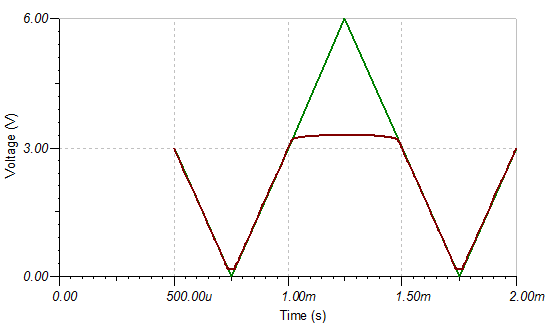
    I created the macro-model for OPA140 and it intentionally clips the input signal a diode above what is specified for the upper input common-mode voltage range of Vs-3.5V to bring the CMR violation to customer's attention - see below.  For low frequency input signals, the actual OPA140 will only get its output visibly distorted by the limitation of the output swing (clipping at the top will be similar to clipping shown at the bottom). Since the macro-model is purely behavioral (uses no single transistor), it will not show other degradations of performance like noise, bandwidth, etc. for non-linear input common-mode voltage range.

  • Thank you for your help in the input range question.

    Perhaps this deserves another thread, but I have one more question.
    I know the R2R output does not go quite to 0V (or the minus rail).
    Is it conceivable that a person can load the output to ground with 1K-2K (or even <1K) and get it to pull to zero, or are there effects of the output structure that will still offset it from zero by 0.2-0.3V? (The price to pay, of course, would be higher current when approaching the upper rail, thus, perhaps even needing a higher upper rail voltage). This is relevant to getting a full swing into an A/D, down to ground.

    Thanks

    Glen