This thread has been locked.

If you have a related question, please click the "Ask a related question" button in the top right corner. The newly created question will be automatically linked to this question.

Transimpedance amplifier application mistake?

Hi,

I found this document :

http://www.ti.com/lit/an/sboa035/sboa035.pdf

In the fugure 2.a there is the transfer function of that circuit. I think there is a little mistake.

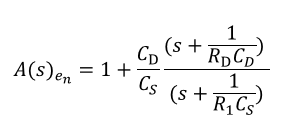
Accordign to me, the right transfer function, considering only the noise voltage(e_n) is shown in the attached figure.

If i'm right, then, there is also a mistake in the reasonings:

"As feedback resistance increases, the pole and zero of this gain peaking move together to lower frequencies encompassing a greater spectrum with high gain. "

because the zero respone doesn't depend from feedback resistance but from diode equivalent resistance.

Thanks  
 

  • Hi Marco,

    I didn't read through the entire article, but after giving it a quick skim it looks correct.  The zero in the 1/beta (noise-gain) response is a result of the parallel combination of the feedback and input resistors interacting with the diode + op amp input capacitance.  Since the feedback resistance is typically much smaller than the effective diode resistance the parallel combination of these two resistances is effectively equal to the feedback resistor.  Therefore the zero in the noise-gain can be estimated to occur at a frequency of:  1/(2*pi*RF*CD).  The full equation would be:  1/(2*pi*(RF||RD)*CD). 

    The pole in the noise-gain is only dependent on the feedback resistor and feedback capacitor:  fp = 1/(2*pi*RF*CF).

    Take a look at the reference design TIPD176 for a full design procedure for transimpedance amplifier circuits.  These concepts are also covered in an easy to read format in the following blog series:  

  • Thank you for the answer, but i still don't understand.

    I've attached a figure where i passive all the generator except  e_n.

    where am i wrong?

  • I think you have an arithmetic error somewhere.   You set up the equations correctly though.  I copied what I calculated using Mathcad below.  Note that RF*RD / RF+RD is equal to the parallel combination of these resistances.  Since RD is usually much bigger than RF, RF dominates the parallel combiation.  Similarly since CD is usually much larger than CF it dominates the sum of the two impedances yielding the common simplifications you found in the articles.

  • Marco,

    Colin's calculations do make sense and are very accurate. For your information, these calculations are contained in the Amplifier Designer Photodiode WEBENCH site.

    Here is how you get there:

    On the www.ti.com page there is a WEBENCH box on the right. Find the amplifier symbol, click on that and the click on the "Start Design" button.

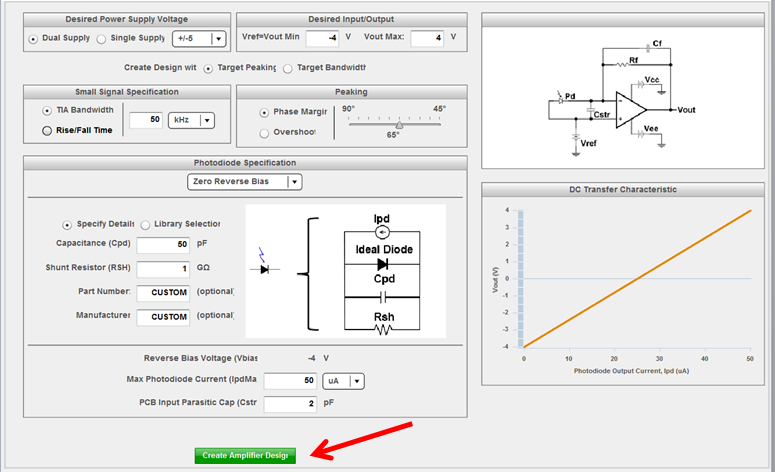
    From three you will see the Amplifier Designer topology page. Find your perferred Photodiode topology. You will see the circuit diagram and the transfer funtion on the right side. Finbd yout topology and then click on the "Start Amplifier Design" button. (I clicked on the Zero Reverse Bias button for the view below.)

    This will take you to the Design Requirements page where you will enter your power supply, amplifier I/O requirements, frequency of operation and photodiode characteristics.

    Once you put in your requirements, Amplifier Designer will recommend a list of applicable amplifiers.

    Have fun with this application.