This thread has been locked.

If you have a related question, please click the "Ask a related question" button in the top right corner. The newly created question will be automatically linked to this question.

OPA2340: Simple transfer function to model Small-Signal Step Response

Part Number: OPA2340
Other Parts Discussed in Thread: OPA340

Is it possible to model the small-signal step response of an OPA2340 with a simple transfer function (as opposed to using Spice)? My task is to properly compensate an ADC driving circuit, and I would like to take an analytical approach.

  • Hello,

    The small-signal response of an op amp is dominated by the open-loop gain (Aol) and the open-loop output impedance (Zo).  These parameters are both featured in the OPA340 datasheet.  Technically the datasheet shows the closed-loop output impedance, but the open-loop can be calculated as shown:  Zo = Zout* (1*Aol*B). This is a rearrangement of the commonly shown Zout (closed loop output impedance) equation of:  Zout = Zo / (1+Aol*B).  Beta is the feedback factor which is equal to 1 for a gain of 1V/V, and is 0.1 for a gain of 10V/V, etc.

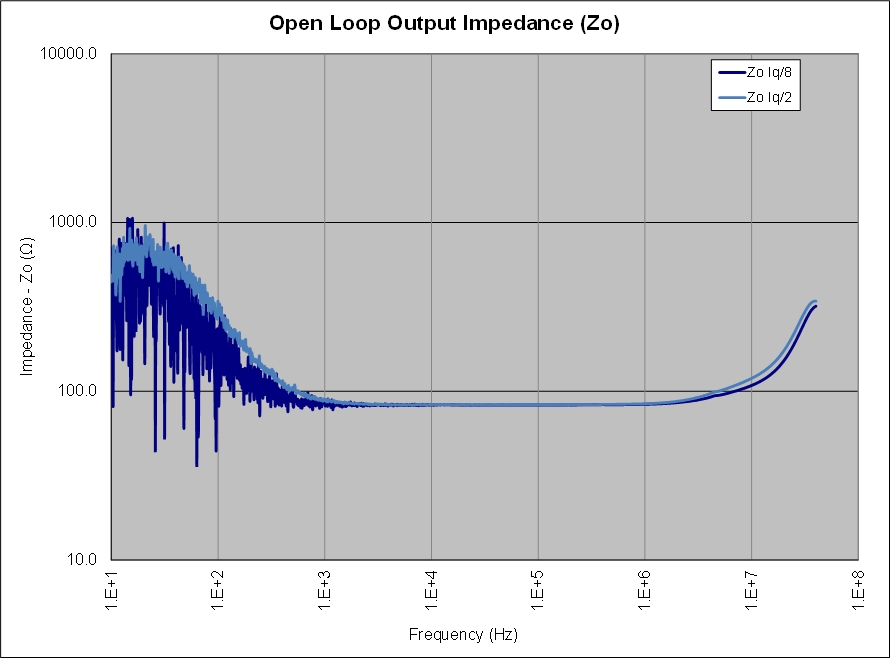
    Actually, after comparing the OPA340 datasheet curves with some measurements we made earlier this year, I'm not sure if the closed-loop output impedance is correct in the datasheet.  Here's a measurement of the open-loop output impedance of the OPA340 with both Iq/8 and Iq/2 loading.  Use these curves for your small-signal model.

  • Thank you for the detailed response and for providing the Zo measurements.

    Can you recommend an equivalent circuit for modeling the frequency dependent resistor?

    Also, I have noticed that a square wave signal applied at the input of the opamp circuit will result in an output waveform that has negative undershoots which are substantially larger than the positive overshoots. Do you have an explanation for this asymmetrical behavior?

  • Collin - after a bit of searching I discovered your recent Article "Modeling the output impedance of an op amp for stability analysis":

    www.ti.com/.../slyt677.pdf

    I find it interesting that you are proposing to obtain the output impedance by "testing" a SPICE model and have a couple of related question:
    1) can a SPICE model typically be assumed accurate when it comes to Zo?
    2) would it not be possible to determine the Zo Bode plots from the SPICE model parameters (as opposed to running simulations)?
    3) how was the data obtained that you provided in the above post?
    4) would you happen to have a corresponding plot with the phase shift so that I can attempt to derive the frequencies of the poles and zeroes?

    Thanks for your support!
  • Cool, glad you found it.  We put that one out recently and I was going to send you a link on my next posting.

    Regarding your comments, we had a little difficulty in figuring out how to word the sentence in question and maybe we could have gone with something a little more explanatory.  We were talking about an IC level simulation circuit like the one TI's designers use to create the op amps, not a simple "Boyle" type op amp macro-model.   

    1.)  The transistor level simulation circuits we were using will product an accurate Zo result.  Modern op amp macro-models from TI also will include the correct open-loop output impedance based on the correlation of bench measurements with the transistor level simulation results.  Macromodels from our competitors and even some legacy TI macromodels may not have the correct output impedance.  You should always confirm that the results match the datasheet figures and you can also post to this forum and we'll help provide guidance based on our experience or measurements.

    2.)  I don't think so.  The types of feedback used internal to the op amp will affect the Zo in ways that simply looking at transistors in a SPICE netlist won't provide.

    3.)  That is measured data based on driving a small current into the output of the op amp and measuring the resulting voltage (R = V/I)

    4.)  We weren't recording the phase on some of the older measurements so unfortunately I don' t have it.  That said, you'll have a pretty accurate model by just using the resistive portion of the output impedance which is roughly 85 Ohms over most of the usable bandwidth of the product.  The low frequency resistance and capacitive regions are less important because it's unlikely that the load impedance will interact with the curve at such low frequencies.  The curve does turn a little inductive after the unity-gain bandwidth which will affect some of the stability results with capacitive loads that intersect with the curve in that region.  Based on the data I took a look at a single-point measurement at 20.182MHz where the value of the impedance was 175.1 Ohms.  The inductance can be estimated therefore as:  L = X / (2*pi*f) = 175.1 / (2*pi*20,182,000) = 1.38uH. 

  • Colin - Thank you for this very detailed and instructive response. If it is not asking for too much, could you please also shed some light on my question with regards to the asymmetry mentioned in my "Dec 15, 2016 7:33 PM" post? Thanks again, Beat
  • Beat - you're welcome, we're glad you enjoyed the information.

    I haven't dug into the asymmetry you're describing. Could you show the example circuit and results you're talking about so we can see the behavior? My best educated guess is that the op amp output impedance changes depending on whether it's sourcing or sinking current. This seems reasonable because the output impedance of one of the output transistors operating vs. the other, vs. both would result in different output impedances for the different output currents. Based on the loading, the change in output impedance could change the system phase margin which would result in different % overshoots.
  • Collin - here is the circuit of interest:

    And here is the measurement exhibiting the different behavior at the end of the positive versus negative edge.

  • Hello Beat,

    There's a few things going on here.  First, when performing transient step response measurements to correlate back to system phase margin a small-signal step needs to be applied.  Appropriate signal amplitudes are around 5 - 10mV but up to 100mV may work if your generator can't output as low as 10mV.  Remember, the goal for a small-signal step is to only test the small-signal settling time of the circuit and not to end up in regions with large signal limitations such as slew-rate, output current, output voltage swing, etc.  I wrote a blog on this topic a few years ago: Transient Stability Testing:  Watch your step!   There are some advanced topics that I didn't discuss in the blog such as how the commonly found %overshoot to phase margin plots are only value for 2nd order systems (2 poles, no zeros).  Adding zeroes or pole-zero doublets to the loop-gain transfer function will change the relationship between %overshoot and phase margin, but those topics weren't the focus of the article.

    Second this test moves the operating region of the output stage from roughly 750mV to 2.75V with a 0-3.3V supply.  This operates the op amp output stage in two different regions which goes back to my suggestion in the earlier post that the output impedance is likely changing with the operating region which yields different phase margins and therefore different transient responses.  As an experiment try inputting a 10mVpp (or as small as you practically can) square wave with a 2.75V DC offset and then do the same with a 0.75V dc offset.  I'm curious if the overshoot and undershoot behavior will match better with the output in a similar operating region for both the undershoot and overshoot. You may want to try a case centered around mid-supply as well. 

    You've kept the output several hundred millivolts from the rails which is also important when performing this type of analysis.  As the op amp output approaches the rails the open-loop gain (Aol) will begin to degrade a certain distance from the supply rails.  This value is typically listed in the Aol specification and will dictate what output voltage ranges the Aol is specified for.  The OPA340 is particularly strong in this area and with a 100k load the Aol specifications are valid within 5mV of the supply rails.  So, this effect shouldn't be causing issues in your current tests but it's something to keep in mind with other op amps and other test cases.

  • You gave a lot of food for thought and useful info here. Thanks again for the great support.