This thread has been locked.

If you have a related question, please click the "Ask a related question" button in the top right corner. The newly created question will be automatically linked to this question.

Issues with high frequency differentiator design

Other Parts Discussed in Thread: THS3061, OPA847

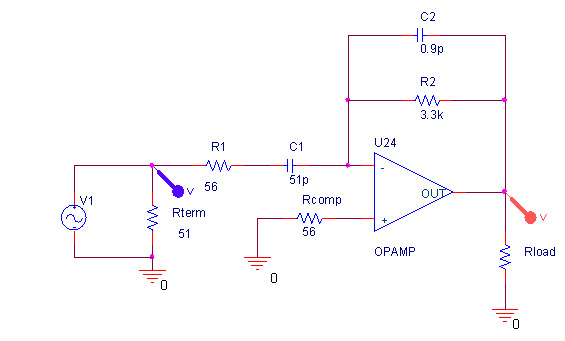
Greetings. I'm trying to design a differentiator circuit with operation up to 10MHz or better (with gain = 1 @ 1MHz, and gain = 10 @ 10MHz) . I've tried several opamps from both the THS and OPA families, but none are working as expected. The best has been the THS3061, which followed the expected response up to about 9MHz then dropped off. Attached are pictures of the circuit as well as a couple opamp responses:

Circuit 
 

THS3061; Rload = 150ohms


OPA847; Rload = 150ohms 


I tested about 6 more opamps with different feedback and load values, but none worked. Some of the responses had huge peaks (gain = 40), and others kind of "bounced" up the expected curve.

I don't understand why these circuits are behaving so oddly. Should there be some kind of compensation circuitry added? Also, what would be the best opamp for this frequency-to-voltage application (Vsupply = +/- 15V preferable)? Any help is appreciated. Thanks.


  • Hello,

    Please try to have the in signal to the + input of the opamp, the neg pin is connected to the out pin. (positive gain and not inverting)

    The differentiator is done with cap and resistor.


    In your case the issue might be with the C2/R2 value that will results in 50MHz range and will have some effect from 5MHz.

    0.9pF is very low and the pcb parasitic might be high, so one more option is to reduce R2.

     Last point is to  try to simulate with ideal opamp.

    Best regards

    Moshe

  • How did you construct it? At high frequencies a breadboard construction with all its stray capacitances will have a very deleterious effect on high frequency response as I found out! You will have to use a small compact board with short path lengths and surface mount components.

    I built an op amp transimpedance amplifier for an infra-red receiver which wouldn't respond above 20MHz with breadboard construction because of this problem - it was vastly improved on a proper board with surface mount capacitors and resistors.