This thread has been locked.

If you have a related question, please click the "Ask a related question" button in the top right corner. The newly created question will be automatically linked to this question.

Current sink

Other Parts Discussed in Thread: REF102

Good evening ...

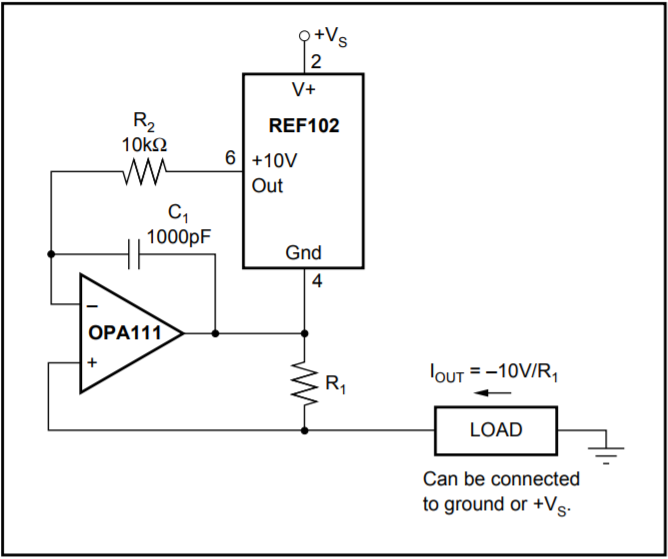
I do not understand the current sink explained in the following link (FIG 2):

Could someone explain?
In what feedback configuration is OPA 102 working.

Build the circuit and work perfectly

Thanks, Daniel.

.

  • Hello Daniel,

    I will look into this for you.


    Best,

    Errol Leon
    Texas Instruments
    Precision Op Amp Applications
  • Ok Errol, thanks

    Best regards, Daniel.
  • Hello Daniel,

    Thank you for your patience. The OPA111 in the precision current sink circuit, drives both the voltage reference ground connection and the current-scaling resistor, R1 , so that the voltage reference output is equal to the load voltage.  The OPA111 outputs a voltage that forces –10.0V across R1 so that the current sink output is –10V/R1.  

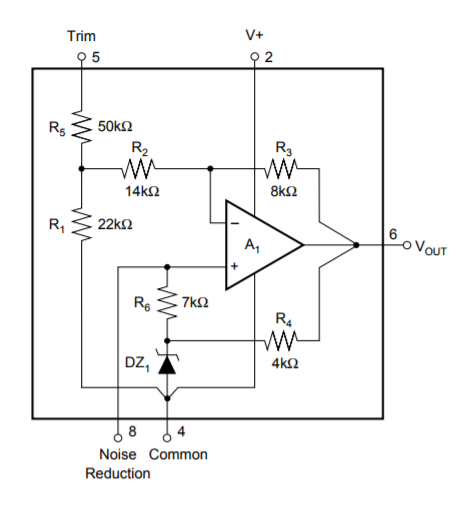
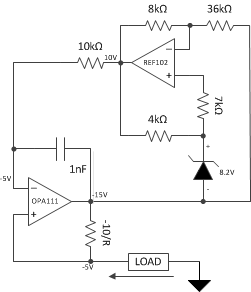
    Another way to look at this is from the load.  Suppose the current sink 1mA and voltage drop across the load is equal to -5V.  Since the OPA111 forces -10V across R1, it will have output a voltage of -15V.  This voltage also drives the common pin (pin 4) of the REF102.  The is pin is connected internally in the REF102 to the negative supply of A1, the positive terminal of the zener diode and R1 in the internal feedback of A1 in REF102. Approximately 8.2V is applied to the non-inverting input of A1 by the zener diode DZ1. R1, R2, and R3 are laser-trimmed to produce an exact 10V output. It is important to note that the negative supply will change with the output and to not let the it exceed the power supply absolute maximum voltage rating.

    An equivalent circuit is shown below with the -5V across the load example.  The R2 , C1 network provides local feedback around the op amp to assure loop stability. It also provides noise filtering. With the values shown, the reference noise is filtered by a single pole with f –3dB = 1/(2 • π • 10kohm • 1nF) = 16kHz.

    Best,

    Errol 

    Texas Instruments 

    Precision Op Amp Applications

  • Errol:


    Good day, thank you for the service. Your explanation is excellent, my problem is solved.

    Thank you very much.
    Best regards, Daniel.