This thread has been locked.

If you have a related question, please click the "Ask a related question" button in the top right corner. The newly created question will be automatically linked to this question.

OPA656: Transimpedance amplifier

Part Number: OPA656

Hi there, My under graduate project is  "Visible light communication for underwater communication networks" . For that I'm using an avalanche photo diode(AD500-8) as the receiver . Here I have attached the circuit diagram of the transimpedance amplifier and the comparator. when there is a signal it works perfectly and gives a digitalized signal.. But the problem is when there is not an input signal the comparator outputs a noise signal with a peek to peek value 5v. How can I remove that noise? If want I can send the output waveforms too.Please help me in this issue.

  • Umesha,

    I assume no input signal means the diode is not excited.

    There is some critical information missing.
    - What is the supply for OPA656?
    - What is the value of CF?

    It would be helpful if you can share the waveform.

    Few quick things I recommend to check:
    - Are you violating any min/max input voltage specs? I see you have a 20k/330k divider to 3V on +In.
    - Your comparator's trip threshold is 42.85 mV (10k/[680k+10k] * 3). When there is no input signal, it is possible the noise current of APD + noise of RF and OPA656 are high enough to be close to 42.85mV threshold causing the comparator to constantly trip the way you report. Try increasing the threshold.
    - How does your voltage signal look between the OPA656 and the comparator with and without the signal?

    Lastly, I suggest you follow the design practices highlighted in section 9.2 pg 19 of the datasheet.
    www.ti.com/.../opa656.pdf

    Thanks,
    Keyur
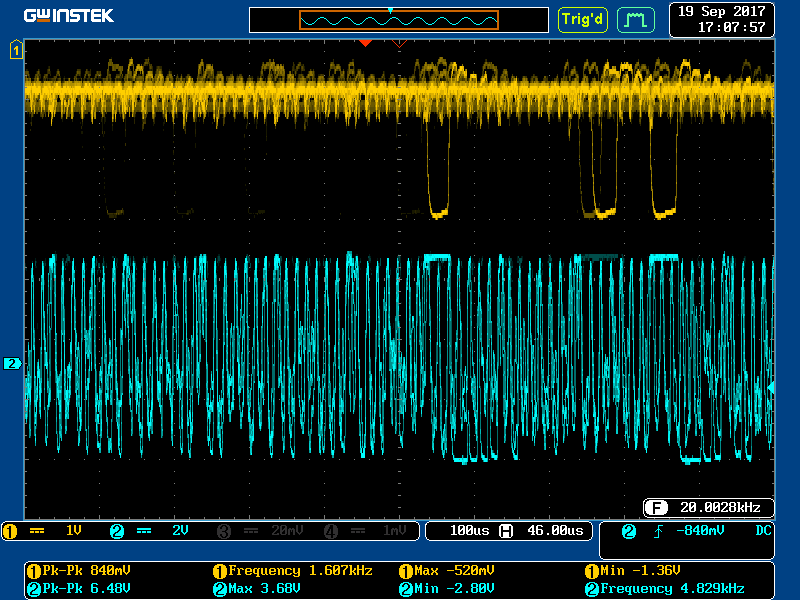
  • No signal means either no light input for the diode or absence of the diode. And the power supply is +5v and -5v. Heres the waveforms when the input signal is not there and it is there respectively.

  • Yellow color one is the output from the transimpedance amplifier and blue one is the comparator output
  • I don't think you clarified what CF value is? It shows 471J in the picture.

    Also, can you clarify?

    - Is the value in yellow measured exactly at OPA656 output (i.e. before the 20k pot) or somewhere else?

    - Have you tried isolating the comparator (remove the 0.1uF cap) and do you still see the same behavior with no light input?

    - Intent of the two diodes in the feedback

    I am assuming you are not changing the diode bias (110V) or any thing else between with and without light signal conditions.

    Thanks,

    Keyur

  • Cf is 47pF an yellow waveform is the output after the 20k pot.We check the comparator only by isollating it and it works correctly. We didnt change the bias voltage for the photo diode.  

  • Ah, I didn't realize 471J was simply the value that comes marked on the capacitor.

    I simulated the circuit and do not see any stability issues.

    Seems the peak-to-peak is higher (840mV, ignoring those high peaks) in yellow without light than the 480mV with light.

    Also, I noticed there seems to be a -1V DC around which the yellow trace is swinging, with and without the light; where is this -1V coming from?

    Can you verify what you see at the output with no APD? Also, check at the amplifier's output vs after the 20k pot.

    Secondly, can you remove the 0.1uF cap (i.e. no comparator connected) and see if the amplifier's output looks the same as before?
  • You mentioned before that no signal = no light or absence of diode. Does that mean you verified that the issue existed even when there was no diode.

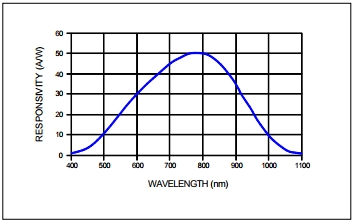
    The APD you are using as fairly wide spectral response (~450nm to 1050nm) and I am wondering if it is picking up signal from wavelengths outside your signal spectrum or the visible spectrum (390nm to 700nm), that is causing the TIA to put out noise like output. How are you ensuring there is no light / signal to the photodiode?

    Below is the spectral response of the AD500-8 that you are using.