This thread has been locked.

If you have a related question, please click the "Ask a related question" button in the top right corner. The newly created question will be automatically linked to this question.

INA333: Input offset current for 2V supply and limited temperature range

Part Number: INA333
Other Parts Discussed in Thread: INA828

I must use some large input resistors with the INA333 which will convert the +/- 200pA input offset currents into large voltage offsets. Can I assume something less pessimistic for input offset current under the following conditions?

Vsupply = 2V  (compared to TI test conditions of up to 5.5V supply)

Vcm = 0.75V

Temp = 20 to 45 DegC

Typical characteristics suggest more Input Bias Current at higher supplies, and for very high temperatures.

Characteristics also suggest higher input offset currents follow when input bias currents are larger.

Therefore, can I assume less than the max +/-200pA input offset current for my operating conditions?  Any guidance on what a realistic max input offset current might be for these conditions?  If I attempt to characterize the input offset current, would you expect large lot-lot variation in the distribution?

Thanks...

  • Gregg,

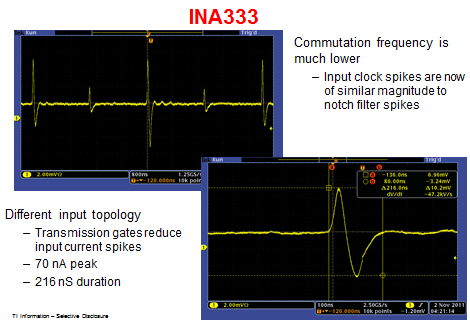
    It is NOT advisable to use large input iresistors in front of INA333.  Since INA333 is a chopper instrumentation amplifier, its +/-200pA input offset current is just an rms value of the input bias current spikes generated by the front-end switches.  Actual current consists of ~200ns duration spikes with an amplitude of up to 70nA - see below.  Thus, for example using 1Mohm input resistors may generates voltage spikes of up to 70mV, which then will be increased by the instrumentation amplifier's gain and reflected at the output.   Therefore, if you truly have to use large input resistors, you should consider using a non-chopper instrumentation amplifier like INA828.

  • Marek,

    Thanks for your quick response.  Though I have high valued input resistors, there are also capacitors which make the AC source impedance quite low.  I am most concerned about the average INA333 input offset voltage generated by the drop across the input resistors caused by average input offset current.  Given that, can I consider an average +/-200pA input offset current too conservative, since I will use a 2V supply and I have a very limited temperature range?  I just thought the published spec encompasses much higher temperatures (where the bias current increases) which I'll never see, and perhaps the input bias current is partially related to switch feedthrough mismatch, which should be less at a 2V supply compared to the 5.5V worst case included in the spec.

    Thanks,

    Gregg

  • Gregg,

    Since you do not provide your circuit schematic, I can only presume that you have the large input resistors followed by the input caps to ac ground, which effectively create a low pass filter.  If that's the case, in order to filter out the input current spikes your RC must be such that the filter corner frequency is a decade below INA333 chopping rate of around 125kHz (100pF||100k, 10pF/1M, etc.). 

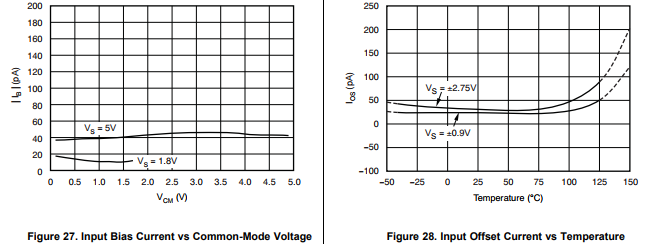
    All of the datasheet graphs show typical values and NOT maximum and thus the max input bias offset current of +/-200pA is for 25 deg C and NOT over temperature range - therefore, a typical spec of 50pA represent one standard deviation and thus max 200pA represents 4 sigma limit of Normal Gaussian distribution.  For that reason you may only assume that the lower typical input bias offset current shown in Fig 27 (see below) in case of 2V supply may translate into around +/-25pA typical and thus +/-100pA max at 25 deg C.

    However, please be aware that Ios spec is NOT tested in production under such conditions so there are some risks involved in making such assumption. Also, it may be useful for you to know that the input bias current shown in Fig 28 (see above) rising above 50pA above 100 deg C is caused by the reverse-bias leakage current of the ESD protection diodes becoming a dominant component of the total input bias current at higher temperature while the integrated value of the input bias current spikes from the front-end chopping action dominates the total current at the lower temperature.