This thread has been locked.

If you have a related question, please click the "Ask a related question" button in the top right corner. The newly created question will be automatically linked to this question.

TLV3502: differential input range

Part Number: TLV3502


Hi Team,

My customer is asking about the differential input range of TLV3502.

I thought this is a comparator so differential should be full range up to supply voltage.

Customer uses DMM and found voltage drop of  1.16V across IN+ to IN- (or vise versa)

Customer wants to double check the input differential voltage range with us, thanks!

Andrew

  • Hello Andrew,

    Yes. The input range for each input is to each supply. There are no clamps between the inputs. The inputs are CMOS and should not draw any current while between the supplies.

    So on a single +5V supply, you should be able to apply 0 to 5V on either input at any time.

    What are the supplies and input voltages? Can you provide a schematic? Or a voltage map?

    Remember most DMM's have a 10MEG input impedance and can load high impedance sources (though you probably will not have impedance that high for a 5ns comparator).

    Also note that the TL3502 has a non-standard dual pin-out, so it is not drop-in compatible for most other duals.
  • Hi Paul,

    Thank you for quick confirmation, very helpful.
    I haven't talked to customer yet but customer sent email to double checking with me.
    Customer want to know why they can see 1.16V voltage drop across IN+ and IN- pin using DMM diode mode. This leads customer to think when differential voltage is over 1.16V, are we sure it's still a high impedance input? And why there is a 1.16V drop across input pin when no VS present?
    Thank you!

    Andrew
  • Hello Andrew,

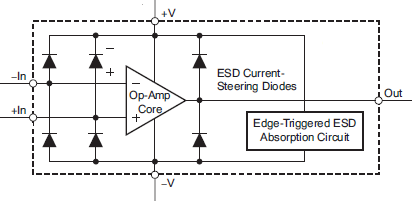
    When the power is off, they are measuring the ESD diodes and/or other internal junctions.

    Below is the typical ESD protection on most devices:


    Most likely they are seeing the series diode drops of the ESD didoes and the IC substrate diode (Upper ESD, through die substrate diode between the supply pins, then lower ESD)

    Measuring with the diode check mode with the power off is not a valid measurement and does not reflect the actual input conditions with the power on.

    Are they having an issue with the TLV3502? Or just inquiring about the DMM reading?