This thread has been locked.

If you have a related question, please click the "Ask a related question" button in the top right corner. The newly created question will be automatically linked to this question.

INA3221: INA3221 Error Calculation on Webpage

Part Number: INA3221

Hi Team,

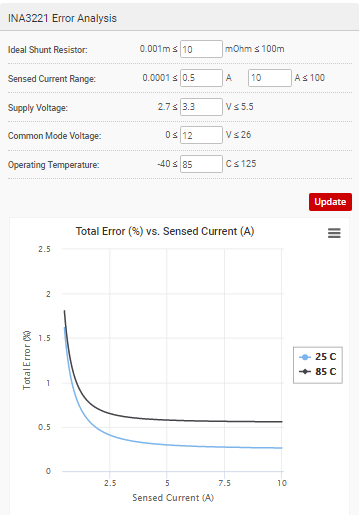
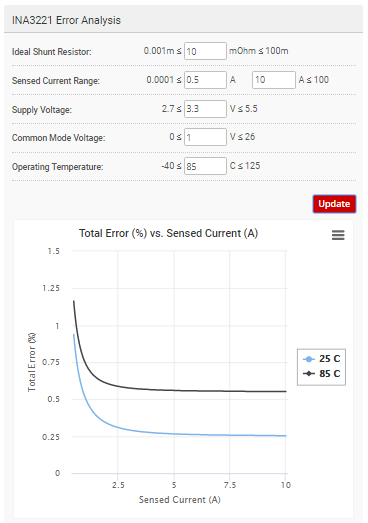
I have recently been using the error calculation tool on the INA3221 webpage. To my knowledge, as the common-mode voltage varies away from the calibrated voltage point, the error should increase simultaneously. Take INA3221 for example, the calibrated common-mode voltage point is 12V (shown on the datasheet); thus, when the common-mode voltage is 1V, the calculated error should be less than the 12V situation. However, the result given from the webpage is shown below. I am wondering is there any place where I misunderstood anything? Thanks!

Best Regards,

Nancy Gau
  • Hello Nancy,

    You are right: the error should increase as the Vcm (Vcm_actual) varies from our datasheet's testing condition Vcm (Vcm_ds); but, the direction in which it varies does not matter when you are considering the offset error generated by common-mode rejection (CMR). You cannot predict if the overall offset will decrease or increase so you design for the bounding worst-case where the offset generated by CMR (Vos_cmr) adds onto the initial offset of the part when at 12V common-mode.

    You can accomplish calculating this with error percentages.

    eVos = max initial offset voltage error = Vos_max/Vshunt *100 = 80uV/2.5A*0.01Ohms *100 = 0.32%
    eCMR = maximum input offset error due to CMR
    = |Vcm_ds - Vcm_actual|*CMRR/Vshunt *100
    = |12V - 1V|*10^(-110dB/20)/ (2.5A*0.01Ohms) *100 = 0.139%

    e_total = 0.32% + 0.139% = .459% (ignoring other sources of error)

    Hope this helps,
    Peter Iliya
    Current Sense Applications
  • Nancy,

    According to my previous post you are right to be suspicious of the tool's calculated values. Using the absolute difference of Vcm the specs were tested at and the actual Vcm of the system when calculating eCMR is proper error analysis.

    We are looking into why this calculator is generating these results.

    Peter Iliya
    Current Sense Applications