This thread has been locked.

If you have a related question, please click the "Ask a related question" button in the top right corner. The newly created question will be automatically linked to this question.

LM2903: COMPARATOR OVERDRIVE

Part Number: LM2903

To All

I need to understand the concept of 'overdrive' in a comparator. How is this related to the speed of response in a comparator circuit? If the input to the comparator has a finite rate of rise what would be considered an 'overdrive' i.e. at some point in time the input to be compared would exceed the reference voltage and the comparator's output would change state in some finite time. In this scenario how would one overdrive the input to better the speed of response?

Regards

ik

  • Hello Imtiaz,

    There is a lot of confusion over this term...

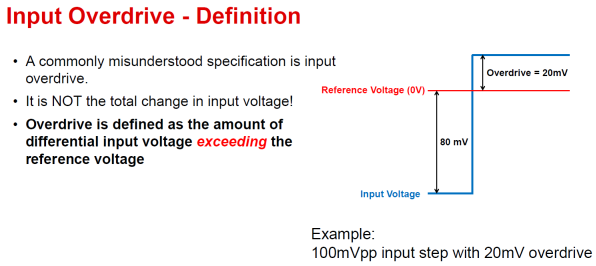
    "Overdrive" is the amount of voltage exceeding the reference voltage. It is NOT the total change in the input signal.

    The above image shows a 100mVpp input signal. But only the last 20mV of the signal crosses the reference voltage (threshold).

    The "overdrive" above is 20mV. It is NOT 100mV, or 80mV.

    The "runnup" voltage below the reference point usually does not make much difference. Only the voltage past the threshold is what determines the response time.

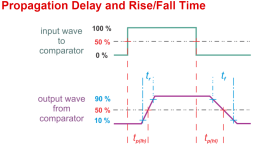
    The generally accepted way the propagation delay time is measured is between the 50% points of the input and output waveforms. The assumption is that the input signal risetime is much faster than the comparator output.

    Most comparator datasheets will have an overdrive vs. response time graph. You will find that most will "top out" thier speed after 100mV overdrive, and that the most drastic speed changed occur below 20mV.

    Also keep in mind that the positve and negative response times can be different - partucularly for open collector outputs (which is dependant on output RC loads).

    So to get the fastest response from a comparator, you want to drive the input as far past the reference votlage as possible. You will also want to keep the reference in the center of the waveform so that the response is symmetrical.

  • Hi Paul

    Thanks for the detailed explanation.

    Regards

    ik