This thread has been locked.

If you have a related question, please click the "Ask a related question" button in the top right corner. The newly created question will be automatically linked to this question.

INA240: Stability

Part Number: INA240
Other Parts Discussed in Thread: INA199, ADS7253

Hi all

Would you mind if we ask INA240?
Could you refer to the attachment file?
20180402_INA240.pdf

There is the description "INA240 Maximum capacitive load 1nF(Typ.)."
In case of 1nF(Typ), does it have any trouble for stability?
According to 0ohms, if there is the trouble, could you let us know?

Kind regards,

Hirotaka Matsumoto

  • Hello Hirotaka,

    Of course we can assist you. The INA240 should have no problem with driving the 470pF capacitor and it does not have trouble with stability when driving a 1nF. You can read about stability analysis for our devices here: e2e.ti.com/.../3581.closed-loop-output-impedance-and-output-compensation-for-capacitive-load-stability

    In this article the INA199 is used as an example and its Zout curve flattens at around 670 Ohms. The INA240 Zout is similar, but flattens around 170 Ohms according to our data not in datasheet. As long as the capacitive load's reactance crosses the resistive (flat) portion of INA240 Zout curve, then there should not be a stability issue.

    Sincerely,
    Peter Iliya
    Current Sensing Applications
  • Hello Hirotaka,

    Thank you for considering to use TI in your design. We do not recommend using a larger capacitor than 1nF if you are shorting the the INA240 output directly to the ADS7253 input as there could be stability issues. I presume that you read the ADS7253 anti-aliasing subsection of the application section as you have a filter capacitor that satisfies their recommendation for reducing sampling charge injection. The anti-aliasing subsection also strongly recommends using a series isolation resistor in conjunction with that filter capacitor. However, I also presume that you did not include this resistance as you are striving to minimize distortion and acknowledged that the INA240 should have some amount of output impedance as it does. If you would like the characteristic curve for output impedance, it may take some time before I can give that to you. If you would like more information on why the the output impedance matters for stability, please check the following links: https://e2e.ti.com/support/amplifiers/current-shunt-monitors/w/faq/3581.closed-loop-output-impedance-and-output-compensation-for-capacitive-load-stability, http://www.ti.com/lit/an/slya029/slya029.pdf

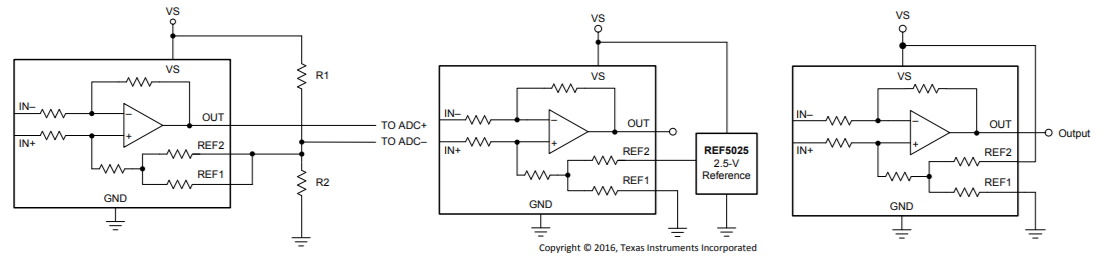
    As for your schematic, we also have some concern over your REF pins as they appear to be floating with only capacitors tying them to the INA240 Out and Ground pins.  Typically, we recommend one of the following setups for the REF pins:


    Is there a particular reason for the configuration you chose for your reference pins?

  • Hi Hirotaka,

    why would you want to use 0R resistors? It's no good idea to use 0R resistors.

    Kai
  • Kai san

    why would you want to use 0R resistors? It's no good idea to use 0R resistors.
    ->Yes, we think so too.We check the back ground of our customer's question.
        We will recommend that the customer should use 170ohm.
       And then, by ringing of output, we assume that it is possible to estimate the phase margin.

    Kind regards,

    Hirotaka Matsumoto