This thread has been locked.

If you have a related question, please click the "Ask a related question" button in the top right corner. The newly created question will be automatically linked to this question.

OPA196: OPA196 distortion

Part Number: OPA196
Other Parts Discussed in Thread: OPA197

Hi team,

OPA196 seems to be seen some distortion in the following condition.

Evaluation in voltage follower
- Positive supply = +24V
- Negative supply = -5V
- Input signal frequency = 500kHz
- Input voltage amplitude = 1Vpp
- Load : 1Mohm + 15pF

If you had already identified some distortion in the similar condition to the above, please let me know the reason why the output waveform is distorted.
If you have not seen it, please try to duplicate it in the above condition.

Best regards,
Iwata Etsuji

  • Iwata-san,

    The distortion is caused by the slew limitation where output cannot keep up with the input signal.  This is known as full-power bandwidth and shown in the graph below:

    Replace OPA196 with higher slew rate OPA197 to fix the problem.

  • Etsuji-san,

    Not having an image of the OPA196 output waveform makes it more difficult to identify what may be causing the distortion. However, the distortion may be related to the unity-gain bandwidth (GBW) of the OPA196 and the 500 kHz frequency.

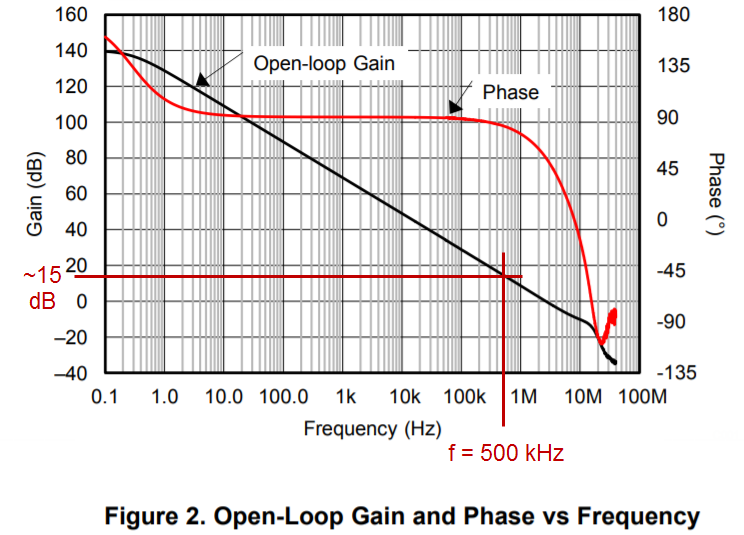
    The OPA196 has a typical GBW of 2.2 MHz. That is frequency where the open-loop gain is 1 V/V (0 dB).  A frequency of 500 kHz is well down on the open-loop gain (Aol) curve as I show in the image below.

    Following the Aol curve it appears that there is only about 15 dB (5.6 V/V) of Aol remaining at 500 kHz, which is very low. The benefits that high Aol affords in a closed-loop negative feedback system aren't realized when the Aol is very low. Distortion such as cross-over distortion is much worse than what is obtained at low frequencies where the Aol is high.

    The OPA196 has a typical slew rate (SR) of 6.5 V/us (rising) and 5.5 V/us (falling). The calculated minimum SR for a 1 Vp-p, 500 kHz signal is 1.6 V/us so I don't think it is slew-induced distortion. You would see triangulation of the output waveform if that is the case.

    The OPA197 has a GBW of 10 MHz, nearly 5x of that for the OPA196. Its Aol vs frequency curve shows about 25 dB (17.8 V/V) of Aol at 500 kHz; about 3x the Aol of the OPA196 at that frequency. That still isn't high Aol, but you should see some improvement in the distortion over what is currently being observed with the OPA196.

    Regards, Thomas

    Precision Amplifiers Applications Engineering