


Hi guys,
My customer has been using the OPA454 in a product, which was working most of the time, but a few units have started to become damaged. We were going to submit for an FA, but we figured we would run the use case by you guys first in case you can comment about our hypothesis and if you have suggestions on how to adjust the circuit:

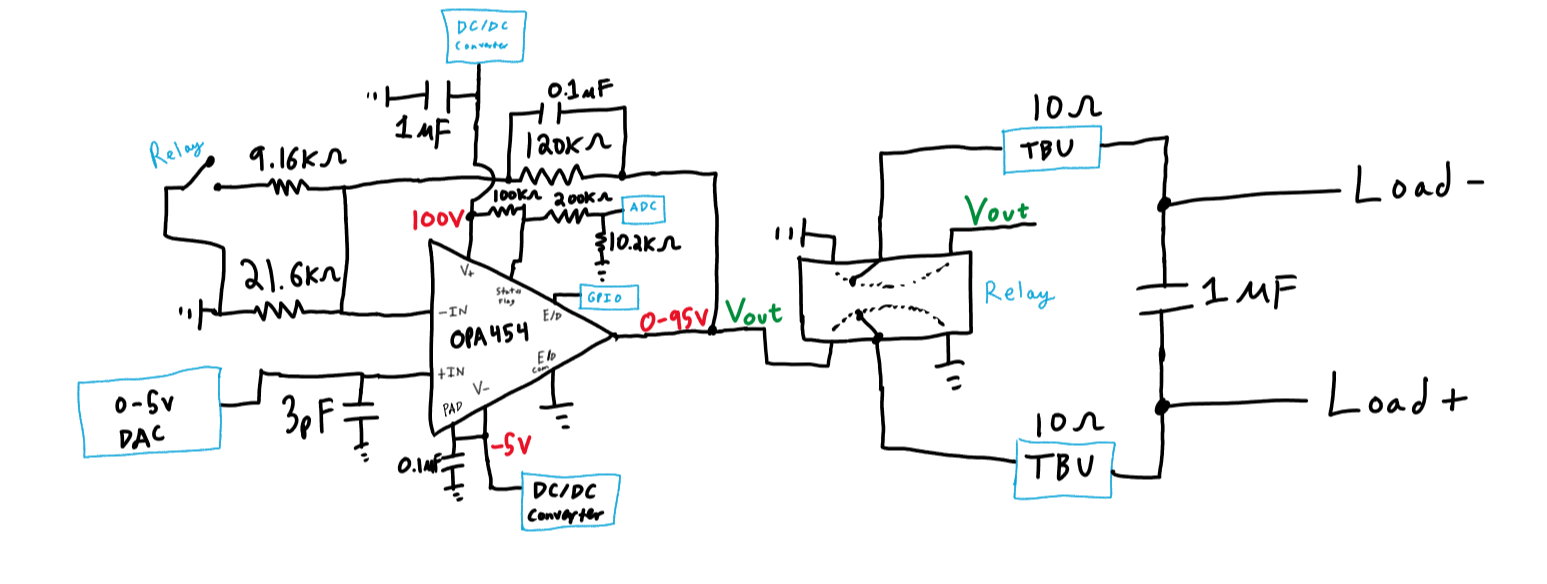
The image above is a sort of schematic for how I am using the OPA454. It is being used in a non-inverting mode. V- = -5V and V+ = 100V, both rail sources are from DC/DC converters. The relay on the far left of the schematic near 9.16k ohm resistor is being used to change the gain configuration as needed. The output of this device is
95V – (-)95V. The OPA454 only ever outputs 0-95V, the output relay flips the loads polarity so that the device is outputting 95V – (-)95V from the loads perspective. The OPA454 seems to break when I switch the output from 95V to -95V. There is no issue if the 1uF cap on the output is removed and no highly capacitive load is attached. But, I do know that there are capacitive loads with varying amount of positive or negative charge being plugged into the device while it is being used. When the OPA454 fails, it gets very hot very quickly and seems to max out the boost converters.
The schematic below adds 2 TBU-CA025-050-WH in series with the output load. This seems to protect the OPA454 but is not an ideal solution. The TBU devices have about 10 ohms of resistance under normal use, and go high impedance as to limit the current to 50mA. As a result, though the device is protected, even a few hundred uA current produces a noticeable voltage drop across the output TBU surge protectors, and the requested output voltage becomes inaccurate. For our purposes in house, this isn’t a problem, as normally, the current load on this device is a capacitor, so the capacitor charges, and then current approaches 0, so the voltage output for is the value which was requested. But I would prefer to be able to deliver small current loads and maintain the requested voltage.
Thanks,
Brian

