This thread has been locked.

If you have a related question, please click the "Ask a related question" button in the top right corner. The newly created question will be automatically linked to this question.

In what condition the inverting and non inverting inputs are not equal in negative feedback op amp ?

Other Parts Discussed in Thread: TINA-TI, INA122

In what condition the inverting and non inverting inputs are not equal in negative feedback op amp ? I am making a simple voltage regulator . I have set my non-inverting input to 5V, thru a zener. My inverting input is fed back thru a Darlington pair and a voltage divider. I measured voltage between inverting and non inverting to be  800 mV !! Shouldnt the difference be a few mV max ? Thanks

The Op Amp that I am using in the circuit is: TL35072P. Thanks

  • Hi Nader,

    Usually this happens if the op-amp is outside its linear operating region. Can you attach a schematic so that we can better understand your circuit?

    In the scenario you describe, are you getting the correct expected output from the voltage regulator?

    -Paul

  • Paul, thanks for your reply. I have attached my circuit.  The circuit is a 4-20 mA circuit. The left part of the circuit is the voltage regulator. The right part of the circuit is the 4-20 mA generator. The RB1 and RB2 simulate my Wheatstone Bridge sensor. The inverting & non-inverting inputs of both channels of my TL35072P do not follow each other. The difference is about 800 mV !! Thanks

    4-20mA_Cir.pdf

  • Hi Nader,

    from where is this circuit? Can you give a link?

    Have you already simulated the circuit with TINA-TI?

    Kai
  • Hi Nader,

    for Z2 (in my circuit!) take a zener diode with a smaller threshold voltage:

    nader1.TSC

    Kai

  • Hi Kai,

    The first part of the circuit (VOL REG) is from a video lecture on VOL REG. The 4-20 mA portion is from Analog Devices App # 2809.

    I have not simulated the circuit. But, I ran tested the circuit. I get 20 mA with not problem. But, I am unable to get the 4 mA, which I am supposed to get when the input s to my INA122 are equal. Instead I get 15 mA. I will reduce the stand off voltage of my Z2, as you suggested. Can you tell me what is the logic behind this proposed cheange of Z2 ?

    Thanks

  • Hi Kai,

    Why lower value of Z2 forces Inv and non-inv inputs closer to each other? Thanks
  • Hi Nader,

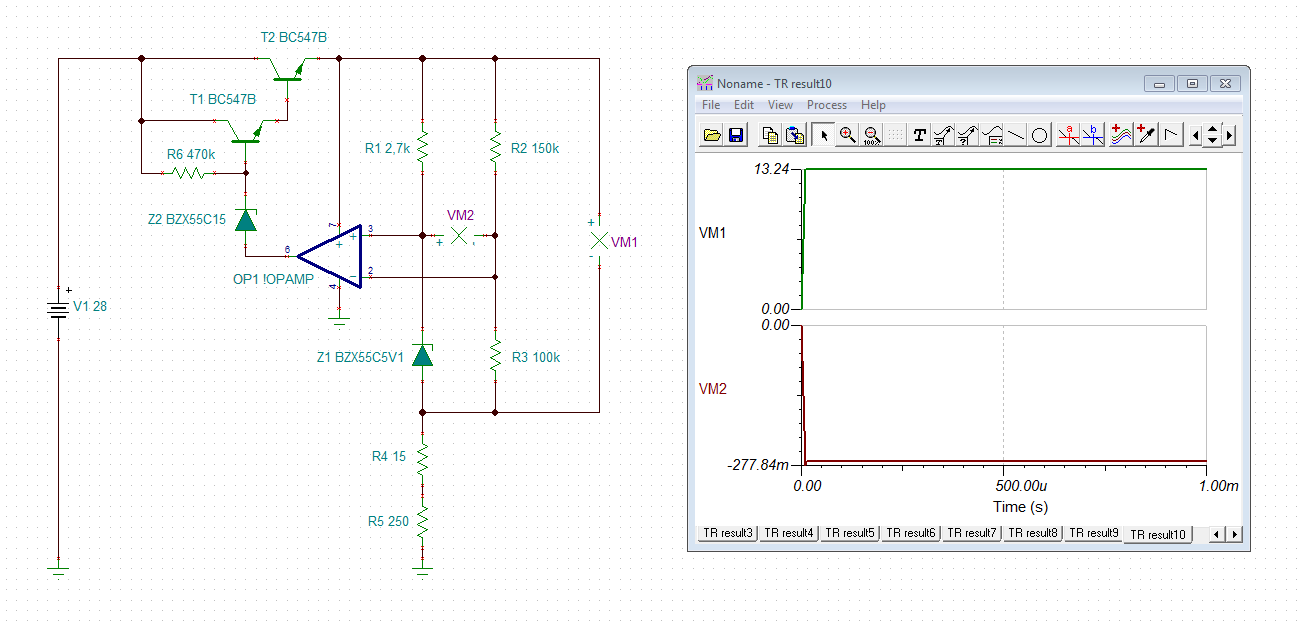
    the minimum output voltage of OPAmp is 0V (when neglecting the current flow through R4 and R5 for simplicity). So, the cathode's potential of zener diode is at least +15V. The emitter voltage of T2 is 1.4V lower than +15V, makes +13.6V. But R2 and R3 try to program a potential of 12.5V at the emitter of T2. So, the output of OPAmp would have to go negative to fullfill this. A potential of -1.1V would be necessary, which is impossible, of course.

    An alternative is to reduce the zener voltage by 1.1V, better a bit more, to avoid saturation of OPAmp output. When choosing a zener voltage of 12V, an OPAmp output voltage of 12.5V + 1.4V - 12V = 1.9V is necessary to keep the OPAmp in regulation, which can easily be accomplished.

    To make things more complicated, the GND pin of OPAmp sits at the ground pin of R5 (other than shown in my simulation) and an additional current is flowing through R4 and R5, additionally shifting up the output voltage of OPAmp.

    Why not running your own simulation?

    Kai

  • 4-20mA.docxHi Kai,

    Instead of changing my 15 V Zener, I changed my vol divider resistor from 100 k to 70 k. Now my pins 2 & 3 measure same voltage with a few mV difference.

    Also, as you suggested I downloaded TINA and simulated my entire  4-20 mA circuit by it. This is my first circuit simulation using TINA, so naturally I did not get what I expected from simulation ! My attached complete circuit supposed to give me 4 mA through 250 Ohms (R13) sense resistor. Instead I get about 92 mA ! The first thing I dont understand is why positive of my VI (28VDC) shows only 4.04V and the negative is -23.96. I know the diff gives me 28 VDC, but I did not expect to get only 4.04 V going through T1 (Darlington) ! In my real physical circuit the positive of VI measures  24.4 V and negative of VI measures -3.6 V (Relative to GND).

    Any idea why simulation is different from my physical circuit ?

    Once again I would appreciate your help.

  • Hi Nader,

    Could you attach the actual TINA file (extension .tsc)? That would save us a lot of work.

    Best,
    Paul
  • I know, and I tried to do that. But, it saves it in pdf format, which then adobe can not open it !! strange. I try again.
  • Hi Paul,

    Here you go. Thanks

    4-20 mA.TSC

  • Hi Kai,

    Thank you. I corrected my circuit. My Op-Amps were connected to wrong Power rails.

    If you include INA122 in your sim cir, you will see that the output of the INA122 would be around +320 mV for the case when In+ = In- ! In order to adjust the offset pin, I wanted to add a buffer circuit connected to the offset pin of the INA122, but my circuit is a single supply circuit and I do not have a negative rail to bring down the +320 mV output to zero.
    So , in general, what is the way for adjusting the offset pin in single supply circuits ? Thanks
  • Hi Nader,

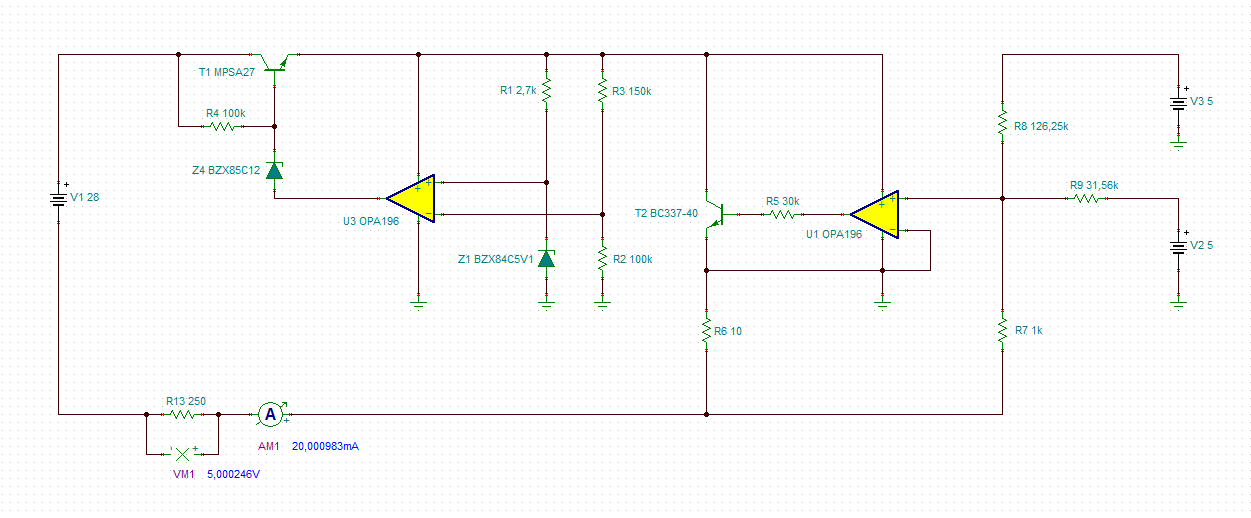
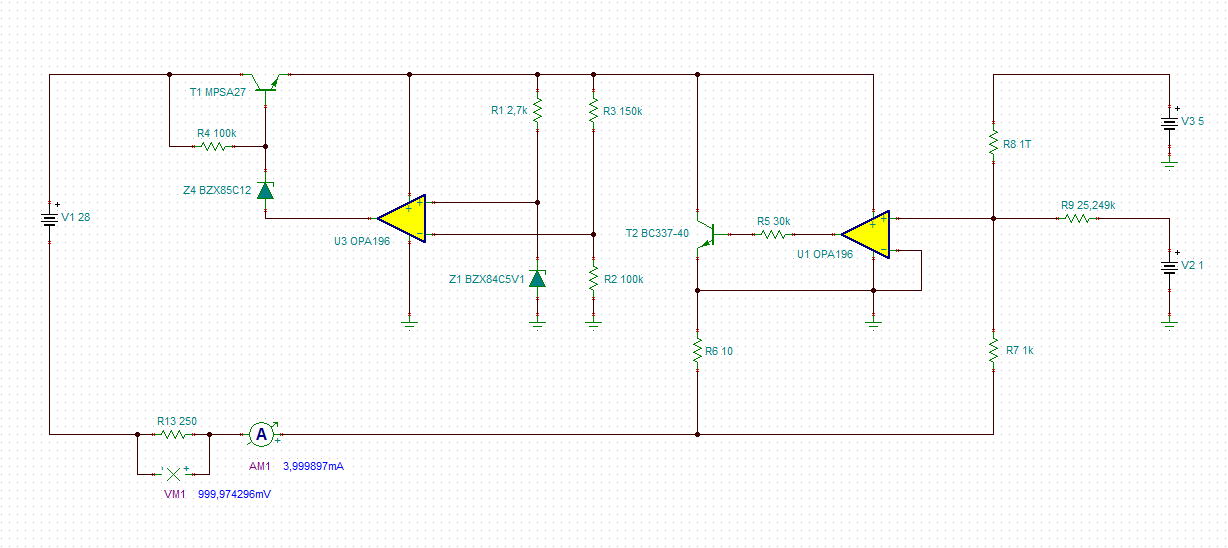
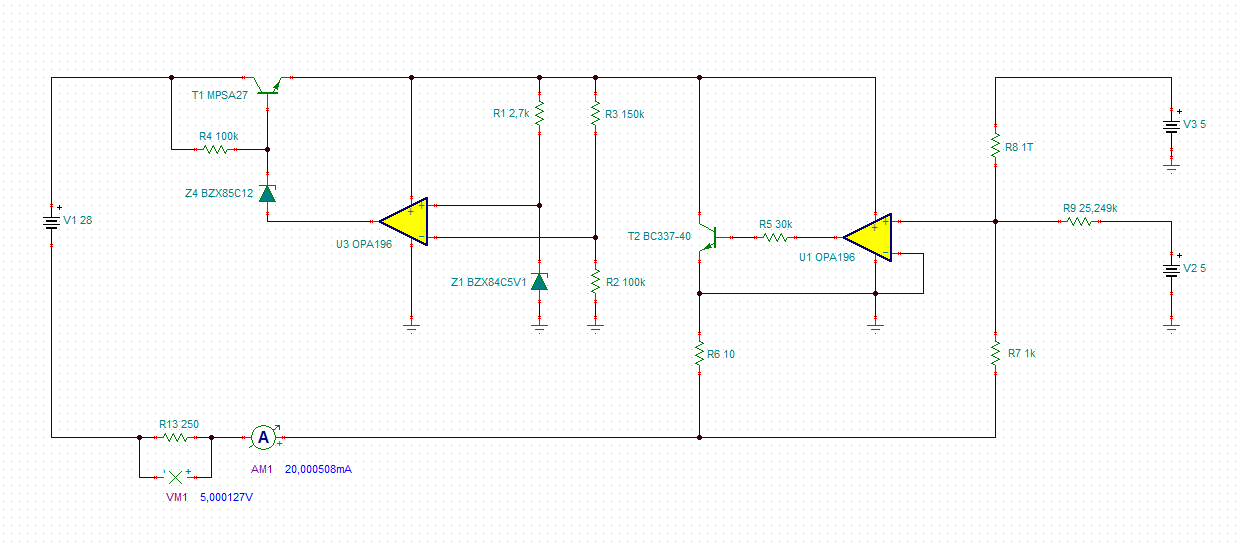
    there's a simple trick: Use the REF input of INA122 to generate a defined output offset voltage of 1V for the case that IN+=IN-. Set the whole measuring range to 1V...5V. 5V / 1V is the same quotient as 20mA / 4mA then! By this you can remove R8 and adjust R9 to R9  = 25k249:

    nader3.TSC

    Kai