This thread has been locked.

If you have a related question, please click the "Ask a related question" button in the top right corner. The newly created question will be automatically linked to this question.

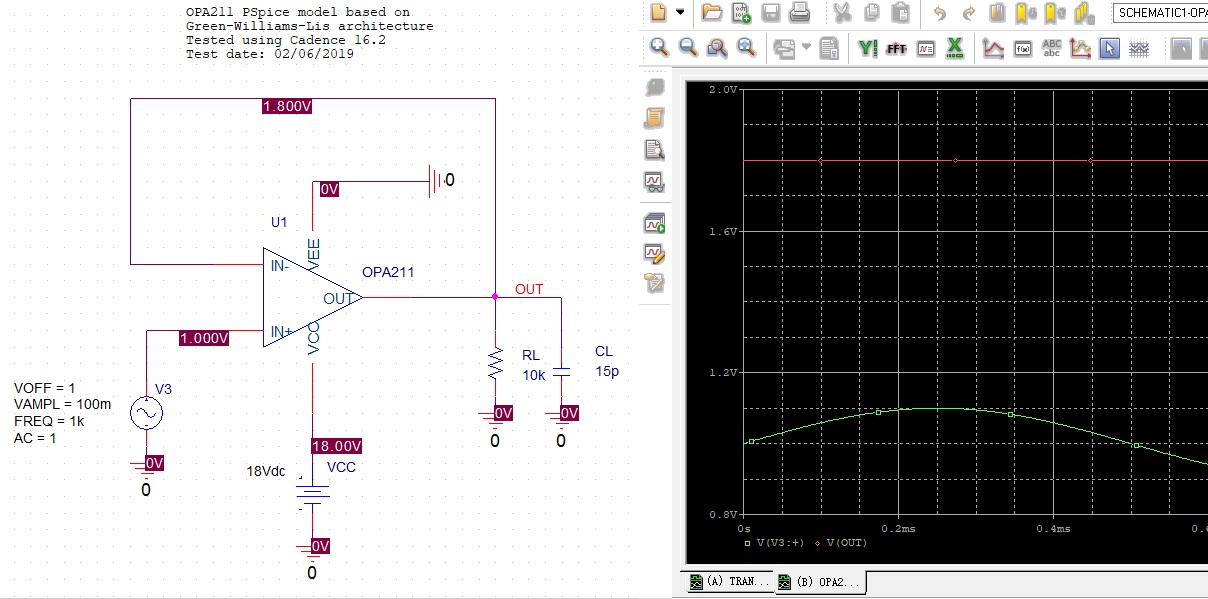
TINA/Spice/OPA211: not work well when single supplied

Part Number: OPA211
Other Parts Discussed in Thread: TINA-TI, , OPA197, OPA140, OPA189

Tool/software: TINA-TI or Spice Models

Hello, I did the simulation with OPA211(sboc250c), the circuit worked when it was dual-supplied, while seemed not work well when single-supplied. The datasheet said that “The OPAx211 series is specified over a wide dualpower supply range of ±2.25 to ±18 V, or for singlesupply operation from 4.5 to 36 V”. So, can anyone help to tell how to understand it?

  • Hi Xueliang,

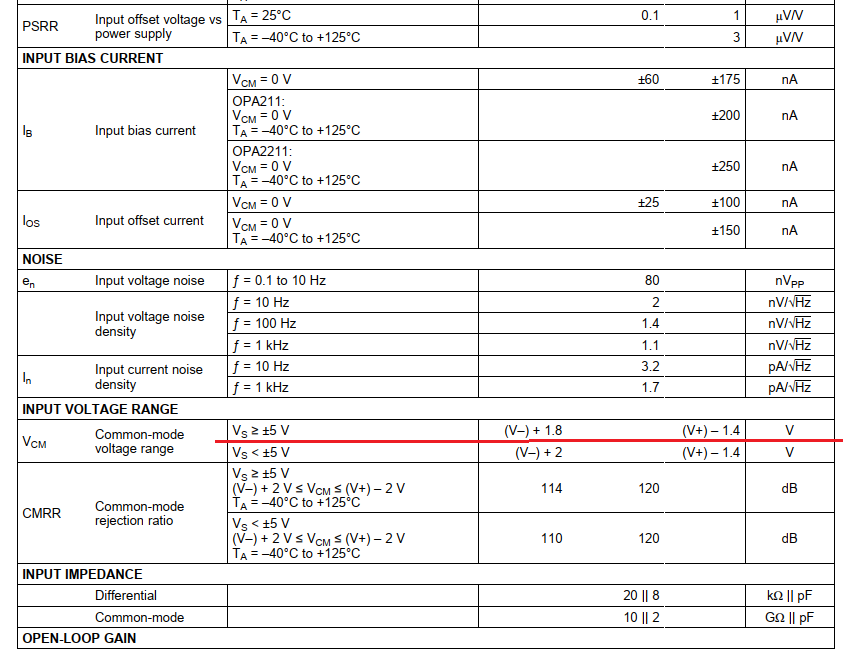
    your input signal must not exceed the common mode input voltage range:

    Kai

  • Hello Xueliang,

    Indeed, the modeling issue here is the result of input common-mode voltage violation that Kai discusses. TI's Precision Amplifier op amp models are designed to provide accurate electrical behaviors provided the amplifier is simulated operating within its linear input and output ranges. Making a model that can do that and easily converge in simulation is challenging for us.

    If a linear range of the op amp are exceeded in simulation, then the results obtained may not accurately replicate what the real op amp does. The model emphasis is correct behavior under linear conditions.

    Regards, Thomas

    Precision Amplifiers Applications Engineering

  • Hi Kai,

    yes you are right, i have got it. Thanks for your reply.

    I'd like to ask one more question, do you know any amplifier with the noise specification close to that of opa211 and the minimum common-mode voltage is about 0.3V?

  • yes, the common-mode range is where the problem is. Thanks for your help and your work in making the accurate models.
  • Hi Xueliang,

    maybe a TI's employee can answer this question.

    Kai
  • Hi Xueliang,

    The high-voltage CMOS op amps offer the widest input common-mode voltage range. However, they don't have quite as wide of bandwidth, or quite as low of noise as a high-performance bipolar op amp. However, their performance is very high overall.

    Have a look at the OPA197 high-voltage CMOS op amp datasheet. It features a rail-to-rail common-mode input voltage range, 10 MHz gain-bandwidth and a f = 1 kHz voltage noise density of 5.5 nV/√Hz. It will get you away from the VCM limitation you are finding with the OPA211.

    You can see the OPA197 datasheet here:

    www.ti.com/.../sbos737c.pdf

    The OPA197 simulation model should exhibit the wider VCM input range of the op amp.

    Regards, Thomas
    Precision Amplifiers Applications Engineering
  • Hi Thomas,

    yes, now I'm assessing opa140/opa189/opa197. I found that opa140&opa197 have similar specifications, and I have some confusion that: 

    1 Why TI made the two similar amps with different process and what is their target application respectively?

    2 Although they seems similar, I think there must be some diffenence between them. Can you say something about this? 

  • Hi Xueling,

    the OPA140 and the OPA197 look totally different to me. The OPA197 provides a much wider common mode input voltage range. See also section 7.2 of datasheets: The internal input circuitries are totally different.

    Kai

  • Hi Xueling,

    This could turn into a very long conversation, but unfortunately I have limited time to spend on discussions. Careful examination of each op amp's datasheet will reveal important differences in the their electrical performances. Each op amp technology JFET, CMOS and bipolar has areas of particular electrical performance where they excel. However, some of the levels of performance may be similar between them.

    Although there are many similarities in the OPA140, OPA189 and OPA197 levels of electrical performances this has been achieved over time by employing different circuit techniques and technologies.Ultimately that progression affects the price which a customer pays for the op amp. If you check the TI on-line, 1k/unit price for the OPA140, OPA189 and OPA197, which came  to market in that order you will see that their price is progressively lower. Price is often one of the very important factors when making a decision to use one op amp over another when they provide similar electrical performances.

    If you know which op amp electrical parameters are most important in you application we can assist you with recommendations.

    Regards, Thomas

    Precision Amplifiers Applications Engineering

  • Hi Kai

    Thanks for your information and i will spend some more time to check it out.

  • Hi Thomas,
    Thank you for the recommendations. For my application I think all the three models will satisfy and maybe i will select one with the lowest price.
  • Hi Xueliang,

    I think we have finished this discussion. Can you close this OPA211 e2e inquiry for us?

    Regards, Thomas
    Precision Amplifiers Applications Engineering