This thread has been locked.

If you have a related question, please click the "Ask a related question" button in the top right corner. The newly created question will be automatically linked to this question.

OPA2187: Output Current vs Supply Voltaage

Part Number: OPA2187
Other Parts Discussed in Thread: OPA2197,

We have been using the OPA2197 in several applications that require good input specs, rail-rail output, 30V supply, and input common mode range that includes 0V.

In a new application, the Iq of the OPA2197 is too much (1.0mA Typical).  The OPA2187 would work.  Its Iq is 0.1mA Typical.  However, I can't tell what the output drive current characteristics are.

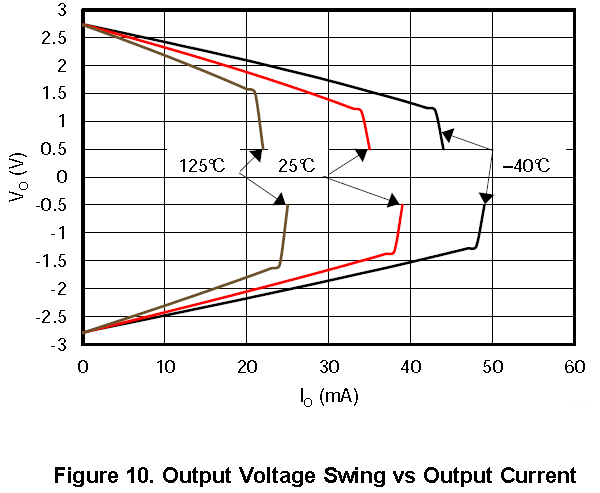
See Fig 10 below.  What does it mean?  The similar figure for the OPA2197 makes sense.  Can you explain the output current drive capability of the OPA2187?

By the way, my output load is a series RC.  R = 1k, C = 1uF.

Thanks,

Richard
  • Hi Richard,

    It is a Typical Characteristics graph for the OPA2187 Output Voltage Swing vs Output Current, when powered by +/-2.75 V (dual) supplies. Unfortunately, that latter point wasn't included in the graph.

    We can see from the graph that the OPA2187 maximum output swing approaches the +/-2.75 V supply levels when the output current Io is 0 mA. That applies to when the output is sourcing current - the upper curves, and when the output is sinking current - the lower curves. Also apparent from the curves is that the maximum output voltage swing decreases as IO increases. Additionally, there are small maximum voltage swing differences between the upper and lower sets of curves and that the maximum swing decreases with increased temperature, for a given IO level.

    Although the datasheet doesn't include a similar graph for a +/-15 V (30 V) supply, the swing to the rail characteristics will be similar with the higher supply i.e. if the output swings to with 250 mV for a particular IO level with the +/-2.5 V supplies, it will swing within 250 mV with the +/-15 V supplies. That is a characteristic of the OPA2187 CMOS output stage design.

    The output current into a series 1 kilohm + 1 uF load will depend on the output waveform ac characteristics. You can always use the OPA2187 simulation model in your exact circuit and monitor the output current levels as the output voltage changes.

    Regards, Thomas

    Precision Amplifiers Applications Engineering

  • Hi Richard,

    Do you have the OPA2187 information that you need? If so, please close this e2e inquiry.

    Thanks, Thomas

    Precision Amplifiers Applications Engineering