This thread has been locked.

If you have a related question, please click the "Ask a related question" button in the top right corner. The newly created question will be automatically linked to this question.

INA333: Input Bias Current Return path

Part Number: INA333


I have a question with regard to the Input Bias Current Return path section (8.2.2.5) of the INA333 datasheet.  I am used to placing this bias current compensation resistor at the input(s) when connecting the In-Amp to a floating source (battery, thermocouple, etc.). 

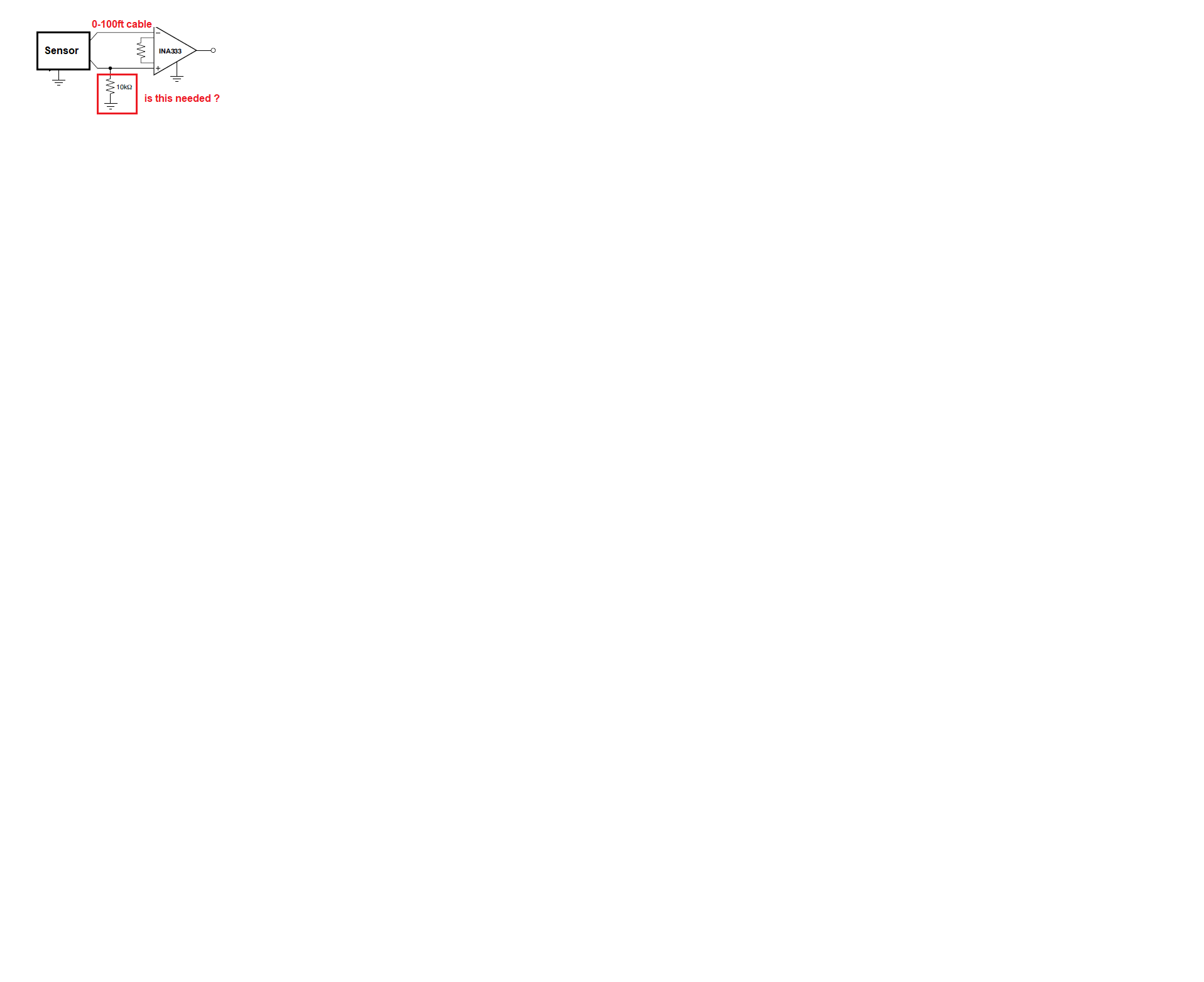
    • Would I still need to add this resistor if the sensor I am connecting to is referenced to the same ground as the INA as shown below ? 
    • What if the sensor is connected at a distance (100ft) form the INA ?

I’ve asked around and am getting different answers on this, hopefully the analog gurus at TI can clue me in on this.
  • Hi TonyMCC,

    Thanks for being patient with me while I looked into this a bit more. Since the sensor input is ground-referenced, you don’t necessarily need a resistor bias current return path since ground creates a complete path. The resistors at the input would only degrade performance by adding noise and lowering the input impedance of the circuit. 

    In the second case highlighted – with a 100ft cable – we might consider additional provisions to reduce the error in particular for a zero-drift device.  As you know, zero-drift technology consists of a set of switches which reduce the effective input offset voltage.  A byproduct of this constant self-calibration is this switching circuit can draw short spikes of AC current correlated to the internal oscillator switching frequency. In this case, when combined with a long cable (modeled as an inductor), the inductor will resist this fast change in bias current by producing a voltage [V = L*(di/dt)]. This voltage could potentially add error to the circuit.  One potential fix is to add a capacitor to ground at each input of the INA333.  This capacitor would be an open circuit at the low frequencies their sensor operates at, but low impedance to high speed current spikes.  Therefore the switching bias current would take the alternative path of the capacitors rather than the cable. 

    Hope that helps!

    -Tamara Alani