This thread has been locked.

If you have a related question, please click the "Ask a related question" button in the top right corner. The newly created question will be automatically linked to this question.

INA219: PGA function

Part Number: INA219


Hi Sirs,

Sorry to bother you.

We have use INA219.

We would like to know PGA features.

1. When will we need to use PGA? because looks not all solution include this function.

2. What range (40-320 mV) will more prefer? looks this PGA output voltage will effect sensing range, so the more large will be better? 

Please correct me if i wrong.

Thanks!!

  • Hello Shu-Cheng,

    Thanks for considering to use Texas Instruments. The PGA is a programmable gain amplifier and is one of the two settings that determine the resolution you can achieve in your measurement. Equation 2 of the datasheet is provided with the assumption that the user sets the configuration register for the 12 bit ADC along with the max PGA setting (PGA=/8=2^(3 bits)) that provides an additional 3 bits.

    The purpose of the PGA is to provide more flexibility with implementation of this device. If you look at our analog output current shunt monitors you will find that typically there are multiple gain variants for each. The PGA essentially allows for more re-usability as only one device needs to be purchased to use three different gain settings.

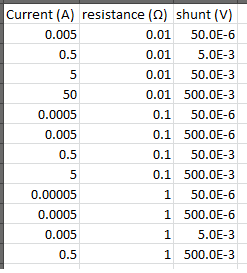
    1. Deciding which setting to use for the PGA comes through determining the suitable compromise on current range, resolution, error, and power dissipation across the shunt.  Along with the PGA design variable is the shunt resistor. The table below illustrates what input voltage ranges you will need for a given shunt resistor. Lower currents will lead to higher error as the value approaches the input bias current. Additionally shunt voltages approaching the ADC LSB size will also lead to larger errors.
    2. I cannot say what is most preferred as many customers do not provide a lot of detail on how they use our product.

  • Hi Sirs,

    Thanks for your explain.

  • Hi Sirs,

    Thanks for your explain.