This thread has been locked.

If you have a related question, please click the "Ask a related question" button in the top right corner. The newly created question will be automatically linked to this question.

Amplifiers forum


Hi, I am wondering of calculating input impedance of OPAMP.

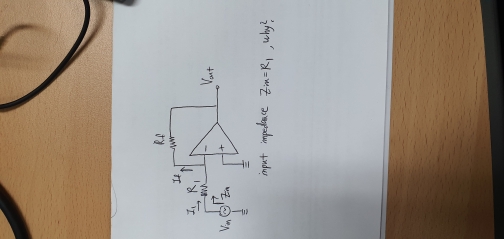
I kind of understand why input impedance is R1 in above circuit.

But I think current from source also flows to feedback loop.

Then, why we do not consider Rf in calculating input impedance?

Thanks,

Yunsik

  • Hi Yunsik,

    due to the action of negative feedback loop the -input of OPAmp is always sitting at 0V for an ideal OPAmp and very close to 0V for a real OPAmp. This has to do with the very high gain of OPAmp (infinite gain for an ideal OPAmp): If there would be a voltage difference between the input pins, the output of OPAmp would immediately correct it. If the -input would go positive, the output would go negative until the input voltage difference would get zero again. And vice versa: If the -input would go negative, the output would go positive until the input voltage difference would become zero again. So, the OPAmp always keeps the input voltage difference to zero. And because the +input is forced to 0V, the -input will also sit at 0V.

    It's said that the -input sits at "virtual ground". Very similar ro "real ground", current can flow in and out of this node. And, you are correct, this current flows through Rf as well. In an ideal OPamp all the current that is flowing thgough Rin is also flowing through Rf. In a real OPAmp, very most of this current is flowing through Rf.

    And, as the -input sits at virtual ground, for the calculation of Zin only Rin is needed. Zin = Uin / Rin.

    But why do we call it "virtual ground" and not "real ground"?

    Well, because this virtual ground cannot absorb currents of arbitrary size. Each current must be sinked or sourced by the output of OPAmp. And it's output current is limited. Also, a real OPAmp cannot provide a true virtual ground because due to the finite gain of OPAmp a minimum of input voltage difference between the inputs of OPAmp is needed. More, a real OPAmp behaves the less ideal the higher the signal frequency is. Have a look with a scope and you will see it...

    Kai

  • Former Member
    0 Former Member

    Hello Yunsik,

    I think Kai has provided a thorough and nice explanation to answer your question.

    In short, amplifiers in negative feedback have their inputs at the same, or very nearly the same, voltage.  Since the non-inverting input is tied to ground, the inverting input will try to match this by going to 0V, which we call the "virtual ground."  Because of this virtual ground, Rf is not "seen" and only R1 contributes to the input impedance.

    Let us know if you have any further questions.

    Regards,

    Daniel

  • Hi Kai,

    Thank you for your detailed explanation!

    I could fully understand it:)

    I really appreciate it

    Yunsik

  • Hi Daniel,

    Thank you for your reply.

    Now I can fully understand this concept:)

    Yunsik