This thread has been locked.

If you have a related question, please click the "Ask a related question" button in the top right corner. The newly created question will be automatically linked to this question.

INA199: output error

Part Number: INA199
Other Parts Discussed in Thread: INA181, INA190, INA186

Hi team,

My customer is using INA199A1 for their new project.

But the output is not precise.

Here is the operating condition:

1. I=1.5A

2. Rshunt=8 m ohm 

3. voltage over Rshunt=12mV

4. The output of INA199A1=560mV

What will cause the unexpected gain error?

Could you provide the solution?

Thanks!

Jamie

  • Hi Jamie,

    can you show a schematic?

    Kai

  • Hello Jamie,

    There could be a few things to cause this error.

    1. What is the shunt resistor tolerance?
    2. Is there an input filter? This can create gain error.
    3. What is the output of the INA199? If it's a heavy load this could affect device performance.
    4. How do you know the load is exactly 1.5A? What is the error in this measurement?
    5. Are all grounds of the load and ICs tied together with low-impedance connection?

    Like Kai mentioned, a schematic here would be very helpful. Also any hardware and test set up information will help.

    Best,

    Peter

  • Hi Teams,

    1. What is the shunt resistor tolerance? +/-1%.

    2. Is there an input filter? This can create gain error.? Just a 100ohm +/-0.1% with 0.1u

    3. How do you know the load is exactly 1.5A? We use a new Chroma electronic load. And make sure the voltage of sense resistor is 12mV.

    4. Are all grounds of the load and ICs tied together with low-impedance connection? Yes.

    Please refer to the schematic below:

    Please let me know if any information needed.

    Thanks and best regards,

    Jamie

  • Hi Jamie,

    you have directly connected the output of INA181 with the output of INA199? This will not work. They short each other!

    And you must remove C182! This can cause instability and oscillation.

    Kai

  • Hi Kai,

    The customer just uses the IC20. (INA199A1). IC20A is nu.

    And no oscillation.

    Jamie

  • Hi Jamie,

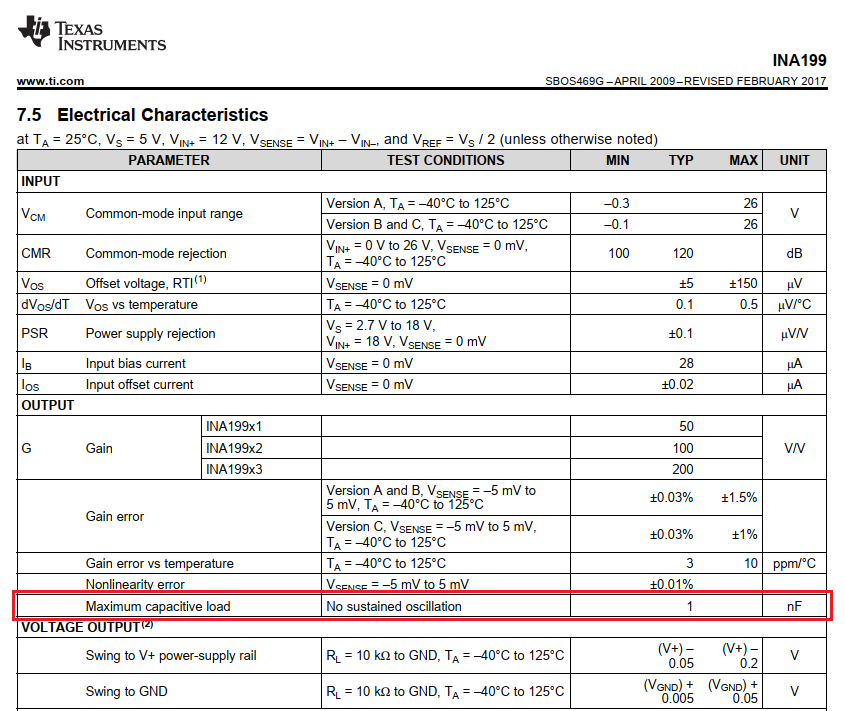
    a too high capacitive load at the output erodes the phase margin and not only causes oscillation but can also make the chip behave weird. You should remove C182. See also here:

    Kai

  • Hey Jamie,

    Kai is absolutely correct. Customer needs to remove C182 (10nF) as this most certainly is causing the VOUT to oscillate. The maximum capacitance we recommend driving with no isolation resistance is 1nF.

    More importantly the 100-Ω input resistors (R240, R241) are attenuating the gain of the INA199A1 (see section 8.4.1 of datasheet). Using Equation (1) or Table 2 of the datasheet, customer can calculate the new device gain. So with input resistors (Rs) = 100-Ω, the gain error factor is:

    20k/(17*Rs + 20k) = 0.921659.

    So the new nominal gain is:

    50V/V * 0.921659 = 46.08295 V/V.

    While the new gain can be calculated, there will be increase gain error variation because internal gain-setting resistors are not trimmed to exact absolute value, only the ratios are trimmed.

    Given the new gain, a -1.5% gain error, a -150uV offset, -1% shunt tolerance, I calculate the minimum Vout at 1.5A is 532.3 mV. In reality this could be worse because gain error has increased a couple percent due to input resistors. This also is not including any output stability error.

    To solve this problem you need to perform a two-point linear gain calibration for every device to negate gain error or use the INA190/INA186, which have high-input impedance stages that are not affected by 100-Ω input resistors. For the INA199, the differential input impedance is only a couple kΩ and thus device gain is affected by input resistors.

    Hope this helps.

    Best,

    Peter

  • Hi Peter,

    It seems like the input resistors are the root cause.

    It is ok to remove the input resistors?

    Thanks and best regards,

    Jamie

  • Hi Jamie,

    yes, of course. See section 8.4 of datasheet of INA199.

    And remove C182. It makes no sense.

    Kai