This thread has been locked.

If you have a related question, please click the "Ask a related question" button in the top right corner. The newly created question will be automatically linked to this question.

OPA857: Restricted output compliance range

Part Number: OPA857
Other Parts Discussed in Thread: TINA-TI,

I encountered some unexpected simulations using the spice model.  I came back to TINA-TI to reproduce the problem.  The attached TINA-TI circuit is from the Reference Design, just pared down to eliminate external currents.  The OUTN voltage scales with the supply as expected.  An inconsistent IN voltage shows the OpAmp saturates, as witnessed in the output as well.  I would expect this at high currents but not at low currents.  Is saturation at the zero-input condition for lower Vss rails expected in the operation of the device or is it a deficit of the simulation model?  I do not see the low-end saturation mentioned in the data sheet.

I would appreciate any insights.

OPA857_sweep.TSC

[Edited:]

Here's a picture from an alternate simulator showing the same results as the TINA-TI design above:

  • Hi John,

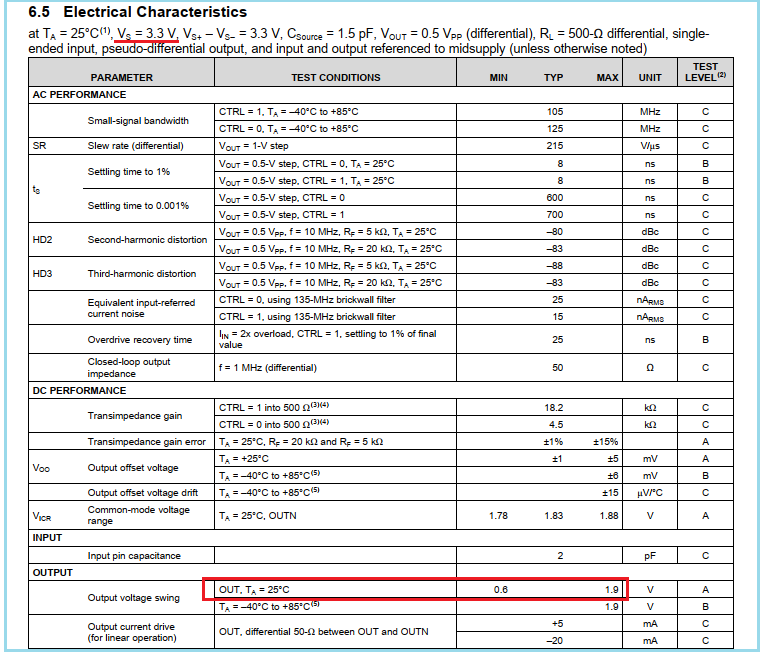
    do you mean this?

    Kai

  • I mean that at a value other than 3.3V.  The output compliance range will be different for 2.7V (5/9 of the supply rail for the high end) but simulation shows the DC output value falling far short of the OUTN buffered reference level.  The OpAmp is saturated in the super-simple TINA-TI design I attached from 0uA to several uA when run at lower voltages.

    The data sheet does nothing to elaborate on why the high end of the Class-A output stage (able to source a flat 5mA per the charts) cannot put the device into an operational state.

    It may be the simulation model doesn't work at lower voltages and that the part will work just fine.  That's what I'm trying to clear up.

  • Hey John,

    This does seem to be an issue with the model, the input-common mode should be the same as OUTN however it looks like when the supply is lowered and no current is provided the input voltage is lower for some reason. The actual part shouldn't exhibit this behavior. 

    Best,

    Hasan Babiker