This thread has been locked.

If you have a related question, please click the "Ask a related question" button in the top right corner. The newly created question will be automatically linked to this question.

OPA2376: TINA-TI model "OPA376 TINA-TI Reference Design (Rev. E)" IIB incorrectly modeled

Part Number: OPA2376


Hi, I'm having trouble with IIB simulations for OPA2376. Configured as a unity gain buffer, I see -5 to +5 nA of input bias current when sweeping VIN from 0 to 5 V (using DC Transfer Characteristics) when modifying the reference design here: www.ti.com/.../sboc261. It should be much lower according to the datasheet. When I use the model , I see IIB of < +/- 20 pA as expected.

Why are the models different? Is one incorrect?

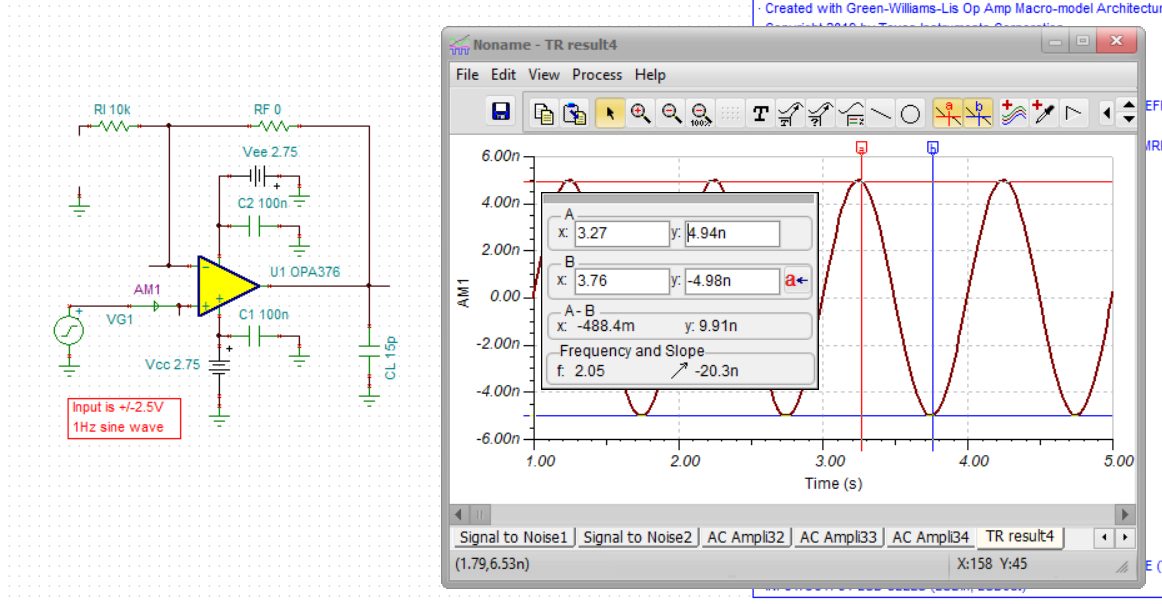
  • Morning Ben, I tested that model as shown here - yes, it does appear to have a 500Mohm input impedance in the model that would explain that +/-5nA input current for a +/-2.5V input swing. 

    Not in the datasheet, but not unbelievable,

    Oddly, TINA has the interesting feature that it allows negative elements, if I put a -500Mohm externally, here is what I get, 

    Got pretty close to nulling this out, that +/-205pA implies a net input Z of 1.2E10 ohms. 

  • Hi Michael,

    Thanks for confirming. Nice trick with the negative resistance. I verified on the bench that the leakage is < 20 pA when at least 500 mV within the supplies. The datasheet says < 20 pA max at VIN = mid supply. Seems like the model is overly conservative.

    Warm regards,

    Ben

  • Yes Ben, I was pretty surprised when I found that. It is useful to modify input impedances when the models seem a bit off (they have gotten better, but the older ones had some issues) Here, I exercised that in an article, essentially  - I started here with an old model that was way off and showed how to fix it externally (without having to drill into the netlist) but then found a model update was exactly matching the datasheet. For me, the C's are more important than the R's normally. 

    https://www.planetanalog.com/input-impedance-extraction-and-application-for-high-speed-amplifiers-insight-9/#