This thread has been locked.

If you have a related question, please click the "Ask a related question" button in the top right corner. The newly created question will be automatically linked to this question.

suppressing/subtracting current at TIA input

Other Parts Discussed in Thread: OPA657, TINA-TI

Dear Support,

I need to suppress/subtract an input current at the entrance of a low-noise TIA based on OPA657. I need not to saturate the TIA (V/A = 10^6) when looking at low frequency current fluctuations (and noise)

with respect to a constant current offset. Could you please suggest me a low-noise circuit capable to suppress/subtract a fraction of the current injected into the TIA ? Such a circuit should not disrupt

the noise performance of the OPA657.

Thank youso much  for your help.

  • Hello Alberto,

       I would need to look into this a bit further but I believe you could simply use back-to-back diodes (there is a concern for additional input capacitance which I would need to explore). I will get back to you by tomorrow. In the meantime, can you share your input characteristics of the TIA: input diode capacitance, input current, rise time (BW). 

    Thank you,

    Sima

  • Dear Sima,

    thank you for your reply.

    I am a bit confused by your suggestion ("...you could simply use back-to-back diodes"). I  need removing a programmable constant DC current

    from the input of my TIA, In my application, I need to amplify the low-frequency current noise from a DUT. In order to avoid saturating the TIA,

    I have to subtract the DC current offset. I have found some discussion on this topic on the Analog Device's website: please have a look

    at the link:

    In my case, the TIA is built around the OPA657. The BW is 100 KHz,

    I look forward to hearing from you.

    Best regards,

    Alberto

  • Hi Alberto,

    can you show a schematic?

    Where is the offset current coming from? From the OPA657 itself?

    Kai

  • Dear Kai,

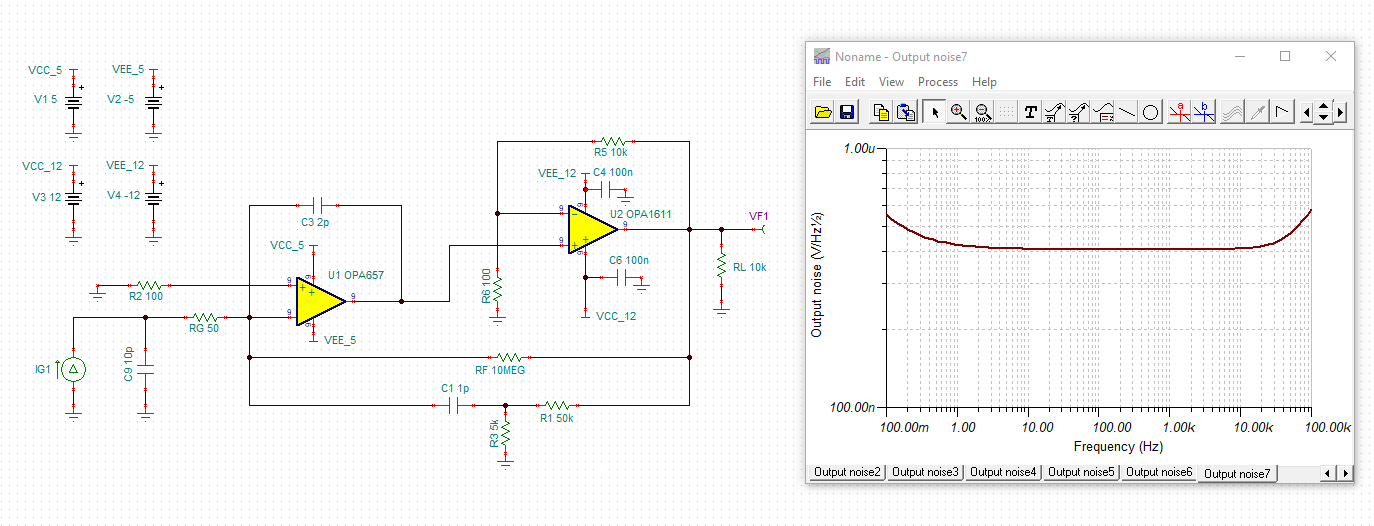
    please find the TIA schematic:embedded_gain_OPA657_OPA1611.TSC

    The current to be canceled comes from the photosensor connected at the input of the TIA (a current generator in the TINA-TI model).

    This TIA is used to study 1/f current noise at very low frequency (0.1 - 100 Hz). As you can see, the V/A amplification is quite high and the

    dark current from the photosensor in some conditions may saturate the TIA. I need a way to cancel a fraction of the input current in order

    to avoid that. I have found a thread on a similar topic on the Analog Device's website:

    Unfortunately, such an approach seems to add a relevant noise to the overall TIA input. I am wondering if a low noise solution does exist, which does not disrupt the noise performance of the TIA. You can simulate the circuit and check the referred-to-input noise. The TINA-TI calculation is in very well agreement with our noise measurements in the lab.

    Thank you in advance for your time and support.

    Kind Regards,

    Alberto

  • Dear Kai,

    please find another schematic where the TIA is used to measure the current noise of a MOSFET device. Drain and gate resistors are trimmed in order to achieve the best resolution in noise measurements:

    embedded_gain_OPA657_OPA1611_v2.TSC

    The Id (drain current) is very often high enough to saturate the TIA. It is then necessary 'to divert' or 'to cancel' a variable function of the Id

    current in order to have a V/A large enough to amplify the current noise without pushing the TIA into saturation.

    I guess two solutions are possibile:

    1) cancellation-in-the-loop, with a servo op-amp acting on the TIA input or on the feedback resistor (see for instance the thread

    in the Analog Device's web site, the link is in my previous message)

    2) cancellation-out-of-the-loop, with a programmable current generator right at the input of the TIA, sinking a fraction of the Id

    Any suggestion/scheme/application_note is very appreciated.!

    Kind Regards,

    Alberto

    Alberto

  • Hello Alberto,

       Thank you for the information. My first reply was under the assumption that you were looking for a solution to essentially current limit your application so the amplifier does not saturate. The reason I mentioned the diode was one way to prevent voltage saturation as a simple application. However, it seems like your focus is to eliminate DC offset current coming from the photodiode which is causing this saturation. Thank you for the TI files, I will look through those, and be looking into your issue today. 

    Thank you,

    Sima

  • Dear Sima,

    thank you for your help.

    Please, have a look at thr seconf TINA schematic I posted. It showa the setup we use to study (and measure) the current noise in FET/MOSFET devices.

    In this setup, we very often saturate the TIA. In order to measure the current noise we need a V/A gain in the range 1M - 10M. However, very often the Isource

    is so large to saturate the TIA, when using this gain. We would need a way to 'cancel' a given DC offeset current, by using a in-the-loop (please, see the Analog Device thread)

    or out-of-the-loop scheme.

    It is paramount the solution does not disrupt the excellent noise performance of the OPA657.

    Thank you again for your help.

    Kind Regards,

    Alberto

  • Hi Alberto,

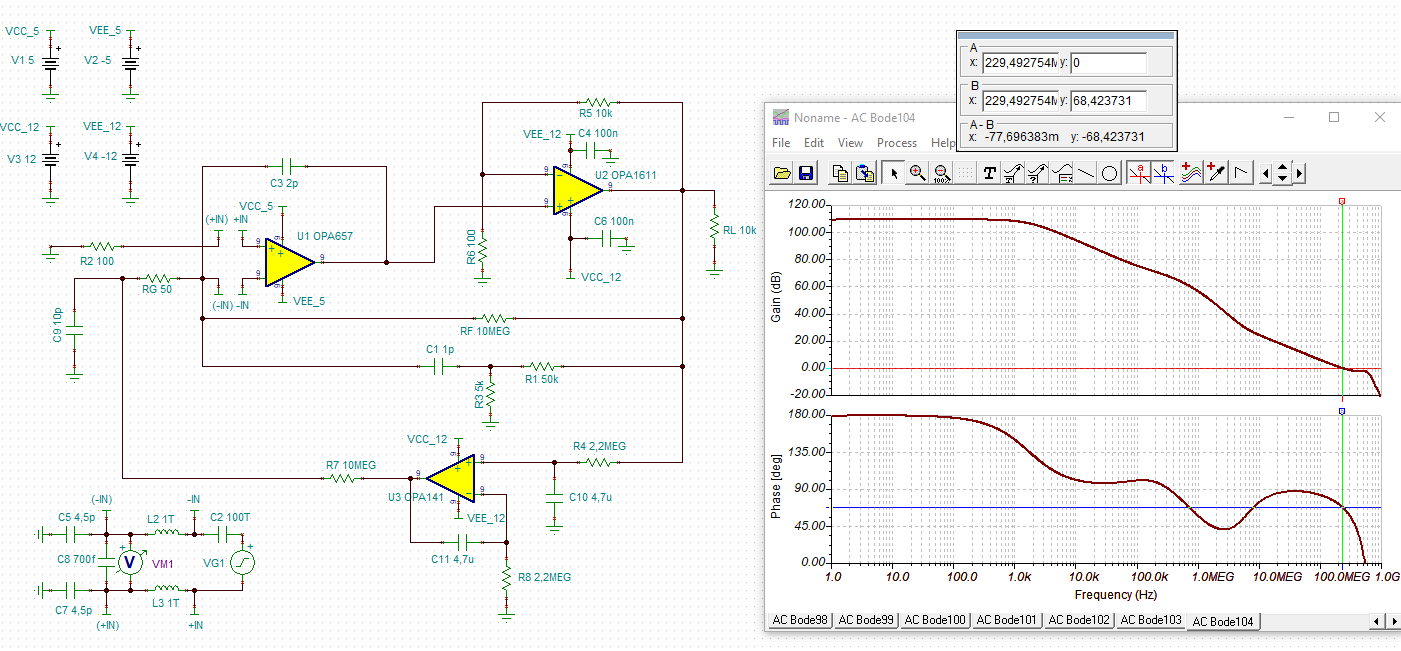
    I have made some simulations and would give the following scheme a try:

    alberto_opa657_1.TSC

    alberto_opa657.TSC

    Kai

  • Dear Kai,

    your circuit fullfill all my requirements ! Thank you so much for the simulations: the noise level of the modied TIA is still great !

    I guess the key point of your solution is the 10M resistor at the output of the servo OP-AMP. In this way, the TIA will amplifiy the servo

    voltage noise by a small factor 20/10 = 2. Of course, a huge voltage drop will be present across the 10M resistor and this will limit

    the total amount of current the servo could eventually sink.

    Also, I guess you selected a FET input for the servo in order to limit input offset current- The RC filter uses a quite high 2.2M resistor

    which could bias the servo itself.

    Is all that correct ?

    Thank you again for your precious time! I will try this solution in the lab !

    Best,

    Alberto

  • Hi Alberto,

    yes, everything you said is corrrect :-)

    R7 not only influences how the noise of DC servo OPAmp is amplified but also the input voltage noise of the OPA657 itself. So for achieving low noise in DC servo amplifiers it's a good compromise when R7 and RF have about the same size.

    Kai

  • Dear Kai,

    thank you again for your time and thank you to all the E2E staff.

    Great job ! This issue is definitely fixed !

    With my best regards,

    Alberto