This thread has been locked.

If you have a related question, please click the "Ask a related question" button in the top right corner. The newly created question will be automatically linked to this question.

AMC1100: Common-mode operating range

Part Number: AMC1100
Other Parts Discussed in Thread: TIDA-00555, AMC1311

I am planning to use the AMC1100 on a new design and I am having problems understanding the common-mode operating range of the device.

I would like to sense an AC voltage in a circuit configuration such as in TIDA-00555, whith an isolated power supply for the AMC1100.

  • On the one hand, in the datasheet it is stated that the common-mode operating range shall not go under -0.16V.
  • On the other hand, in such a AC application, if I connect GND1 to VINN and use the full ±250mV differential input voltage range, my common-mode voltage on VINP would go down to -0.25V, which violates the previous operating range.

Since the "absolute maximum rating" for analog input voltage is GND1-0.5V I think the device will not collapse, but I would like to know how all these parameters play together. 

Should I constrain my AC sensing to an input range of ±160mV? Or did I understand something wrong?

Thank you in advance!

  • Hi Pablo!

    Welcome to our e2e forum!  Think of it this way - if you tie the VINN pin of the AMC1100 to GND1, you are essentially looking at a single ended signal on VINP swinging +/-250mV about GND1 which is absolutely fine.  If both VINN and VINP are moving together, you need to concern yourself with the -160mV common mode voltage.  In that case, -160mV + -250mV keeps you under the -500mV ABS MAX voltage level.

  • Hi Tom,

    We are stil having problems with the signal quality while sensing Phase to floating neutral with AMC1100.

    The distortions show low frequency content. Please see the picture below. We tried to connect a small capacitor

    of 1 nF gnd1-gnd2 in order to reduce potential noise coming from the floating HV side +5V. It only aggravated the issue further. The 5V supply seams to be OK.

    Since AMC1100 is to us pretty much a Black Box, have you got any further hints ? thanks a lot in advance for the quick reply !

  • Hi Erol,

    your picture didn't come through. Please try again and use the "paperclip" button in the header of text box.

    Kai

  • Hai Kai ;

    Here's the picture below.

    Could the problem be fixed by lifting Vin-with a voltage divider and follower to create an offset voltage ?

    TI_Voltage_Sensing.docx

  • Hi Erol,

    Can you please tell me where that screen shot was taken?  Looks like 50Hz and I suspect it's one of the two output pins.  Can you provide a schematic of your setup?

  • Hi Tom, 

    Thank You !

    It is taken at the output of a DA=Difference Amplifier with Rseries=10kOhm , Rfeedback=7.5 kOhm, c=10nF. It is 50Hz fundamenmtal with a switching ripple on top of it.

    The input to this DA is the ouput of AMC1100. The signal to AMC1100 is brought through a chain of 2 x 3 Mohm Resistors with 2 x 1.69 kOhm

    in the middle (the voltage across these two 1.69kOhm resistors is input to the ISO. The Vin- of the ISO is connected to gnd. I was wondering if the

    negative of the ISO Vn- wwas not to be connected to gnd but lifted off with a voltage divider followed by an OP Amp Voltage Follower, the circuit may work. 

    Then it would point out to nonlinearity.

    Thanks a lot !

    Erol

  • Hi Erol,

    Could you sketch this out for me?  Photo with pen/paper or white board hand drawing is fine.  I'd like to try and understand the situation better.  The GND of whatever power source you are using for VDD1 must also tie back to GND1 (pin 4) and the 1.69k resistors.  I'm not sure that I follow what you mean by adding an OpAmp follower circuit.

  • Hi Tom,

    I answer here on behalf of my colleague Erol. This is our current circuit.

    - On a first stage we attenuate the AC voltage down to the +-250mV analog input range of the AMC1100.

    - On a second stage we convert the +-2V analog differential output of the AMC1100 to 3V single-ended in order to interface a microcontroller's ADC.

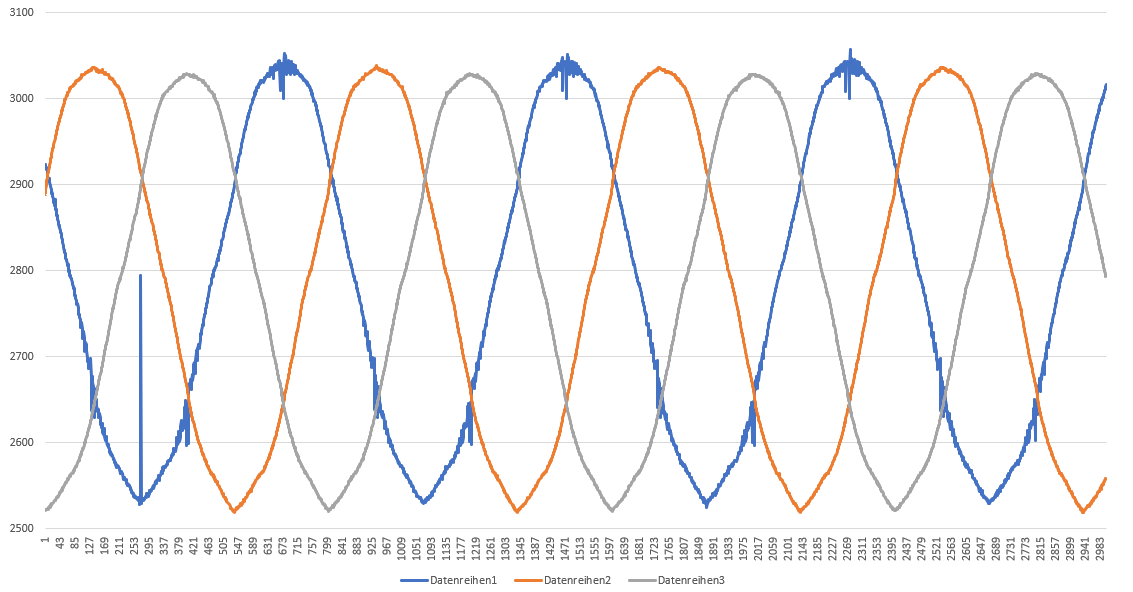
    However, we measure at the VADC output distorsions exactly at the peaks of the 50Hz AC waveform, as you can see in the following scope:

    We believe we are not violating the recommended operating conditions of the AMC1100, so we literally have no idea what is going on.

    What my colleague Erol suggested by OpAmp follower circuit is the solution proposed in this thread, addind a 1V offset to the input signal:

    <https://e2e.ti.com/support/amplifiers/f/14/t/669814?AMC1311-For-AC-Voltage-Sensing>

     Thank you for your ideas!

  • Hi Pablo,

    OK - now I understand.  The AMC1311 in the other thread has a 0-2V input range, so the idea of adding a level shifting circuit there was to get the bipolar AC signal into the correct voltage range for the single ended input on that device.

    Your graph above looks like the reconstructed analog signal from your MCU - what is the Y axis scale?  Codes?  Volts?  What voltage level is in VH_P and VH_N?  I believe you are seeing somewhat of an offset at the input of the AMC1100 in this configuration.  What results do you get if you tie pin 4 of the AMC1100 between R13 and R14 instead of directly to pin 3?