This thread has been locked.

If you have a related question, please click the "Ask a related question" button in the top right corner. The newly created question will be automatically linked to this question.

OPA2335: Gain Setting Margin Consult

Part Number: OPA2335

Hi Team,

Here is one question about DC gain setting consult about our OPA2335. For DC signal, customer sets gain is 1000 and the circuit can work well currently. They want to know what's the limitation or gain margin they should care when they increase the circuit gain continually? Does this gain setting is only limited by output voltage range for DC signal?

Best Regards,

Stanley

  • Hi Stanley,

    the higher you set the gain of an OPAmp the less linearizing gain reserve the OPAmp has. So for an ultra high gain application I would use two or more OPAmps in a row and split the total gain onto the individual OPAmps. This also helps to keep the amplifier stable and to prevent oscillation. Additionally, use low pass filtering at each stage to improve stability.

    Kai

  • Hi Stanley,

    Q: They want to know what's the limitation or gain margin they should care when they increase the circuit gain continually? Does this gain setting is only limited by output voltage range for DC signal?

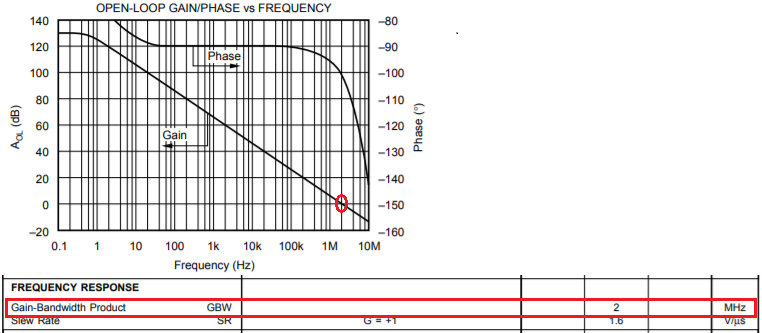
    The Gain Bandwidth Product (GBW or GWP) is defined that voltage_ feedback_amplifier_Gain * bandwidth (closed_loop) = GBW (Open Loop). In your current application, the closed loop gain=1000, the close loop bandwidth = 2MHz/1000=2kHz, see the attached image. In other words, the close-loop bandwidth behavior can be estimated from open-loop gain, if an op amp has a single pole roll-off at -20dB/decade. The 2kHz BW will work well for most of DC amplification application. 

    If the customer wants Gain=2000, for instance, the BW will be 1kHz. It is likely still acceptable, if the DC amplification is driving resistive load and still maintaining a single pole roll off. However, the DC output signal responses may start to get sluggish, especially there are timing requirements that output DC change has to follow changes in input DC signal. If changes of input DC signals are slow or very little changes, then 1kHz BW may be adequate.  

    With increasing in op-amp gains, the feedback resistors matching start to become important. The customer may have to use higher precision resistors, if signal gains have to be controlled accurately.  

    Conclusion: There are no definitive answers to your questions without understanding the input and output response requirements in the application. Without going through too much analysis, it will be safer to follow Kai's recommendation and split the gains into two op amp stages. 

    If you have additional questions, please let us know. 

    Best,

    Raymond