This thread has been locked.

If you have a related question, please click the "Ask a related question" button in the top right corner. The newly created question will be automatically linked to this question.

LOG112: Log conformity error calculation discrepancy

Part Number: LOG112
Other Parts Discussed in Thread: LOG104, LOG114, LOG101

Hello everybody,

I want to use a logarithmic amplifier (LOG104, LOG104, LOG112, etc) but it seems that there is some discrepancies about le log conformity error calculation in volt.

I found the LOG100 original datasheet where the error calculation seems to be best described but there is always something that I doesn't understand well.

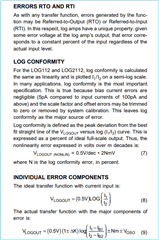
The non linearity is given in Volt with the formula:

VOUT (NONLIN) = K 2Nm V

Where K is the gain of the amplifier (V/dec), N the log conformity error and m the number of decade.

But Why there is this factor of 2?

In the specification table, in all the datasheets, the log conformity error is given relatively to the full scale peak to peak output. The mention "peak to peak " disappeared from the TI datasheet in the log conformity chapter so we could think that we need to take the one sided full scale value (by dividing the value given in the table by 2?).

Where is the truth? is the value in the table not peak to peak? Or if somebody is able to explain me where the factor of 2 come from?

Best regards,

Wilfrid

  • Hi Wilfrid,

    The log conformity error refers to "log (I1 / I2)". But Vout is "0.5V x log (I1 / I2)" and not "log (I1 / I2)". To correct for the scale factor differing from unity you have to multiply with "2".

    Kai 

  • Kai,

    Thanks much for providing the LOG112 log conformity 2x multiplier explanation.

    Regards, Thomas

    Precision Amplifiers Applications Engineering

  • Hello Kai

    Thanks a lot for your answer.

    I disagree with you, why would we need to correct for the scale factor? the log conformity error is proportional to the full scale, so it's natural for me that it is multiplied by the scale factor at some point. Furthermore the formula I gave above (from the LOG100) already take in account the gain with the factor K and there is however the factor of 2 (and not some 1/K factor).

    May be I made a mistake chosen the LOG112 as an example as the scale factor of the component is 0.5V/dec and it may be confusing with the factor of 2 correction, but for the others component like the LOG101 with a scale factor of 1V/dec there is always the factor of 2 in the formula, the same with the LOG114 and a scale factor of 0.375V/dec, I do not see a correction of 1/0.375.

    Best regards,

    Wilfrid

  • Hi Wilfrid,

    Good points. Now that I look and compare the transfer functions of the various TI log amplifiers your point regarding the different gains is well made.

    I have been searching, but I am finding the 2x factor in the VOUT (NONLIN) = K 2Nm V term isn't explained in any of the TI log amplifier information. You mention the other log amplifiers and their inclusion of the 2x factor as well. I located the LOG100 datasheet online from 1981 and not only does it include the 2x factor in the non-linearity error equation listed  above, but also in the actual transfer function with the major components of error included:

    VOUT = K (1 ± ∆K) log((I1 – I B1)/(I2 – I B2)) ±K 2Nm ± VOS OUT

    The "2" was dropped from the equation from log amplifiers that came later such as the LOG112, but yet it remained in the VOUT(NONLIN) equation.

    My thought on the subject is if we consider an amplifier's output linearity relative to the ideal response, the log-conformity error specification is the equivalent specification for a log amplifier. It is a measure of the maximum deviation from the ideal log relationship VLOGOUT = (0.5V)LOG (I1/I2) expressed as a percentage deviation, when all other error sources have been nulled. The 2x factor source isn't readily apparent as to why it is in the log conformity error equation.

    I'll keep looking for information about the 2x factor, but I suspect the derivation (or an error) may have been established decades ago and it may be difficult to determine what is behind it. Certainly it may be apparent to someone else why it is there in which case I hope they step in and help solve the mystery.

    Regards, Thomas

    Precision Amplifiers Applications Engineering

  • Hi Thomas, hi Wilfrid,

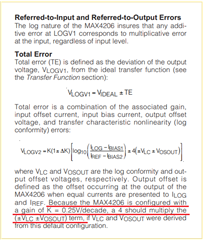
    the datasheet of MAX4206 is showing what I mean:

    MAX4206.pdf

    Kai

  • Hi Kai, Hi Thomas,

    Thanks to you for your quick responses.

    Kai,

    Good idea to go see some datasheet from other manufacturer. The log conformity error given in the MAX4206 datasheet is already in volt that is why they are forced to compensated for it with the factor 4 in the formula. But it help to understand and also confirm Thomas deductions.

    Thomas,

    I am on the same line as you, I suppose this is an old legacy... I just hope the values in the table doesn't take in account this factor of 2, but I don't think so.

    I am considering to check the "this resolved my issue" button unless otherwise stated as I don't think we will be able to get a more precise answer. For now I will calculate the absolute log conformity error in volt without this factor until further notice.

    Best regards,

    Wilfrid

  • Wilfrid,

    Thank you for bringing the OPA112 log conformity question to our attention. We will certainly keep it in mind for any future log amplifier developments and will make sure we have it correctly established in the datasheet.

    Best Regards, Thomas

    Precision Amplifiers Applications Engineering

  • Hi Wilfrid,

    unfortunately, my time is very limited so I cannot fully analyze what thoughts and considerations led to this formula. From my feel there's something wrong with the whole formula. It seems to me that the formula was taken out of a context which was making more sense. And I think that there are some brackets missing...

    In the datasheet of LOG100 a book is mentioned to what all this seems to refer to:

    (Unfortunately, I cannot post a picture right here :-()

    Copying and posting from the mentioned datasheet gives:

    "Refer to: Yu Jen Wong and William E. Ott, “Function
    Circuits: Design & Applications”, McGraw-Hill Book, 1976"

    I think this book could shine some light on all this :-)

    Keep in mind that there are two sections in such a log amplifier, the log-antilog section with the ultra precise base emitter junctions and a gain stage responsible for the scaling. So it should make a difference for the error budget analysis (log confirmity, offset error, etc.) what scaling is set, not only referring to the log-antilog section but also to the scaling section.

    Kai

  • Hi Kai,

    I noticed the reference to the “Function Circuits: Design & Applications” book when I was going over the LOG100 datasheet the other day. Having been a long-time Burr-Brown employee before TI and the opportunity to work with Yu Jen on a project I still have my pristine copy of the book.

    I poured over Chapter 2, Logarithmic Conversion, looking for the definition and derivation of the log-conformity equation. In Section 2.3, Log Amplifier Specifications and Testing, there are two pages that appear to be most relevant with regard to explaining log conformity, even though they don't quite call it that. Unfortunately, I don't have a scanner at home from where I am working so I attempted to take photos of pages 66 and 67 with my phone. Hopefully, they are viewable.

    Section 2.3.1 shown as the second page below (Pg 67) states, "Once A and IREF have been set, the accuracy specification puts an upper limit on the amount of allowable deviation of the output voltage from the ideal log response. . . " The section goes on to establish the output error voltage ϵO.The term A in the error equation is from the previous Pg 65, and is seen in the output voltage equation (not to be confused with the output error voltage ϵO):

     eO = -A log10 i1 / IREF

    Therefore, the A term as seen in the LOG112 datasheet Eq. 12, would represent a scale or gain factor.

    VLOGOUT = 0.5 LOG (I1 / I2)

    Section 2.3.1 provides an equation for the output error term ϵO:

    ϵO = A log (1 + ∆i1 / i1)

    From this equation which describes the deviation from the ideal log response I do not find the "2" factor that is found in the LOG112 

    linearity error equation 7, expressed in volts over m decades as: VLOGOUT (NONLIN) = 0.5V/dec • 2NmV

    So maybe, unless I am still missing some point, I do not think the 2x factor should be included.

    Regards, Thomas

    Precision Amplifiers Applications Engineering

  • Hi Thomas,

    thank you for taking the time and effort to copy the book pages Relaxed

    After studying these book pages and all the datasheets on Burr-Brown's logarithmic amplifiers I could get into my fingers the last days I'm convinced now that you are fully right and that there's no plausible explanation for the "2" factor appearing in the formulas. The correct "log conformity error" voltage should be

    VLOGOUT (NONLIN) = K x N x m

    Hi Wilfrid,

    The log conformity error given in the MAX4206 datasheet is already in volt that is why they are forced to compensated for it with the factor 4 in the formula.

    Yes, correct, you hit the nail on the head Relaxed

    Kai

  • Wilfrid and Kai,

    Thank you for your insights and contributions to the LOG112 conformity error calculation discrepancy discussion. 

    Wilfrid,

    If you could close this e2e inquiry it would be appreciated.

    Regards, Thomas

    Precision Amplifiers Applications Engineering