This thread has been locked.

If you have a related question, please click the "Ask a related question" button in the top right corner. The newly created question will be automatically linked to this question.

OPA2209: OPA2209 delay issue for current sense application

Part Number: OPA2209
Other Parts Discussed in Thread: OPA209, TS321, OPA2197, TINA-TI

Hi Support team 

My customer adopted OPA2209 as the current sense, hope the delay can be as small as possible. Please help to see if there is any value that can be adjusted
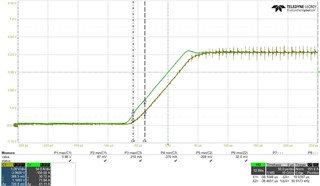
CH4 actual current, CH1: IOUT
  • Hi Red,

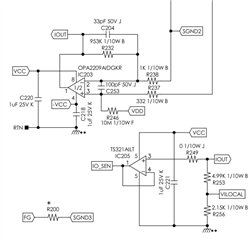
    the gain of G = 953k / 1k is way too high for allowing a fast settling. Also, R232 and C204 form a time constant of 31.4µs. I think this huge time constant is the major cause for your delay.

    Also, remove C253. It will erode the phase margin and decrease stability.

    If you need such a high gain, you should follow an approach using two OPAmps in a row and evenly distributing the gain onto the both. Also, reduce the time constants in the feedback loop by using low ohmic feedback resistors.

    Kai 

  • Hi Red,

    All of Kai's points regarding the circuit's response time are spot on and should be followed. And indeed, I would recommend splitting the high gain up evenly among two amplifier stages. 

    It is interesting that the design sets a high gain requirement for IC203, an OPA2209, followed by IC205 a TS321 connected as a unity-gain buffer. The TS321 has much lower gain bandwidth than the OPA2209. Possibly, IC205 could be replaced with an OPA209 and the stage gain increased from +1 V/V, to +30.9 V/V. The gain of IC203 then would be decreased to +30.9 V/V so that the overall gain of the two stages remains at 953 V/V. Another op amp with similar bandwidth and speed to the OPA209 could be considered for IC205.

    Regards, Thomas

    Precision Amplifiers Applications Engineering

  • Hi Thomas, Kai, 

    Thanks for your help 

    Do you have any data or waveform compare single OPA with dual OPA approach??

    And other question is does OPA2197 have better transient performance? We saw OPA2197 have better offset and slew rate in spec


    Part number

    offset

    GBW / SR

    OPA2197

    +/- 25uV(typ); +/-100uV(max)

    10MHz/ 14V/us

    OPA2209

    +/- 35uV(typ); +/-150uV(max)

    18MHz/ 6.4V/us

  • Hi Red,

    why not running a TINA-TI simulation?

    Kai

  • Hi Red,

    We don't have the full details of the customer's current sense circuits so I put together a TINA simulation circuit based on some guesses. The circuit compares the transient response of the OPA2209 and the OPA2197. The circuit has been designed so each stage has a gain of 30.9 V/V and the resistors have been scaled down by 10x, per Kai's recommendation. The capacitors have been removed to eliminate any delay they might contribute.

    This comparison provides some idea how the OPA2209 and OPA2197 perform with a fast step current change across the sense resistor resulting in a 5 V change at the second stage output. The TINA circuit could be modified to be more inline with the customer's circuit needs.

    The transient simulation of the two-stage op amp amplifiers shows about a 250 ns time for the OPA2209, and about 600 ns for the OPA2197. Either time is much, much faster than the several hundred microsecond time of the original circuit.

    The TINA file is attached.

    Regards, Thomas

    Precision Amplifiers Applications Engineering

    OPA209_OPA197_CurShnt_01.TSC