This thread has been locked.

If you have a related question, please click the "Ask a related question" button in the top right corner. The newly created question will be automatically linked to this question.

LMK04803: Automatic on "8.3.9.3.2 Methods of Generating SYNC"

Part Number: LMK04803

Hi all

Would you mind if we ask LMK04803?

<Question1>
Our customer would like to configure all outputs with sync.
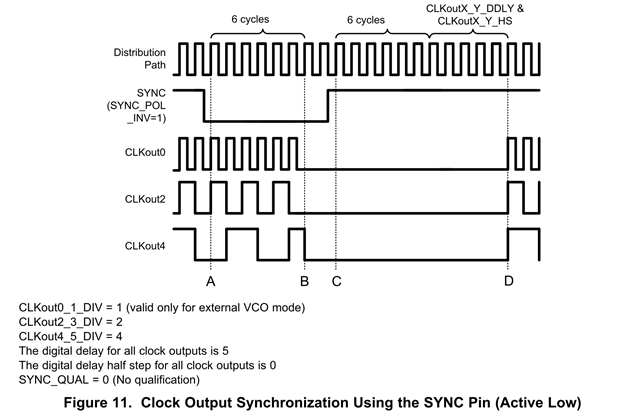
Using Automatic on "8.3.9.3.2 Methods of Generating SYNC", is it possible to configure all outputs with sync like as Figure.11?


<Question2>
When the customer uses Automatic on "8.3.9.3.2 Methods of Generating SYNC", should they use SYNC pin(6pin)?
As the background of this question, in case of Automatic, using register setting, we could not judge whether PLL2_N generates sync event or not.

<Question3>
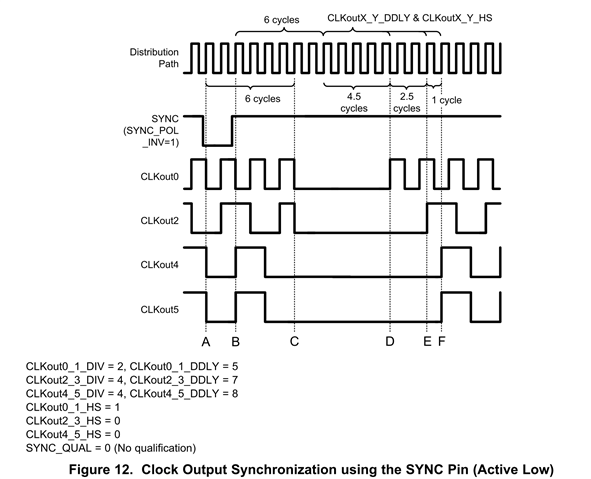
Using Automatic mode with R0-R5 delay setting, is it possible to delay applicable outputs?
The customer assumes like as Figure.12 .

Kind regards,

Hirotaka Matsumoto


  • Hello Matsumoto-san,

    1. All outputs can be configured in this manner. Note that outputs in the same channel (e.g. CLKout0 and CLKout1) which share the same divider must also share the same digital delay.
    2. Writing to PLL2_N generates a SYNC event whenever using the internal VCO. The SYNC pin is not required for any of the automatic SYNC methods.
    3. Yes, it should be possible to use automatic methods while still setting R0-R5 delays. Any of the methods below will work:
      1. If SYNC_EN_AUTO=1, writing to any of [R0, R1, R2, R3, R4, R5] will trigger a SYNC event. Typically the easiest thing to do, to prevent unneeded SYNC events, is to configure digital delays in R0-R5 first, then set SYNC_EN_AUTO=1, and write to R0.
      2. Writing to PLL2_N generates a SYNC event whenever using the internal VCO. The digital delays could be established beforehand, then the PLL will naturally SYNC dividers when PLL2_N is written during register programming.
      3. Otherwise, setting SYNC_PLL1_DLD or SYNC_PLL2_DLD will automatically trigger a SYNC event on PLL1 lock or PLL2 lock respectively. This ensures the delays for the PLL are established every time the PLL locks, without needing to write any other register settings.

    Regards,

    Derek Payne