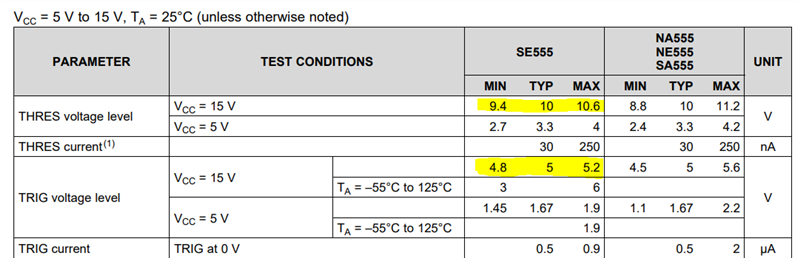
Part Number: SE555
Hi E2E
I am using SE555 in Astable operation for generating a PWM signal of ~38kHz.I have chosen the resistors RA RBand capacitor C as per the formula given in the datasheet under 8.3.2 A-stable Operation.
Attaching that datasheet formula snippet for your reference.
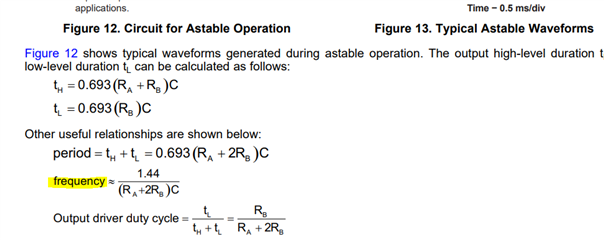
After calculation, I have chosen the
RA = 1.1kΩ,RA = 1.3kΩ,C = 10nF
As per the calculations Frequency F= 38.9kHz and Duty Cycle D= 0.64%
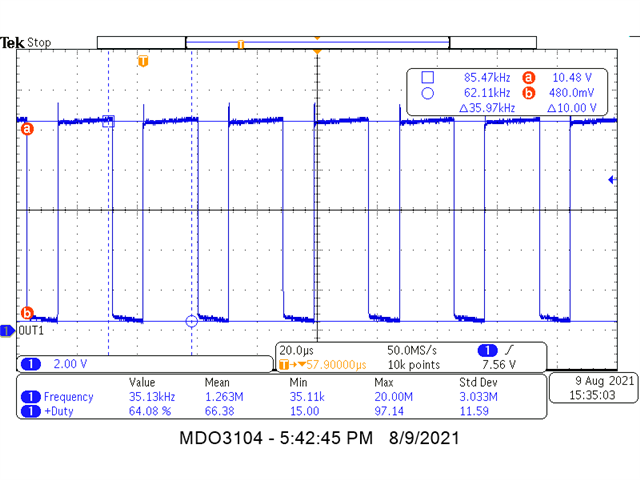
I have tested the circuit with the above Resistors of ±1% Tolerance and C0G Capacitor ±1% Tolerance and measured Frequency F= 35.1kHz and Duty Cycle D= 0.64 %
Attaching the capture for your reference
Later we have updated the passives to RA = 1kΩ,RA = 1.2kΩ,C = 10nF
As per the calculations Frequency F= 42.3kHz and Duty Cycle D= 0.65%
I have tested the circuit with the above Resistors of ±1% Tolerance and C0G Capacitor ±1% Tolerance and measured Frequency F= 37.9kHz and Duty Cycle D= 0.64 %
Attaching the capture for your reference
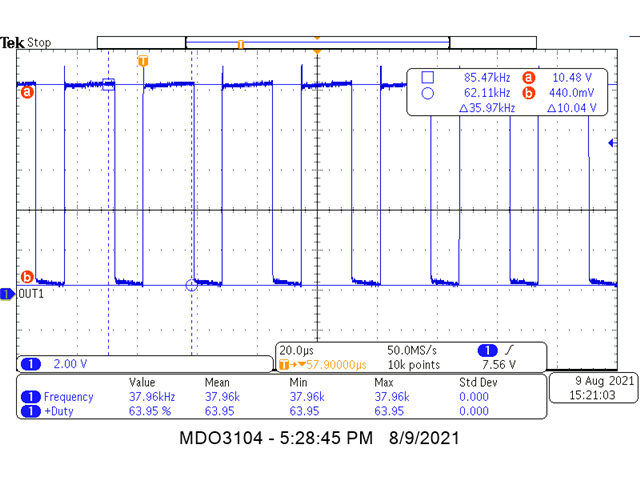
In both of the cases, I have seen a difference of ~4kHz, and this is more than ~10% difference on measured and calculated frequency. Can you please help me out why I am seeing this difference?
BR
Chaitanya