Hello,
How much is the isolation between Cha-A and Ch-B in LMX2592?
Regards,
Naveen.A
This thread has been locked.
If you have a related question, please click the "Ask a related question" button in the top right corner. The newly created question will be automatically linked to this question.
Hello,
How much is the isolation between Cha-A and Ch-B in LMX2592?
Regards,
Naveen.A
Naveen,
I just realized I left you hanging without an answer for over a month, I am terribly sorry about that... I have the raw data that I collected, but not the post-processed data that summarized the results well (we had a break-in shortly after our facility move, my computer was stolen, and I believe the post-processed file was on that computer...). For now I'll give you the raw data, and I'll work on post-processing to give a more clear picture of the results tomorrow.
I took data at various VCO frequencies, channel divide ratios, channel power settings, and with channel A/B powered on or powered off, with the intent of capturing variation between VCOs, channel divides, or buffer drive strength (and corresponding impact on power rails, if any). I then recorded the power of feedthrough/crosstalk spurs at the frequency given by VCO/CHDIV. The measurements for output power are in absolute dBm, and the column definitions are in the format X_Y_Z where X=the measured channel, Y=the output state on/off of channel A, and Z=the output state on/off of channel B.
https://e2e.ti.com/cfs-file/__key/communityserver-discussions-components-files/48/LMX2592_5F00_isolation.tsv
More to come tomorrow.
Regards,
Derek Payne
Naveen,
Once again, apologies for the delay - getting the time to post-process the data took longer than expected.
First, I'll point out that all data is taken at 25°C and 3.3V supply on one EVM. I used the default termination values for RFoutA and RFoutB, so 50Ω pull-up to VCC on RFoutA and inductive pull-up + resistive pad on RFoutB.
There are really two major categories of crosstalk to consider: direct VCO/multiplier use, and divider use.


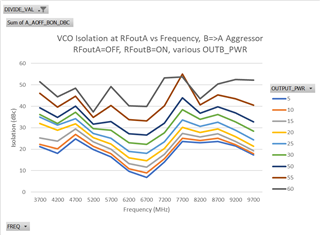
For VCO usage, measuring resistive-pullup RFoutA as the victim with inductive-pullup RFoutB as the aggressor, the cross-talk feedthrough of the VCO is significantly worse at lower OUTB_PWR values. Meanwhile, measuring inductive-pullup RFoutB as the victim with resistive-pullup RFoutA as the aggressor, the trend is reversed, and lower OUTA_PWR values improve isolation. I'm not totally sure why this is the case. I note that at higher frequencies, isolation at RFoutB overall degrades noticeably, with the best case RFoutB isolation value comparable to the worst-case RFoutA isolation value. I suspect this a function of the termination differences. It also seems there is some kind of resonance at 6700MHz - I have checked this data again and confirmed these results are real. I suspect this is an interaction between the inductive pull-up and crosstalk coupled through the supply.


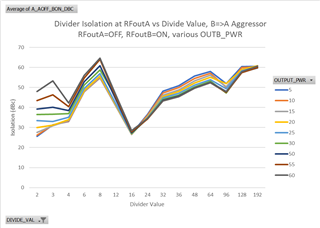
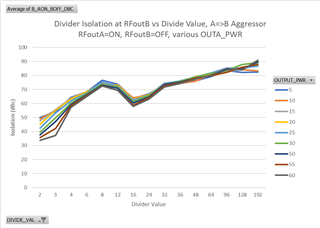
For divider usage, RFoutA isolation with resistive pullups is overall worse than for RFoutB isolation with inductive pull-ups, but in general both are modest at worst. RFoutA and RFoutB both exhibit a noticeable dip in isolation around divide-by-16, which I believe is a function of the divider architecture. I used the datasheet recommended combination of divider settings to realize each divide value, so it's possible that the datasheet recommendation is uniquely poor for divide-by-16 (and perhaps divide-by-12 and divide-by-24); or there may just be something uniquely poor about this divide value in general. As the divide value goes up (and the frequency goes down) the isolation improves to the limit of the measuring equipment for isolation at RFoutB measurements, and still remains modest at around 50-60dBc for RFoutA measurements.


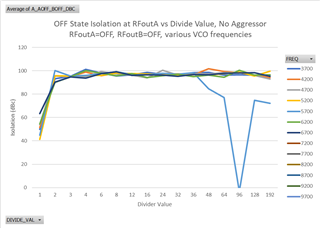
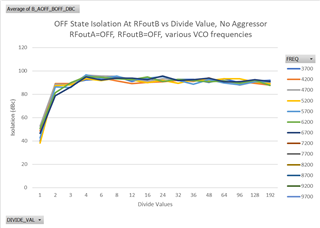
Off-state isolation for both outputs measures the noise floor of the equipment as long as the divider is active, so around 100dBc. For the VCO or multiplier case, isolation is between 40-50dBc on average. The left plot reveals that something went wrong measuring 5700MHz data at divide-by-96, and it may have affected other values; I suspect the VCO lock may have been disrupted, the wrong frequency was measured on the spectrum analyzer, or there was some error due to other reasons (maybe spectrum analyzer decided to calibrate then?). I have no reason to believe there is any degradation in isolation performance at 5700MHz VCO and higher divide values.
From the spreadsheet data, I see about ±1dB difference max in output power across frequency if the other channel is enabled or disabled at the same frequency. I don't think this needs a chart to describe in detail.
A final thing that didn't make it into the data, but which I checked out of curiosity after some thought: when using the output in divider mode, there is still some VCO feedthrough at about -35dBc (± maybe 5dB depending on VCO frequency, worse at higher frequency, better at lower). I believe this is coming from the capacitive coupling across the output mux - final stage mux cannot completely isolate the VCO signal while running. I do note that when both outputs are off, the VCO isolation is slightly better at around -40dBc average (± maybe 5dB depending on VCO frequency, worse at higher frequency, better at lower frequency). I don't have a lot of data points for this (tested at three frequencies to get a feel for it) so I will forego a plot here, just a caution that this effect exists.
My post-processed data is attached below.
LMX2592 isolation post-processed.xlsx
Regards,
Derek Payne