


Part Number: LMC555
Hi Experts,
Good day. Seeking your assistance on this query about propagation delay:
Regarding LMC555CN/NOPB and LMC555CM/NOPB, I would like to know the propagation delay from Reset falling below 1.1V to Out beginning to fall (I can add the 15ns fall time myself).
It is not stated in the datasheet I have: LMC555, datasheet version: SNAS558K –FEBRUARY 2000–REVISED JANUARY 2015. I have not found any information online or in TI e2e posts. The [FAQ] How do I design monostable timer circuits using LMC555, TLC555, LM555, NA555, NE555, SA555, or SE555? says the following in the RESET input effect on mono stable timer section: "When the reset input goes low, the output will go low immediately."
Besides being a meaningless non-numerical value that cannot be used in timing calculations, when we look at the simplified schematic in the datasheet, this is clearly not so:
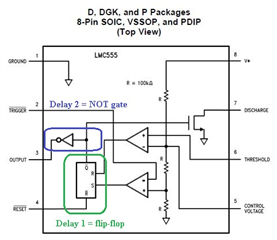
We have the propagation delay of the FF and the propagation delay of the NOT gate. As this part must be a different technology to CD4000 parts, I guess (and hope) that it is not 250 - 500 ns per stage, but more like the 100ns propagation delay of Trigger to Out.
However, guessing is not appropriate for the circuit I wish to make (a dreary, little, pathetic, hobbyist, home-use capacitance meter). I am doing my various preliminary timing calculations of the various "IN to OUT" paths around the circuit (based on the assorted components' used datasheets specs, and at times have to work from common sense extrapolations if need be, e.g. NMOS datasheet specs at 20V, 750mA for my ~5V, 5mA circuit block it drives...) but can't do the calculation for how long it would take from Reset being pulled low to Out going low if there is no number anywhere to work from.
I would be very grateful for either "minimum-typical-maximum" test data results for this part or even extrapolated approximations from other parts using the same technology process(es), I assume the FF and NOT gate are possibly standard blocks used in other ICs based on the technology/fabrication process, even.
I'd be happy with any numerical value for this parameter that I can punch in to the delay calculations I need to do, a numerical value that is either factually accurate or is an informed guess by yourselves.
The circuit will be powered by 5V DC, if that matters.
Thanks for your support.
Regards,
Archie A.
