This thread has been locked.

If you have a related question, please click the "Ask a related question" button in the top right corner. The newly created question will be automatically linked to this question.

LMK04828: Can buffer output optimize phase noise?

Part Number: LMK04828

Hi Team

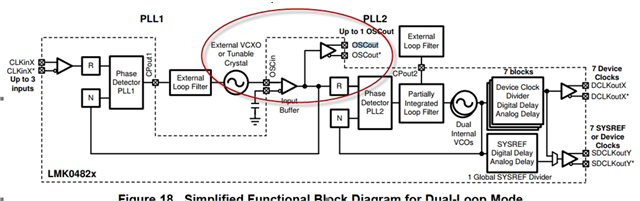
Show as the following picture, customer evaluates two kind of VCXO (better performance: Crystek, worse performance: EPSON )through PLL1. and using OSCout as the output of VCXO.

We believe OSCout is only the buffered out of VCXO, and superimpose the noise of buffer itself, the OSCout's phase will become worse compared with the output of VCXO.

But actually we see:

1. whatever which kind of VCXO customer using, the OSCout has the similar phase noise performance

1. Buffer will optimize the phase noise of output of VCXO when using EPSON's VCXO which has the worse phase noise performance compared with Crystek.

My question is:

why buffer can optimize the phase noise performance of VCXO, what is the theory of the phenomenon?
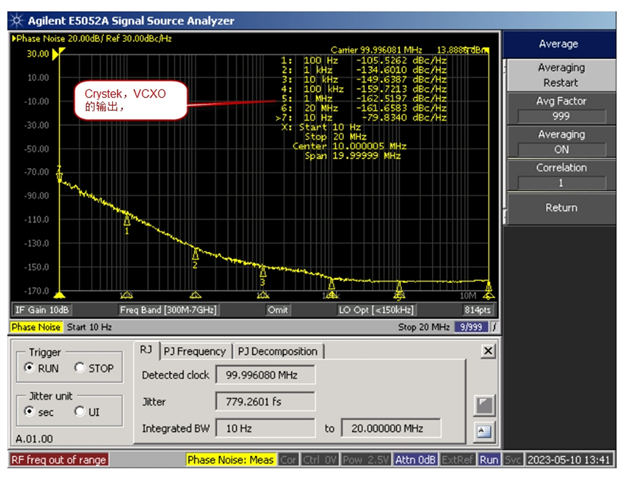
Picture 1: Crystek, VCXO's output
Picture 2: Crystek, OSCout output

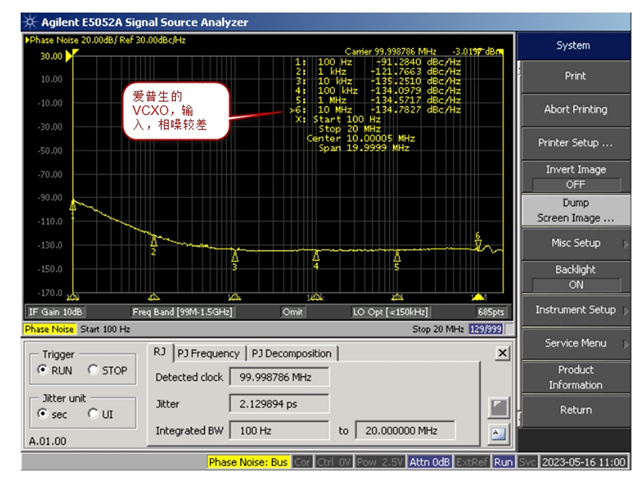
Picture 3: Epson, VCXO‘s output with worse phase noise compared with Crystek
Picture 4: Epson, OSCout output, the phase noise is optimized.

  • Hi Harry,

    Do the VCXO's plots in open loop conditions? If yes, there performance would be without PLL, which show case the actual VCXO performance only.

    Whereas when getting the OSCout plots, those would be with PLL1 locked condition and PLL1 loop BW will optimize the VCXO performance based on loop BW.

    What is the loop BW consider for these tests? The loop BW can be different for individual VCXO for optimized PLL performance.

    Thanks!

    Regards,
    Ajeet Pal

  • Hi Ajeet

    Agree your point. 

    But my question is why looks Buffer can optimize the VCXO's phase noise? Especially for Epson's VCXO, the phase noise be optimized after buffer.

    In my opinion, the buffer can't optimize the phase noise, and opposite, it will increase the noise.

  • Hi Harry,

    The close-in phase noise improvement could be due to the used PLL1 loop BW. If the loop BW is very low (~ in few Hz or less), it will suppress the VCXO effect and follow the PLL 1/f and flat noise performance. The OSCout buffer degrades the noise floor, can see the below plots from datasheet.

    Thanks!

    Regards,

    Ajeet Pal