This thread has been locked.

If you have a related question, please click the "Ask a related question" button in the top right corner. The newly created question will be automatically linked to this question.

LMX2594: about LMX2594 Spuers

Part Number: LMX2594


Hello, TI!

I am currently using the PLLattinnum sim tool to predict the spurious behavior of LMX2594. Through this tool, we can know that there are the following types of spurious behavior:

1. fpd_ Pluse

2. fpd_ Leakage

3. IBS

4. Prim factorial

5. Sub freight

6. mash_ Linear

7. mash_ Nolinear

8. fvco% fpd

9. Fvco% osc

10. out% osc

Currently, I can predict most of my spikes through tools, but there are still a few spikes that I don't know how to calculate predictions,

For example:

Prim divergence, I can predict by calculating FPD% Fden using PLLaltinnum sim's prompt that these spurs are even or odd harmonics of this,

however

According to the prompts from PLLaltinnum sim, calculate FPD% Fden for the SUB farctional, but the simulated data does not correspond to the actual simulation data. Why?

Let me give an example. I want to obtain FOUT=4851.1, FPD=200MHZ, OSC=100MHZ,,Fden=1000 as shown in Figure 1

         Figure 1

Through the tool prompt, I can know that Prim factorial=FVCO% Fden=9702.2% 1000=200khz.

The simulation result shows that Prim factorial is 200khz and its higher harmonics, which is correct.( Figure 2

                  Figure 2

Through the tool prompt, I can know that sub factor=FVCO% Fden=9702.2% 1000=200khz,.

However, the simulation result shows that the sub factorial is 100KHZ and its higher harmonics, which is inconsistent with the method calculated by the tool.(Figure 3)

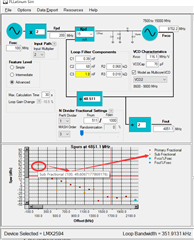
             Figure 3

  I have tried other frequencies, and the results calculated by Prim factorial are consistent with the simulation results. However, the results calculated by sub factorial and the simulation results are not consistent. Please tell me the correct calculation method for sub factorial. I need to predict these spurs through calculation and then use other methods to eliminate or reduce them.
Best wishes.

  • The tool actually says "sub-multiple of Fpd/Fden.   In this case, Fpd = 200 MHz, Fden = 1000, so Fpd/Fden = 200 kHz.   But what is the sub-multiple.  My book at deanbanerjeepll.com discusses this.  In this case, the simplified denominator is 1000, which is divisible by 2, but not 3 and you are using a 3rd order modulator.  So the sub-multiple is 2.  Therefore, the sub-fractional spurs should be at 200 kHz/2 = 100 kHz multiplies.

    Regards,
    Dean

  • Hello!
       Dean, thank you very much for your timely response. I have another question that I would like your help 。

    I need 11.5GHZ~13.5GHZ. During the debugging process of LMX2594, FPD=200MHZ, OSC=100MHZ, and IBS is inevitable due to the exaggeration of several integers. However, we stepped frequency hopping at 10KHZ and found that many frequency points would have fractional spurious noise. I tried to reduce the amplitude of some spurious noise by modifying the PLL loop bandwidth or reducing Icp, which can worsen phase noise. Is there any other way to solve these bugs!

    Regards,
    sea

  • Hello!
    Dean, in your reply, you mentioned your book at deanbanerjeepl.com. I went in and looked at it, but there are many types. Could you please tell me which article specifically mentioned this sub multiple

  • Chapter 21, Delta Sigma fractional spurs, mentions these spurs.

    For these spurs, if you have 10 kHz channel spacing and Fpd=200 MHz, you will see strong spur energy at frequencies like  11599.99, 11600.01,11799.99,11800.01,11999.99, 12000.01, ... and channels that are 10 kHz offset from multiplies of 200 kHz.

    Spurs are a reality of fractional PLLs, so you will see them..  There is no substitute for trial and error and there are limits to what you can do, but can try some things like using the programmable input multiplier to shift the phase detector frequency and tinkering with the MASH_ORDER.

    Regards,
    Dean

  • Hello!
       DEAN, I saw your book 'PLL Performance, Simulation, and Design 6th Edition', which provides a detailed introduction to PLL performance and Spurs. Your response was very useful to me, and thank you very much!

       Regards
     sea

  • Hello!
      Dean, I have a suggestion that you can promote your books to make everyone more direct about PLL, and you can also save time researching more things

  • Hi Yihai,

    Dean is on vacation, we will pass your suggestion to him when he is back to the office.

  • Yihai,

    My book is at DeanBanerjeePLL.com

    Right now, you can only get it at Lulu Press

    It should show up in amazon, but it might take 4-8 weeks.

    Regards,
    Dean
