This thread has been locked.

If you have a related question, please click the "Ask a related question" button in the top right corner. The newly created question will be automatically linked to this question.

LMX2595: Difference in phase noise values

Part Number: LMX2595


Hi Team,

The customer designed a local oscillator source for phase noise testing using the LMX2595, which was designed with reference to the EVM. With the same configuration word, the phase noise values are different and are more pronounced.

The following video shows 10k moving around 112dBc (poor) and 10k moving above 114 is in good condition. 

Could you help check this case? Thanks.

Best Regards,

Cherry

  • Hi Cherry,

    When doing phase noise measurement, we must use averaging and use higher correlation factor. From the videos, I am not able to tell if there is an issue at all. 

  • Hi Noel,

    Thank you for the support.

    we must use averaging and use higher correlation factor.

    Yes, averaging is being used at test and could you help tell how to set the higher correlation factor?

    Thanks and regards,

    Cherry

  • Hi Cherry,

    I have never use Keysight PXA before, I don't know how to set the correlation factor. 

  • Hi Noel,

    Thanks and there's one more question may need your help:

    The customer needs to divide the power divider into two or three reference signals, and divide the three out to the single LMX2595 reference input. May I know is there a similar reference design available? Will there be any impact between the 3 references? 

    Thanks and regards,

    Cherry

  • Hi Cherry,

    Did you mean, the customer want to split a signal to 3 copies, one of the outputs will be used as the reference clock of LMX2595?

    In this case, we recommend use a clock buffer to fan out a signal. What is the format of the clock signal? 

  • Hi Noel,

    Did you mean, the customer want to split a signal to 3 copies, one of the outputs will be used as the reference clock of LMX2595?

    Yes, and the format of the signal is a clipped sinusoidal signal. With a thermostatic crystal, is there a recommended clock buffer without affecting the phase noise of the LMX2595 output? 

    Also, assuming use a clock buffer, the three signals output by the LMX2595 are mixed. If the phase noise is very close apart, will it worsen? (3dB specific indicator, mixed-frequency signals with similar noise will deteriorate by 3dB)

    Doesn't it affect phase noise if using power? (Mixed-frequency signal correlation, where mixed-frequency signal correlation of similar signals with similar noise is almost non-existent). To summarize, are the signals of the clock drive and the power output both related? 

    Thanks and regards,

    Cherry

  • Hi Cherry,

    what is the frequency of the clipped sine wave clock?

    I don't understand the last two questions, do you have a block diagram?

  • Hi Noel,

    what is the frequency of the clipped sine wave clock?

    The input signal uses a clipped sinusoidal wave of 100MHz. 

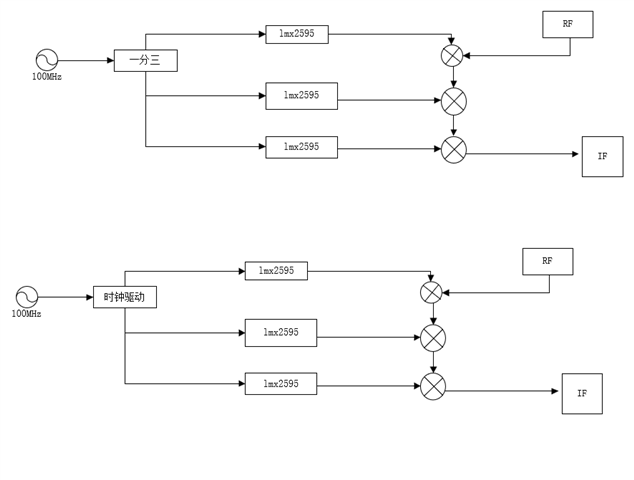
    do you have a block diagram?

    (Chinese in the diagram on the top is "Diving into 3 copies" and the bottom one is "clock drive" )

    Also, assuming use a clock buffer, the three signals output by the LMX2595 are mixed. If the phase noise is very close apart, will it worsen? (3dB specific indicator, mixed-frequency signals with similar noise will deteriorate by 3dB)

    Doesn't it affect phase noise if using power? (Mixed-frequency signal correlation, where mixed-frequency signal correlation of similar signals with similar noise is almost non-existent). To summarize, are the signals of the clock drive and the power output both related? 

    The questions are as above, please let me know if any information needed.

    Thanks and regards,

    Cherry

  • Cherry,

    As averaging is not on, I am not sure if we can be fully confident that this has nothing to do with the measurement.  Also, is the RF signal synchronized with the 100 MHz input reference?  What gives you confidence that this is not related to the measurement?

    In response to your questions::

    1. Also, assuming use a clock buffer, the three signals output by the LMX2595 are mixed. If the phase noise is very close apart, will it worsen? (3dB specific indicator, mixed-frequency signals with similar noise will deteriorate by 3dB)

    The phase noise will add with the highest one dominating.  PNtotal = 10*log(   10^(PN1/10) + 10^(PN2/10 ).   So if both PN1=PN2, then PN3 will be 3 dB higher. 

    2. Doesn't it affect phase noise if using power? (Mixed-frequency signal correlation, where mixed-frequency signal correlation of similar signals with similar noise is almost non-existent). To summarize, are the signals of the clock drive and the power output both related? 

    (1) above assumes the same power level at the output.  But if one signal has higher power, then it will emphasize the signal of that more.

    Some other things to think about:

    a.  If the part is not in integer mode, I would try this and see if it impacts it.  I do not think it will impact your noise issue, but it is an easy check to do.

    b.  On the input, you are sharing three synthesizers with the same input reference.  I do wonder if there is some kind of interaction between these.  Is it possible to power down some of hte other LMX2595's and just look at one of them and see if the noise wanders.?

    Regards,
    Dean