This thread has been locked.

If you have a related question, please click the "Ask a related question" button in the top right corner. The newly created question will be automatically linked to this question.

NE555: astable oscillator

Part Number: NE555

Tool/software:

Hi Experts,

Good day! I am posting on behalf of the customer

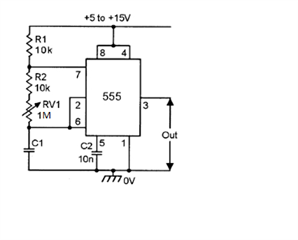
I'm working on a capacitance measurement using the NE555. The capacitor C1 determines the output frequency in this setup. C1 is approx 1nF. This all worked well, but now I'm having no signal output anymore. Resistance measured over the foil cap C1 is around 50-100k (it might have become a bit humid) meaning its not an ideal cap, however can that be related to the fact it doesn't oscillate anymore? My C-meter can still measure the capacitance though.
Thank you in advance. 

Regards,

Jonathan

  • Hi Jonathan,

    Did the customer try a different device to see if this particular part has failed? Additionally, could you provide voltage measurements at each pin or a scope capture of the output?

    Best Regards,

    Alex Curtis

  • Hi Alex,

    Thank you for your support. Sorry for the delay.

    For some unclear reason, the board appears to work again.


    Do you know if measuring a capacitive change using this circuit is a 'robust' way of measuring or will it be better to measure the phase difference between I-U to capture the imaginary part as well?

    Any elaboration from your experiences on this topic would be appreciated.

    Regards,

    Jonathan

  • Hi Jonathan,

    I'm glad the board is working. I'm used to hearing about boards breaking for unknown reasons so hearing the opposite happened is a nice change Slight smile

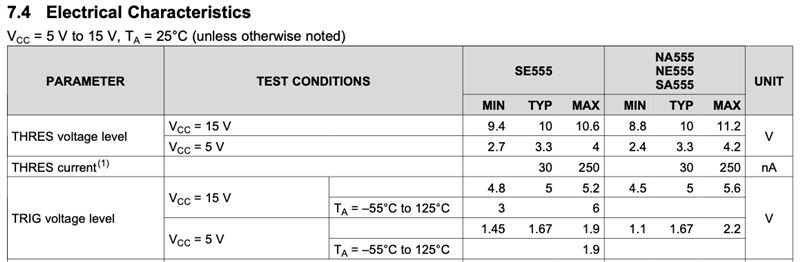
    One thing to keep in mind is that the trigger and threshold levels can vary from part to part and may not be exactly 1/3*VCC and 2/3*VCC, as you can see in table 7.4 of the NE555 data sheet.


    For the NE555 at 5V, the threshold voltage can vary from -27.9% to +26.1% and the trigger voltage can vary from -34.1% to +31.7% of the ideal value.

    Additionally, its worth mentioning that larger capacitors will be easier to measure accurately given that board parasitics will be less impactful on the timing of the output and 555 timers tend to behave more predictably at lower operating frequencies.

    Best Regards,

    Alex Curtis

  • Hi Alex,

    Appreciate your support a lot. 

    Regards,

    Jonathan