This thread has been locked.

If you have a related question, please click the "Ask a related question" button in the top right corner. The newly created question will be automatically linked to this question.

LMX2595EVM: Manual Ramping Pulse Count

Part Number: LMX2595EVM

I am performing manual ramping, from 480 MHz to 700 MHz and its equivalent fvco is 7860 MHz and 11200 MHz respectively. and trying to ramp with step size of 1 MHz.
Below are the calculations made as per TICs pro software
channel divider 16 
Ramp Input Clock  0  2684355 
Ramp Input Clock 1 1071057469
Ramp Limit high 590558003.2
Ramp Limit Low 8589934591.

My doubt is that how do I calculate the number of ramp clock pulses needed  here ? 
If I use
ramp pulse count = (fvc stop frequnecy - fvco start frequency)/step size 
I observed that its just ramping from 485MHz to 521MHz, even though we are sending 3520 pulse

pulse count = (11200-7680)/1
                    = 3520 pulses 

Could you please explain why is this happening ?
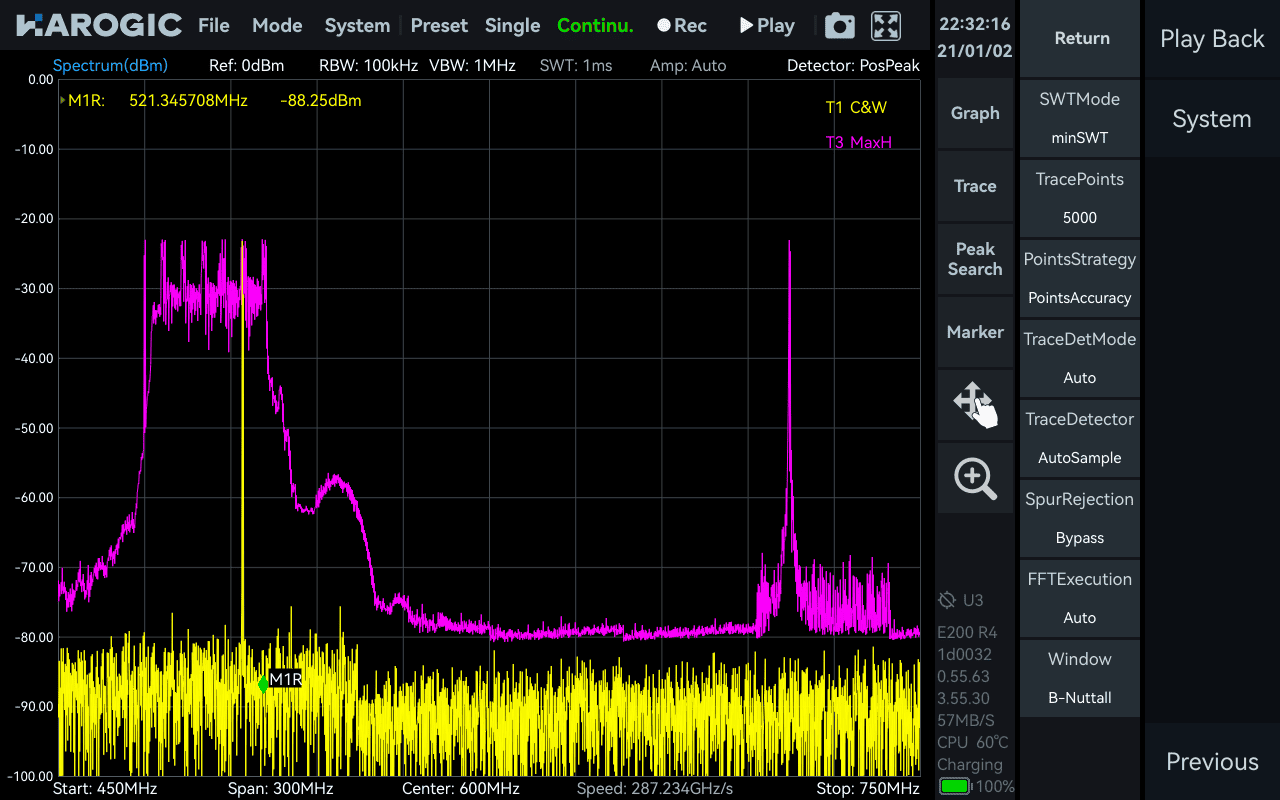
ManualRamping.png

but if I send double (3520*2) pulses I get full range (480 to 700MHz).
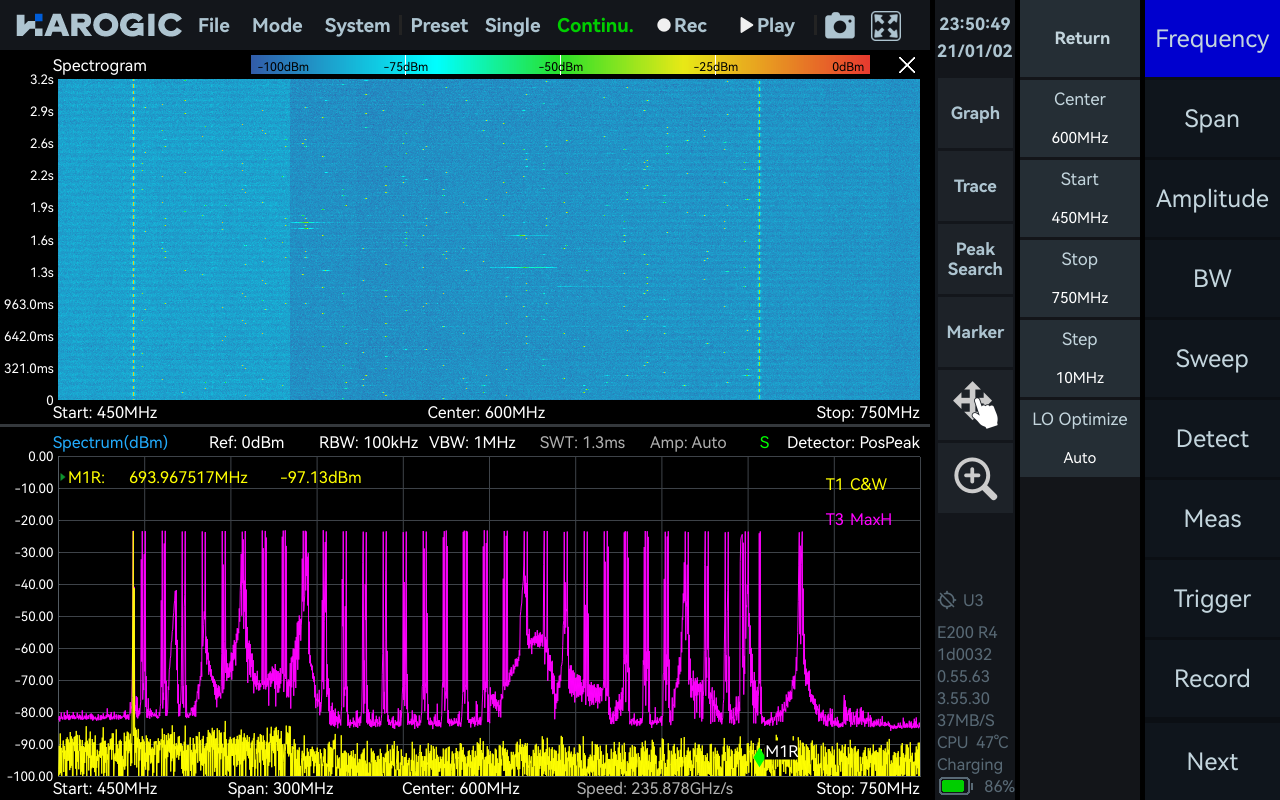
 

20210102_235049.png20210102_235035.png

  • Hi There,

    If the 1MHz step size is at VCO frequency and the ramp clock frequency is low (e.g. 10kHz), then 3520 ramp clocks are enough. 

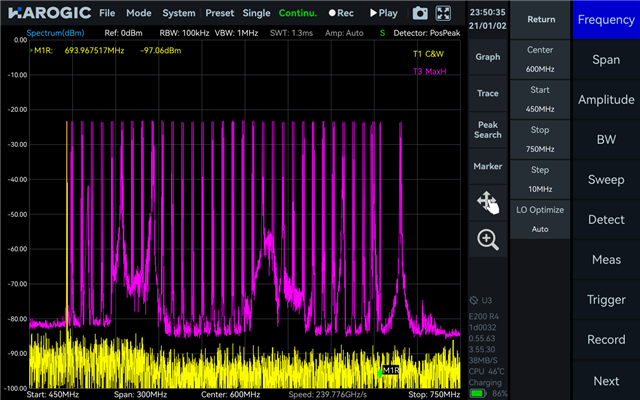
    Please note, there are multiple VCO calculations during the whole ramp period. Calibration may take more than 20µs, during this time interval, ramp clock is ignored. For example, if your ramp clock frequency is 1MHz, assume the calibration takes 10µs, 10 ramp clocks will be ignored during calibration. As a result, you need more ramp clocks than the theoretical number. 

  • Thank you for the response Noel Fung,

    I have set my ramp clock frequency to 200 kHz (time period of 5 µs). Since the calibration time can take up to <20 µs, does this mean that the ramping is not actually occurring at the expected speed of 5 µs per frequency step/lock?

    For example, when manually ramping from 480 MHz to 700 MHz (FVCO: 7680 MHz to 11200 MHz) with a 1 MHz step size, I send 3520 ramp clock pulses. The theoretical ramp time would therefore be:

    3520 × 5 µs ≈ 17.6 ms

    However, if the device cannot complete the full ramp within those 3520 pulses because some ramp clocks are ignored during VCO calibration, then the effective ramp time becomes longer than the theoretical value.

    Also, since this ramp crosses multiple VCO regions, does the PLL perform additional VCO calibrations during the sweep, thereby increasing the overall ramp duration further? how much time does it take here? 

    Could you please clarify whether the calibration time is effectively added on top of the theoretical ramp duration?

    Additionally, I would also like to understand how automatic ramping achieves the programmed ramp timing. If calibration itself can take longer than one ramp clock period (for example, >20 µs while the ramp clock period is 5 µs), then how is automatic ramping still able to maintain the configured ramp speed?

    Thank you.

  • Hi There,

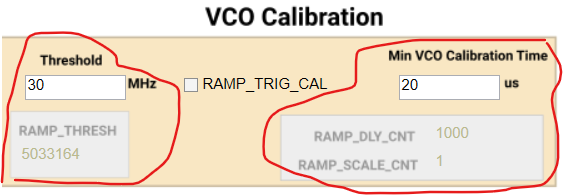
    We can setup a threshold and pause time (for VCO calibration) to make the time taken for calibration more deterministic.

    Whenever the accumulated ramp frequency reach or over the ramp threshold, the device will calibrate automatically. 

    For example, we can make RAMP_THRESH = 30MHz and pause time = 20µs.

    Then there will be 3520 / 30 = about 117 calibrations. Each calibration takes 20µs, the total calibration time is 117 x 20 = 2.34ms. Given ramp time is 17.6ms (for 3520 ramps), the total ramp duration is 2.34 + 17.6 = 19.94ms.

  • Thank you for your response, Noel Fung.

    I have two queries:

    1. In automatic ramping, what determines the step size, and what is the minimum possible step size that I can use?
      I am ramping from 480 MHz to 700MHz with current setting and configurations I am seeing 7MHz of step size. (what parameter decides this step size)


      spectrum Analyzer


    2. Could you please explain step-by-step how to perform automatic ramping from 480 MHz to 700 MHz with full assist using TICS Pro software?


  • Hi There,

    In automatic ramp, the frequency is incremented once every fpd cycle (or 2x fpd cycle when RAMPx_DLY = 1). 

    From "desired duration" and fpd, we know how many ramp (RAMPx_LEN) are required. For example, if fpd = 100MHz and the desired duration is 100µs, then there are 10000 ramps, from the start frequency to the end frequency. Given the number of ramp and the ramp range, we know the step size of each ramp.

    I don't understand your second question, automatic ramping and full assist are two different features of the device.