This thread has been locked.

If you have a related question, please click the "Ask a related question" button in the top right corner. The newly created question will be automatically linked to this question.

LMK04828B - Holdover

Hello,

I have a question about LMK04828B.

[Q]

Do you have some document or presentation about the conditions to enter/exit the holdover for HOLDOVER_PLL1_DET ?

(Please tell me how to choose the parameters, PLL1_WND_SIZE, PLL1_DLD_CNT, HOLDOVER_DLD_CNT, frequency of the PFD1, ...)

  • I understood the conditions and operations to enter/exit the holdover for HOLDOVER_LOS_DET by using the EVM.
  • I can not understand the relationship between the accuracy of PLL1 Locked event and the accuracy of Holdover exit event.

In Tracked CPout1 Holdover mode ,

Reference existed -> Reference lost -> Entered the Holdover function with tracked. ... Looks Good.

Reference existed at the correct frequency -> Reference existed at low frequency than the correct frequency -> Entered and Exited the holdover.

... CPout Voltage did not tracked as a result.

I think this is a configuration issue.

Please show some document or presentation, video, and so on about it.

Best Regards,

Hiroshi Katsunaga 


  • Hi Hiroshi-san,

    Holdover mode is described in detail in section 9.3.7 of the datasheet, please let me know if you find any part confusing.

    Regarding the parameters you mentioned:

    - fPFD1 is a loop parameter, you decide it based on your frequency plan requirement and min/max restrictions of the PFD and dividers. if you have several possible alternatives, we recommend going for higher PFD frequency for better noise performance. but this might not be the optimum, so please use the Clock Design Tool to optimize the PFD frequency.

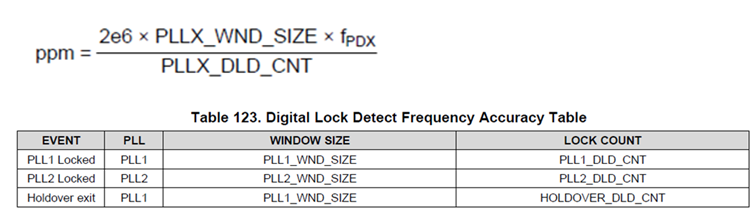
     - The paramters PLL1_WND_SIZE, PLL1_DLD_CNT are controlling how the lock is achieved (from unlock , non holdover state). DLD (Digital Lock Detector) circuit will check that both inputs to the PFD has a dealy less than WND_SIZE, if true, it starts counting number of reference edges equal to DLD_CNT to assert DLD signal. if PFD input signals skew esceeded WND_SIZE for at least one cycle before DLD_CNT is achieved, the process aborts and has to start again to asser lock.

    smaller WND_SIZE means tighter PFD offset is considered for lock. higher DLD_CNT means the input/output has to stable enough to achieve lock. together those two parameters determine how accurate your output will be relative to the input when lock is asserted. this is illustrated in the following relation:

    Tighter ppm error might be required by a communication system with limited error budget for the clock. to guarantee the required accuracy, the system might set higher CNT, and lower WND. note that this is a function of the fPFD.

     - Parameter HOLDOVER_DLD_CNT is the equivalent parameter to PLL1_DLD_CNT, but for aquiring lock from holdover state instead of unlock state. ( i.e. exiting the holdover). same relation applies as above.

    The tradeoff in setting very tight ppm is settling time, which gets longer. and possibility of difficulties achieving the lock if the input signal is modulated or noisy that is preventing the tight ppm to be achieved.

    - Regarding your example: you mentioned that the reference switched to a lower frequency. this is not a typical case, but in that case the HOLDOVER more should stay engaged. the issue you see is holdover exit without recovered correct frequency. I bet this is a configuration issue. please send the .mac file of your configuration.

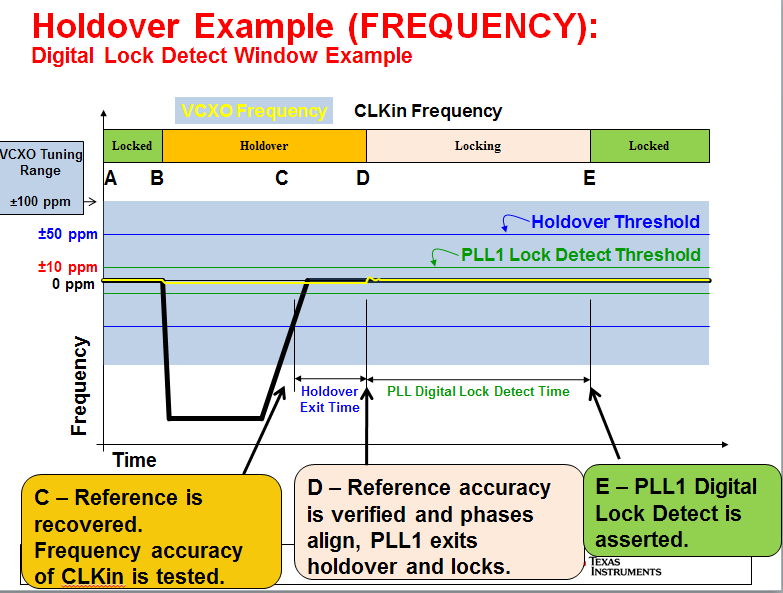
    The following figure shows the criteria of entering and exiting holdover.

  • Hi Ahmed,

    Thank you for your fast response.
    And I'm sorry for my late response.

    I confirmed it in EVM, and I understood all your comments.
    Thank you for your support !

    I have some other questions about LMK04828B.
    I will post about them in the other thread.

    Best Regards,
    Hiroshi Katsunaga