


Other Parts Discussed in Thread: ADC12J4000, LMX2592, LMK04828
Hello,
In my design I need to supply clocking for a JESD204B interface between the ADC12J4000 and a STRATIX V FPGA.
The FPGS requires other clock signals for additional transceiver interfaces.
Moreover, the design incorporates a DAC (NON-JESD) the I need to provide with a sampling clock as well.
We wish to separate between the clock signals of the ADC & DAC and those of the FPGA. This is in order to keep as clean as possible clocks for the ADC and DAC.
So,
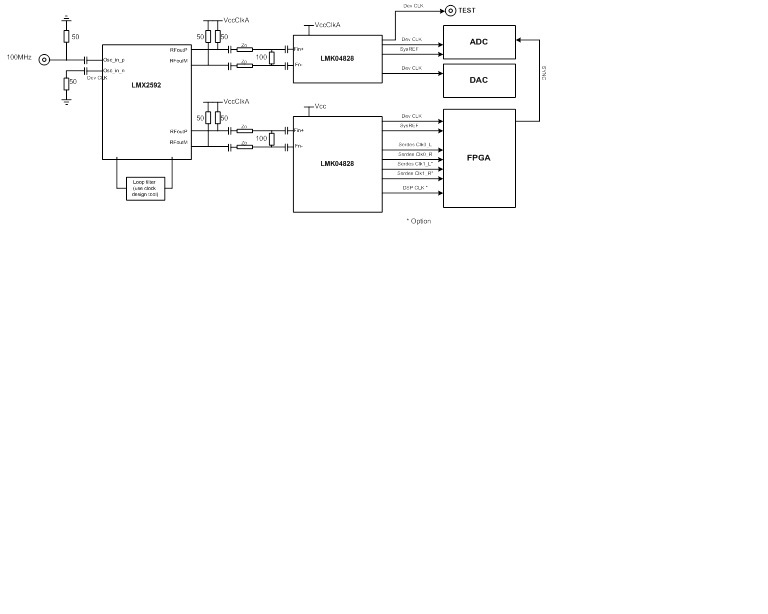
our thought is to use the LMX2592 to produce the sampling clock of 2.7GHz and drive it to 2 separate LMK04828 devices:
- 1 for the DAC & ADC (dev_CLK & SYSREF)
- and 1 for the FPGA (DEV_CLK, SYSREF, and additional clock signals for the transceivers).
Note: I'm using the Fin input of the LMK such that the PLLs are not used in order to allow for a higher frequency
see atached image below:
To my understanding I comply with the JESD clocking requirements:
- DEVCLK & SYSREF of Tx ( ADC) are provided from the same LMK and will be routed together (same trace lengths).
- DEVCLK & SYSREF of Rx (FPGA) are provided from the same LMK and will be routed together (same trace lengths).
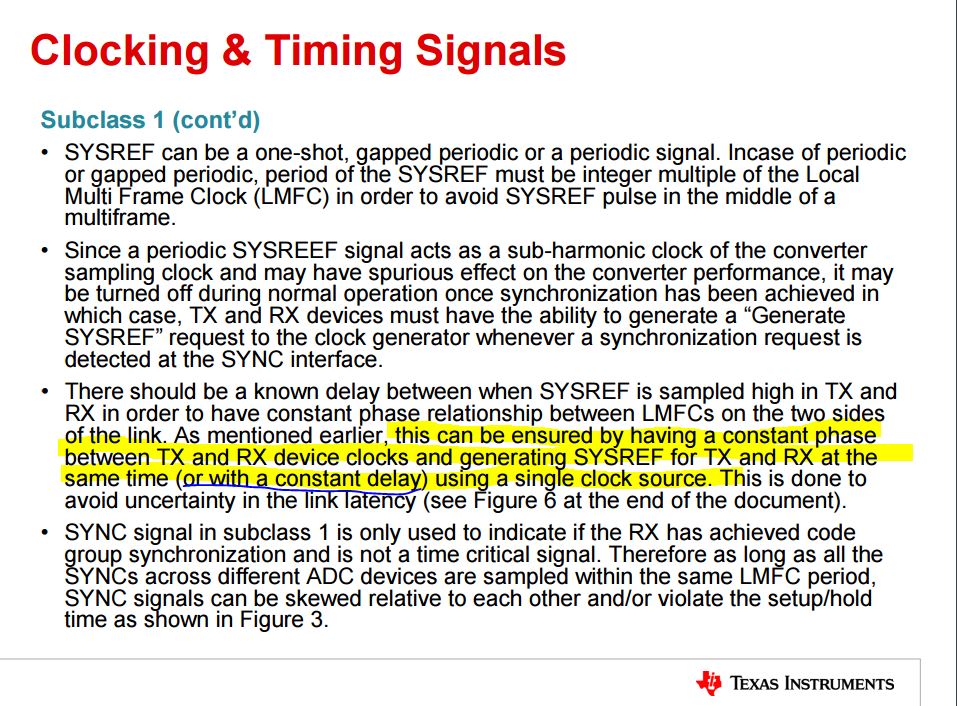
- To my understanding it is OK to have a SYSREF to SYSREF delay. this is based on a TI JESD204 presentation & snau139:
* "The only thing that matters for JESD204B is SYSREF to Device Clock timing for the same device. Not SYSREF to SYSREF"
* need for "generating SYSREF for TX and RX at the same time (or with a constant delay) using a single clock source" [snau139 slide 6] see attached image below:
 .
.
My questions are:
1. is this an adequate solution?
2. Are there any cons compared with the solution that is used in the ADC12J4000 EVM where the ADC DEVCLK is driven from a synthesizer and the ADC SYSREF, FPGA SYSREF & FPGA DEVCLK from the LMK?
3. Are there any issues that I should be concerned about when implementing such a solution?
4. will it make the setup more complicated (will it need additional delay settings in the LMK to make it work for example)?
Best regards,
Itai
