This thread has been locked.

If you have a related question, please click the "Ask a related question" button in the top right corner. The newly created question will be automatically linked to this question.

LMX2594: LMX2594 Near end stray problem

Part Number: LMX2594
Other Parts Discussed in Thread: PLLATINUMSIM-SW, , LMX2592

100M oscillator, the power is 8dBm, the phase frequency is 100M, Have Stray When output near 2571, and 2571 * 2= 5142, 2571 * 3= 7713 has been to dozens of times are not found from the harmonic phase frequency of integer times very close, so I can't understand what is the mechanism that stray from? The feeling is a bit different from ADI and Hittite. How to solve it, which registers will have a greater impact on this stray

  • I am not sure what you mean by "have stray". I am thinking that you are talking about fractional spurs. If so, I encourage you to download the PLLatinum Sim tool at www.ti.com/tool/PLLATINUMSIM-SW, as this tool can simulate fractional spurs.

    For both 2571 and 2x2571, your VCO frequency should be at 10284 MHz and you can do this with a fraction of 21/25. I would recommend the third order modulator for this. For 7713 MHz, this is a VCO frequency of 7713 MHz.

    If this "stray" problem is spurs due to our device, I would expect changing the modulator order (MASH_ORDER) between 2 and 3 should have some impact. If it does not, then it might be suggesting something else on our board.

    Regards,
    Dean
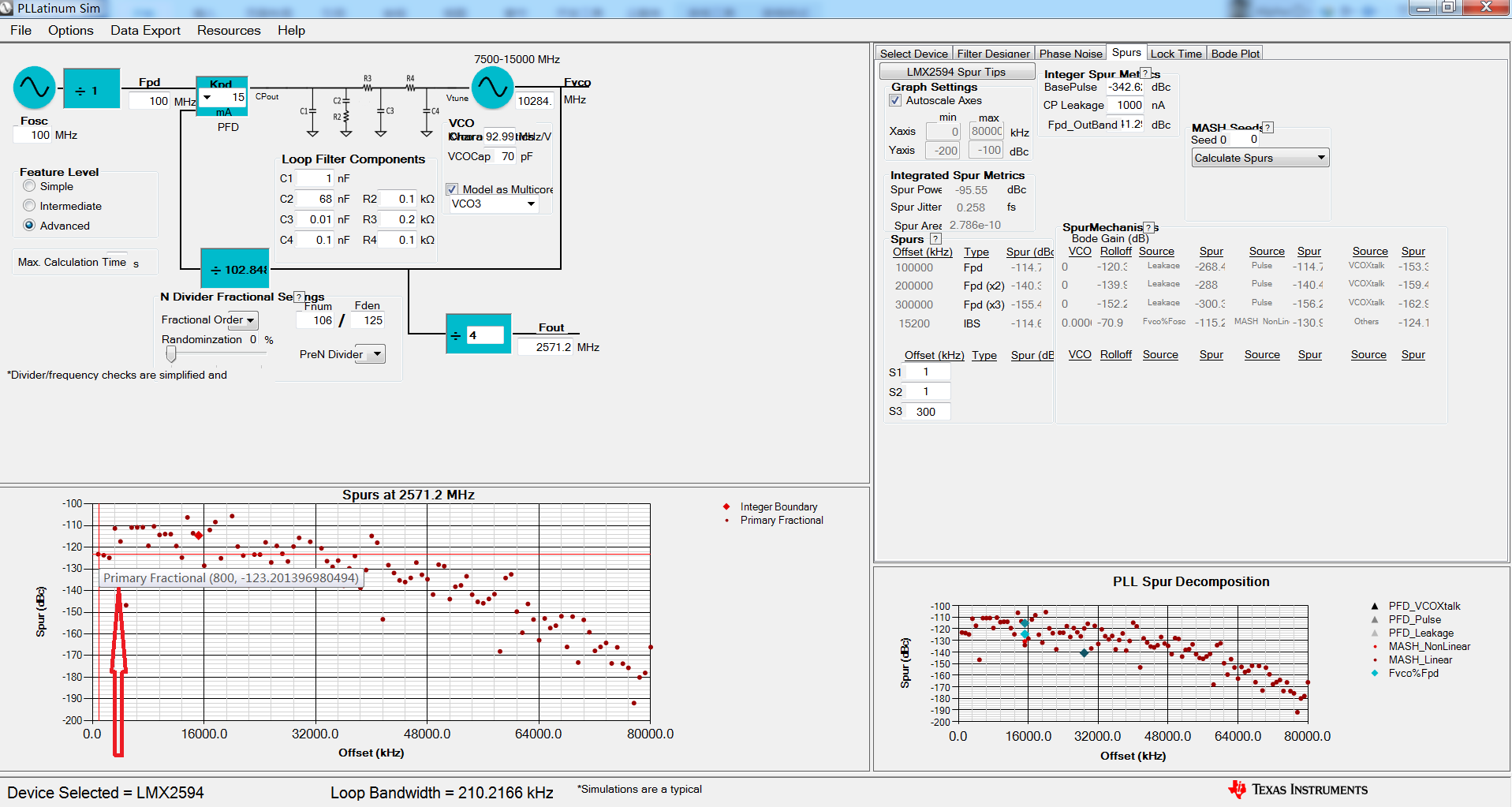
  • 1、First、I used PLLatinum simulation fractional spurs,As the Figure 1 (Figure 2 is a register configuration). LMX2594's fractional spurs Very small,about -123dBc.

    2、Second、Actual test LMX2594. As the Figure,LMX2594's fractional spurs -70dBc,Compared with the simulation, the difference is too large.

    3、Third、I Check LMX2592 datasheet,As the Figure,I find primary fractional spurs Related to fpd/den, I think LMX2592 and LMX2594 internal principles should be the same.So I want to know What factors affect fpd/den. I am very eager to solve this problem,So Please Help me.

  • For PLLatinum Sim, here's a few tips:
    1. If you go to your windows display settings and set display text size to 100% instead of the larger setting I think you have, then the screen will not be distorted.
    2. You can type in "800" into the spur offset box and PLLatinum Sim will analyze the 800 kHz spur.
    3. Understand that spur levels are very hard to predict and have many factors that can influence them. That being said, this one is really far off and I don't know why.

    Here's a couple of things to try:
    1. 3rd order modulator is theoretically about 3 dB lower spur.
    -> as a bonus with 3rd order modulator, PLLatinum Sim suggests seed of 118 could further improve this 800 kHz spur.
    2. 4th order modulator is theoretically worse and our characterization shows this
    -> with 4th order modulator, try seed of 108 for MASH_SEED and see if it improves spur.
    3. Try changing charge pump current to 3 mA. Theoretically this should drastically improve the spur and it probably will, but you might see much less than expected. I suspect that some spur energy is cross-talking around the loop filter and getting to the output. In other words, I suspect that although your 4th order filter filters noise through it, the spur is going around it.
    4. I notice that the capacitor closest to the VCO is only 100 pF. PLLatinum Sim suggests that this should be larger for better VCO noise. With this low 100 pF value, you are likely to see a significant bump in the VCO phase noise in the 200kHz - 1 MHz range. As this spur is also in this range, maybe the spur is impacted too.

    Although the simulation says -123, this does not model crosstalk effects on the board and part. Anything below -90 dBc could easily be degraded by other factors. At 800 kHz, this is a primary fractional spur, but not any of these other types. I would have expected the simulation to be a little closer, which does make me wonder if there is something that is agitating this 800 kHz spur.

    Regards,
    Dean