This thread has been locked.

If you have a related question, please click the "Ask a related question" button in the top right corner. The newly created question will be automatically linked to this question.

LMK04828: Making Dynamic Digital Delay work

Part Number: LMK04828

I have an LMK04828B and I am trying to get dynamic digital delay to work.  At the moment nothing happens, but I think the documentation is a bit confused (and confusing), so hopefully my mistake is simple.

I'm referring to two separate reference manuals:

  • SNAS605AR – MARCH 2013 – REVISED DECEMBER 2015
    This covers the LMK04828 which is my part, but as the instructions don't seem to work, I hunted out the latest revision
  • SNAS703 – APRIL 2017
    This covers the LMK04828-EP which may be subtly incompatible, in particular this manual documents registers DCLKoutX_DDLYd_CNTH and DCLKoutX_DDLYd_CNTL (0x102, 0x10A, ..., 0x132) which are not mentioned in SNAS605AR.

In my configuration I have my VCXO running at 500 MHz (in nested 0-delay dual loop mode, feedback on DCLKout8) and am looking at DCLKout10 relative to my input reference clock.

I have the following configuration for DCLKout10 (I don't think any of the other fields are relevant):

DCLKout10_DIV = 5
DCLKout10_MUX = 3
[0x12E] = 1 (only SDCLKout10_PD set)

After reset and full initialisation I then follow section 9.3.3.3 of SNAS605AR after setting SYNC_EN = 1 and [0x140] = 0 (so all SYSREF units powered on) and SYSREF_CLR = 0:

  1. DCLKout10_DDLY_CNTH = 3
  2. DCLKout10_DDLY_CNTL = 3
  3. (DDLY_PD already clear)
  4. DDLYd10_EN = 1 (all other enables clear)
  5. SYNC_DIS10 (so now [0x1ff] = 0xdf)
  6. SYNC_MODE = 3 (I gather that the assignment of 2 to this register in the following step is a documentation error)
  7. SYSREF_MUX = 2
  8. DDLYd_STEP_CNT = 1

Nothing happens, the phase of DCLKout10 remains unchanged.  What am I missing?

  • Dear Michael,

    Thank you for the detailed description. Your procedure seems fine so we need to look at it more closely. Someone on the team or myself will get back to you in the next 24 hrs with some answer.

    Thank you for your patience.

    Regards, Simon.
  • Ok, that's encouraging.  In case it's helpful, here is a complete transcript of the LMK initialisation sequence from reset (all numbers in hex):

    PLL[000] <= 80
    PLL[100] <= 00
    PLL[101] <= 55
    PLL[103] <= 00
    PLL[104] <= 00
    PLL[105] <= 00
    PLL[106] <= f9
    PLL[107] <= 30
    PLL[108] <= 00
    PLL[109] <= 55
    PLL[10b] <= 00
    PLL[10c] <= 20
    PLL[10d] <= 00
    PLL[10e] <= f0
    PLL[10f] <= 11
    PLL[110] <= 05
    PLL[111] <= 55
    PLL[113] <= 07
    PLL[114] <= 00
    PLL[115] <= 00
    PLL[116] <= 01
    PLL[117] <= 01
    PLL[118] <= 00
    PLL[119] <= 55
    PLL[11b] <= 00
    PLL[11c] <= 00
    PLL[11d] <= 00
    PLL[11e] <= f9
    PLL[11f] <= 01
    PLL[120] <= 05
    PLL[121] <= 55
    PLL[123] <= 00
    PLL[124] <= 00
    PLL[125] <= 00
    PLL[126] <= f1
    PLL[127] <= 00
    PLL[128] <= 05
    PLL[129] <= 55
    PLL[12b] <= 07
    PLL[12c] <= 00
    PLL[12d] <= 00
    PLL[12e] <= 01
    PLL[12f] <= 03
    PLL[130] <= 05
    PLL[131] <= 55
    PLL[133] <= 00
    PLL[134] <= 00
    PLL[135] <= 00
    PLL[136] <= f1
    PLL[137] <= 30
    PLL[138] <= 00
    PLL[139] <= 00
    PLL[13a] <= 0c
    PLL[13b] <= 00
    PLL[13c] <= 00
    PLL[13d] <= 08
    PLL[13e] <= 03
    PLL[13f] <= 0b
    PLL[140] <= 00
    PLL[141] <= 00
    PLL[142] <= 00
    PLL[143] <= 91
    PLL[144] <= 00
    PLL[145] <= 7f
    PLL[146] <= 10
    PLL[147] <= 1b
    PLL[148] <= 02
    PLL[149] <= 42
    PLL[14a] <= 02
    PLL[14b] <= 16
    PLL[14c] <= 00
    PLL[14d] <= 00
    PLL[14e] <= 00
    PLL[14f] <= 7f
    PLL[150] <= 43
    PLL[151] <= 02
    PLL[152] <= 00
    PLL[153] <= 00
    PLL[154] <= 78
    PLL[155] <= 00
    PLL[156] <= 0d
    PLL[157] <= 00
    PLL[158] <= 96
    PLL[159] <= 00
    PLL[15a] <= 0d
    PLL[15b] <= df
    PLL[15c] <= 20
    PLL[15d] <= 00
    PLL[15e] <= 00
    PLL[15f] <= 0b
    PLL[160] <= 00
    PLL[161] <= 3d
    PLL[162] <= 45
    PLL[163] <= 00
    PLL[164] <= 01
    PLL[165] <= 7d
    PLL[171] <= aa
    PLL[172] <= 02
    PLL[17c] <= 15
    PLL[17d] <= 33
    PLL[166] <= 00
    PLL[167] <= 01
    PLL[168] <= 7d
    PLL[169] <= 59
    PLL[16a] <= 20
    PLL[16b] <= 00
    PLL[16c] <= 00
    PLL[16d] <= 00
    PLL[16e] <= 13
    PLL[173] <= 00
    PLL[143] <= 11
    
    >>> step_delay()
    PLL[129] <= 33
    PLL[12e] <= 01
    PLL[139] <= 02
    PLL[141] <= 20
    PLL[143] <= 13
    PLL[144] <= df
    PLL[142] <= 01

    At the >>> prompt above I check the alignment of DCLKout10 against CLKin on the oscilloscope, and then make the final seven assignments to try and step the phase.

  • Ok, so "24 hrs" was a bit optimistic ... but could I please have a response to this inquiry?  As you say, I seem to be following the documentation correctly, so I am at a loss.

  • Hi Michael

    Sorry for the relay in response.

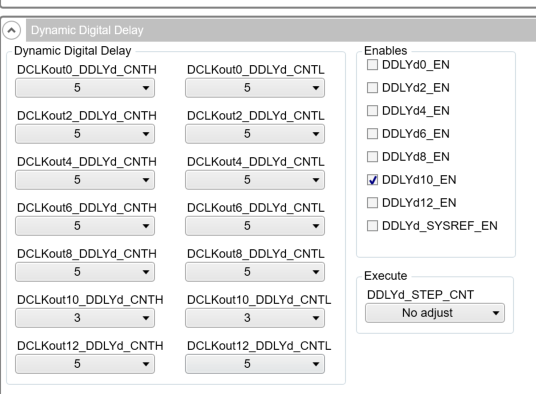
    In the step 1 & 2, please also program 3 to DCLKout10_DDLYd_CNTH & DCLKout10_DDLYd_CNTL. You can find those registers in Dynamic Digital Delay section in the TICSpro as shown below:

    After that you can continue the steps 3-8 and the dynamic digital delays should be working. Let me know if you see any issue,

    Best regards

    Puneet

    “ If this answered your question, please click “This Resolved My Issue” button.

  • Alas, I have already tried this.    These registers are not documented in SNAS605AR, so at first I assumed they were specific to the LMK04828-EP, but I have tried adding them to the procedure with no effect.  Here is the transcript of my updated attempt to step:

    >>> step_delay()
    PLL[129] <= 33
    PLL[12a] <= 33
    PLL[12e] <= 01
    PLL[139] <= 02
    PLL[141] <= 20
    PLL[143] <= 13
    PLL[144] <= df
    PLL[142] <= 01

    As you can see, the only difference is the assignment you suggest.

  • Hello Michael,

    Sorry for your troubles with this feature.  Yes, we need to update the datasheet in regard to this.

    I have reviewed your config and checked in the lab.  I've found that for the dynamic digital delay to work, the CLKin_OVERRIDE must = 0.

    To do dynamic digital delay, you should only have to set for clock X: DCLKoutX_DDLY_PD = 0 & DDLYdX_EN = 1.  The SYNC_DIS_X would not impact dynamic digital delay.  Since you are not in distribution mode, there is no reason to set this bit = 1.

    73,
    Timothy

  • This does seem to work.

    So let me confirm.  The procedure seems to be:

    1. For normal operation ensure CLKin_OVERRIDE = 0 and DCLKoutX_DDLY_PD = 0
    2. All of DCLKoutX_DDLY_CNT{H,L} and DCLKoutX_DDLYd_CNT{H,L} should be set for a single delay step (as described in 9.3.3.2).
    3. Ensure that DDLYdX_EN is set to 1
    4. Write 1 to DDLYd_STEP_CNT

    Some notes:

    • I'm finding that the setting of DCLKoutX_DDLY_PD doesn't seem to make a difference!  Clearly I'll leave it set to 0 for safety.
    • Of course, the disabling effect of CLKin_OVERRIDE is undocumented; I'd set this as I was nervous of automatic clock selection activating unexpectedly.
    • As already remarked, DCLKoutX_DDLYd_CNT{H,L} are undocumented for the LMK04828.
    • The LMK04828-EP documentation (SNAS703) makes a confusing remark on page 28 (section 9.3.3.2): "after a divider sync it is not permitted to change either of these values".  At what point does a "divider SYNC" occur?  I guess this may be a follow up question.
    • The documentation (9.3.3.3) mandates setting SYSREF_MUX = 2 and SYNC_MODE = 3, but it's not clear to me that these play any role.  Indeed, delay stepping seems to occur ok with SYNC_EN = 0.

    What is the status of the documentation for this device?  I listed the documentation I found at the start of this thread.  SNAS703 looks like an update to SNAS605AR, but specifically does not appear to cover the non -EP devices.  I'm not sure though, maybe the only substantive difference between the LMK04828 and the LMK04828-B is the documented oscillator ranges of the VCOs.

    I seem to have two outstanding questions.  Do I need to raise these separately, or as part of this thread?

    1. What is the true minimal Dynamic Digital Delay configuration?  In particular, what do I do with the SYNC infrastructure?
    2. What do I need to do to be 100% confident that my clock outputs are synchronous after startup?  At present I'm not doing anything apart from setting and then resetting SYSREF_CLR, and I seem to be seeing synchronous outputs ... but is this just luck?

  • I forgot to say: Timothy, thank you very much for taking the time to set up and diagnose my problem. I don't think there's any way I would have discovered my error, I'm afraid.