This thread has been locked.

If you have a related question, please click the "Ask a related question" button in the top right corner. The newly created question will be automatically linked to this question.

LMX2581: Phase Noise Optimization

Part Number: LMX2581
Other Parts Discussed in Thread: LMX2541, CODELOADER, USB2ANY, PLLATINUMSIM-SW, LMX2531

Dear Sir,

               Thanks a lot for earlier guidance for LMX2581 locking issues . It is showing lock on all frequency I made changes in my PCB Vbias VCo Cap  chaged to 2.2 uF  from 3.3 uF and VrerVCO cap changed to 1uF from 2.2 uF.

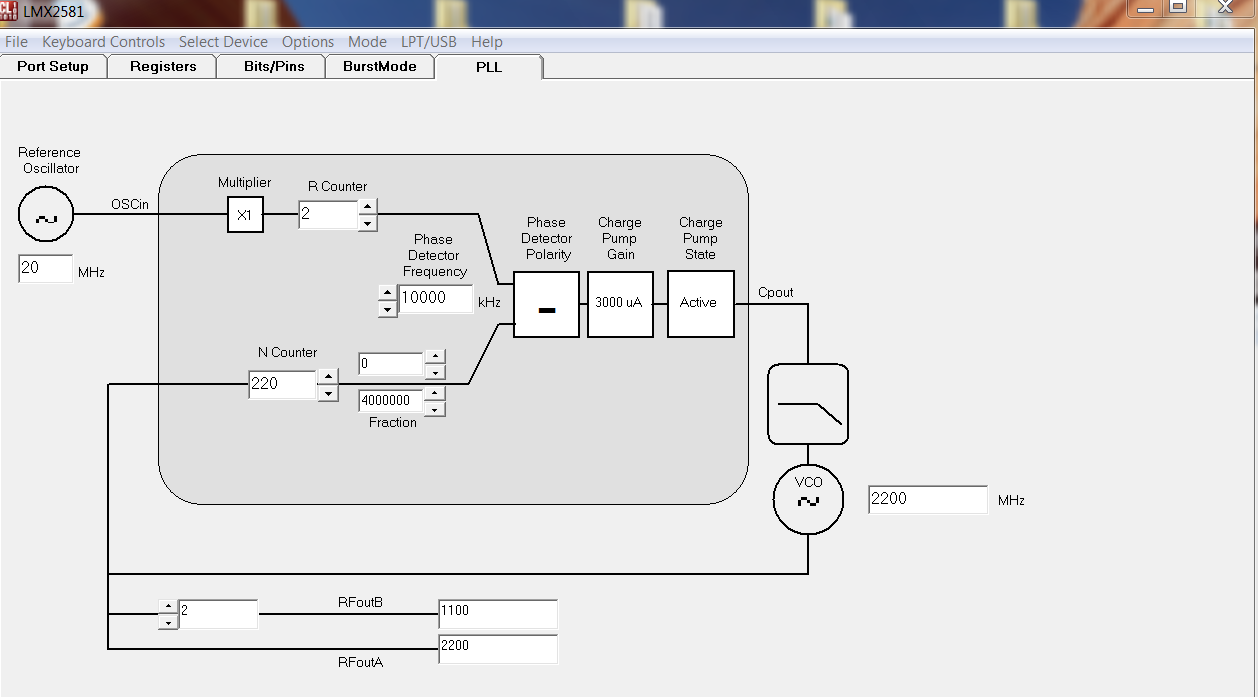
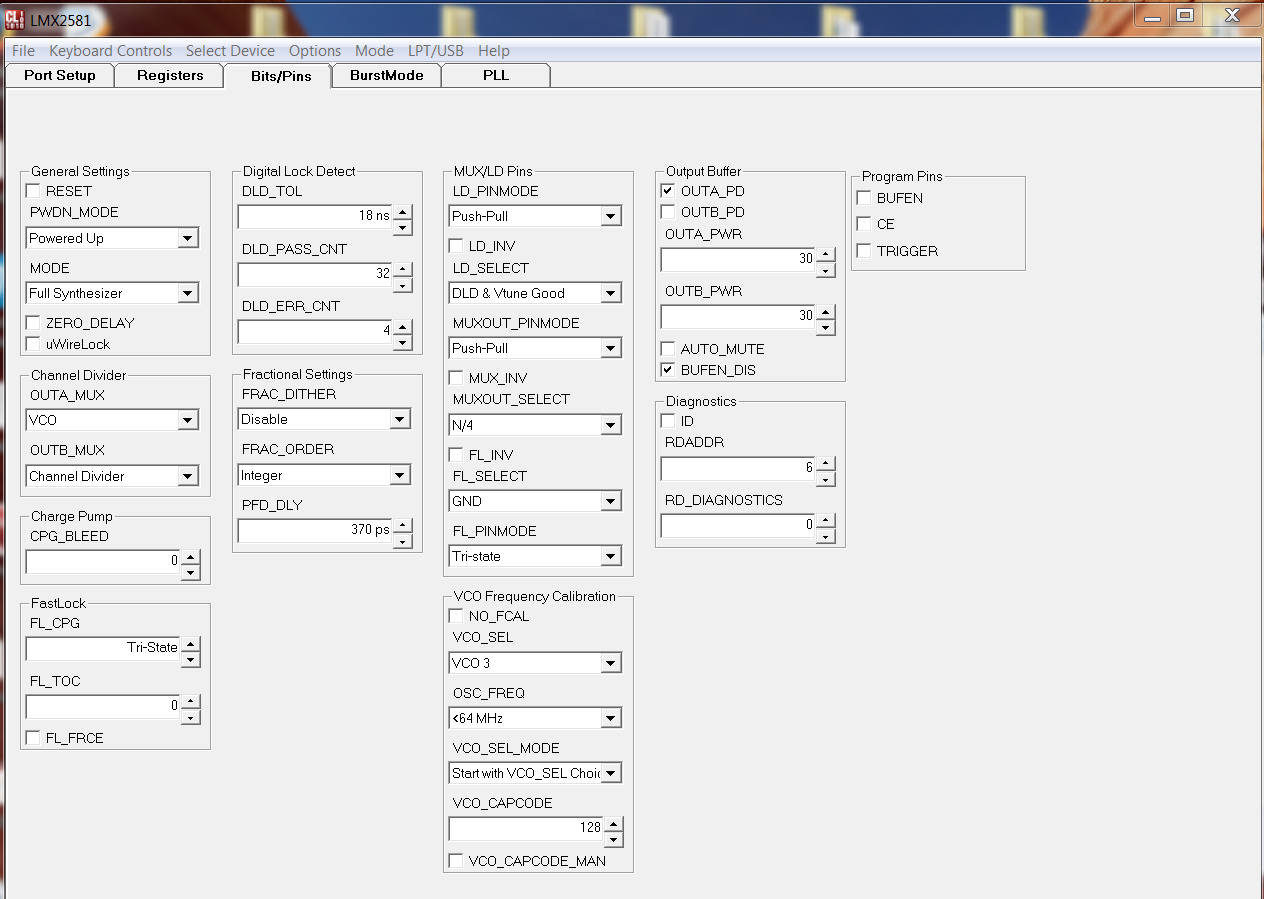
Now I am trying to optimize the phase Noise at 1100 MHz (using divide by 2 )  I set my Phase Detector frq= 10 MHz. I measured  the Muxout  (set for N/4 in code loader) in Spectrum Analyzer which should be 2.5 MHz which is very clean signal (very good Phase Noise)  . The same I tried for Muxout (R/4) which is also very clean signal (very good Phase Noise) . The photos are attached by N_ref and R_ref.

But when I see the spectrum at 1100 MHz it phase Noise becomes bad at 10 KHz away from the Carrier. I set  the Loop Bandwidth for 25 KHz and 48 deg Phase Margin Values for C1=1.8 nF, C2=56 nF, R2=390 Ohm, R3=270 Ohm, C3=3.3 nF  as per evaluation board. But Nothing is improved. Can you suggest how can  I improve my phase Noise (or How can I the spikes at 10 KHz way from the carrier) I I tried to changed the Phase detector Freq to 20 MHz but then also problem persists phase noise bad.The Spectrum attached as 1100_Spectrum
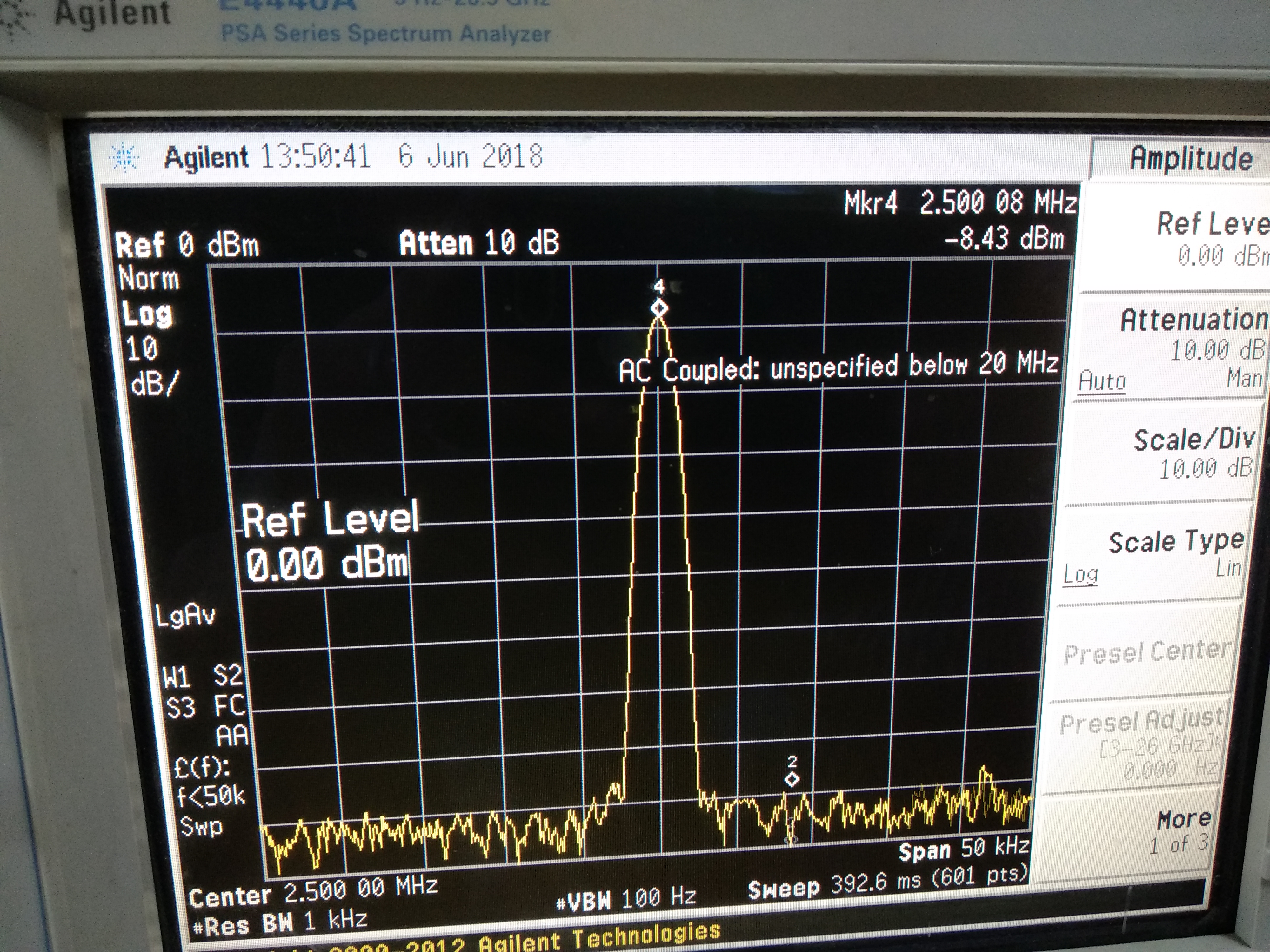
N_ref.PNG
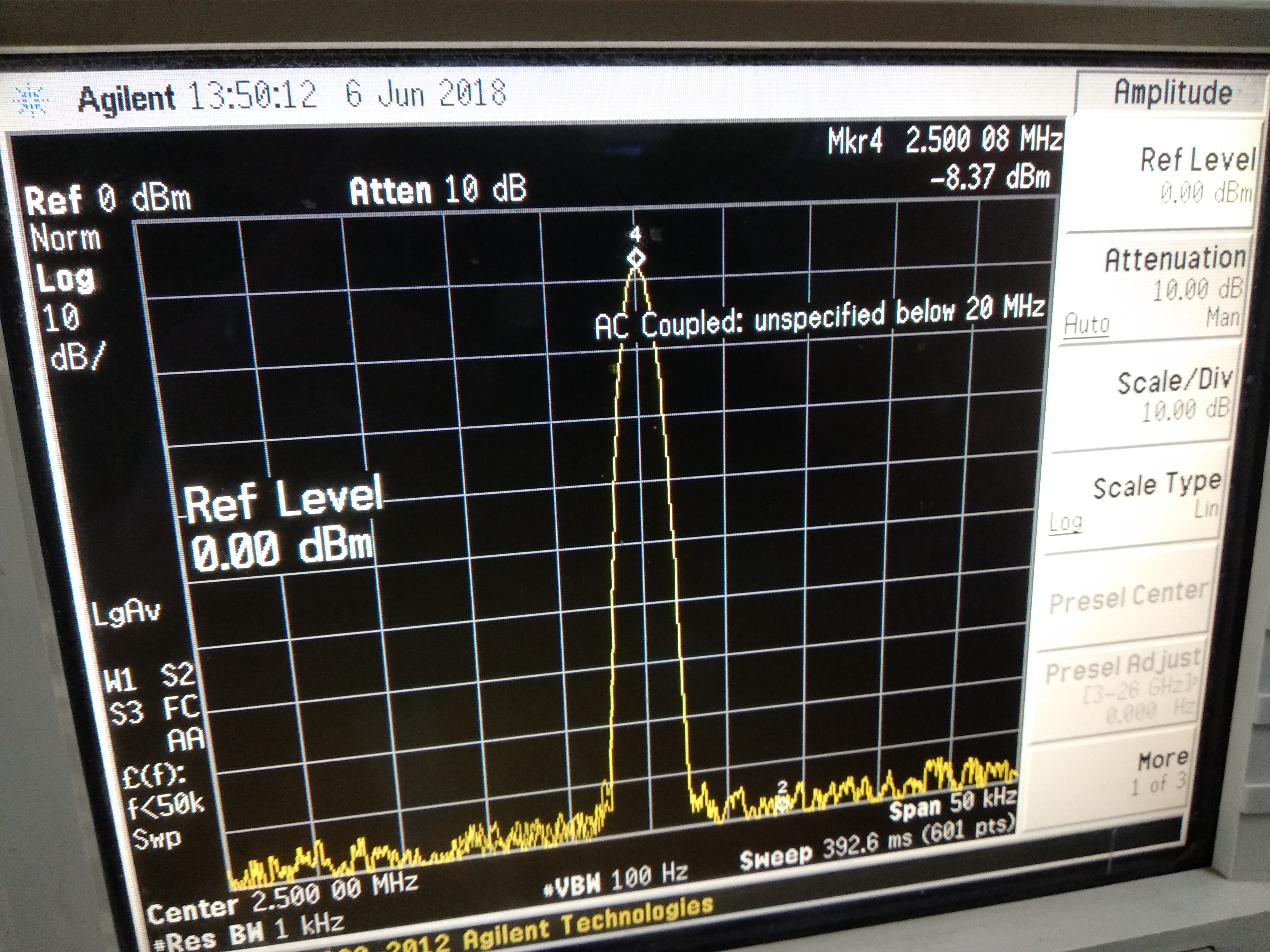
R_ref.PNG
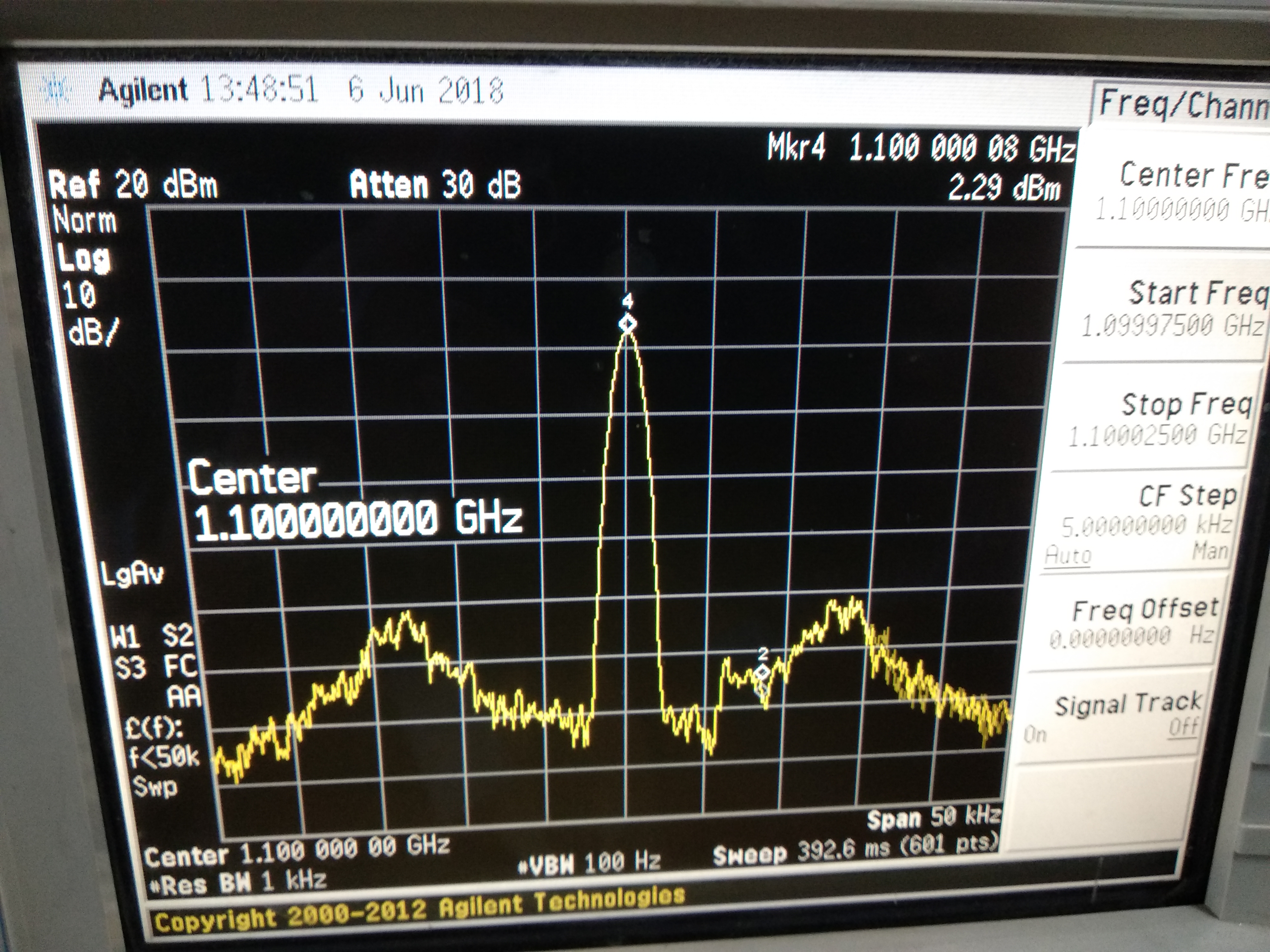
1100_spectrum.PNG
One more question which is related to environmental testing what should be the ideal loop bandwidth and phase margin  for any LMX2581 or LMX2541 or other  LMx   PLL sothat it passes 6g rms vibration test.

Thanks in advance

Regards

LB Dube

Mirowave Systems

  • Hi Dube,
    It looks like a filter design not matching PLL setting.
    Could you save the configuration file as a .mac file in Codeloader?
    Our engineer could load it directly without typo. Thanks.

    Regards,
    Shawn
  • [SETUP]
    ADDRESS=888
    CLOCK=2
    DATA=4
    LE=1
    PART=LMX2581
    PINPOSITION00=10
    PINPOSITION01=11
    PINPOSITION02=6
    [MODES]
    NAME00=R5 (INIT)
    VALUE00=1082589200
    NAME01=R15
    VALUE01=35645455
    NAME02=R13
    VALUE02=1082310925
    NAME03=R10
    VALUE03=553668810
    NAME04=R9
    VALUE04=63422521
    NAME05=R8
    VALUE05=545119224
    NAME06=R7
    VALUE06=795415
    NAME07=R6
    VALUE07=1222
    NAME08=R5
    VALUE08=1089541
    NAME09=R4
    VALUE09=4
    NAME10=R3
    VALUE10=536994771
    NAME11=R2
    VALUE11=265326594
    NAME12=R1
    VALUE12=4093640737
    NAME13=R0
    VALUE13=1625030656
    OSCIN00=20
    EXTRA_PLL_N_DIV_1_00=1
    PINS=0
    [BURST]
    COUNT=0
    [FLEXHASH]
    HASHVALUE=0
    
    Dear Sir,

                     Thanks for your early reply. I have attached the code loader setting File . ' setup_2581'

  • Dear sir, I have Sent as setup_2581 .txt instead of setup_2581 .mac because .mac file is unable to send. But you can use this file ' setup_2581 .txt' in codeloader by just restoring and giving the path for this file. I have checked.
    Regards
    LBdube
  • Hi LB,

    What is your reference clock output format? Sine wave, square wave or clipped sine wave? How did you connect the reference clock to LMX2581?
  • Dear sir,

    The Ref Clock is 20 MHz sine wave from Agilent Signal Generator .Which I have divided vy 2 using R counter Hence my phase detector Frequecy is 10 MHz.  The power input at Oscillator input pin of LMX2581  is +3 dBm . The External loop Filter Values mounted on my PCB board are as per your Evaluation Board C1_LF=1.8 nF, C2_LF=56 nF , R2_LF=390 Ohm, C3_LF=3.3 nF, R3_LF=270 Ohm, C4_LF=3.3 nF.

    Regards

    LBDube

  • LBDube,

    1. Assume that any signal generator frequency has absolutely horrible phase noise, as this is almost always the case. A signal generator costing a lot of money or claiming to be low nose does not make it low noise.

    One useful experiment to do is to change the frequency. For instance, if this is signal generator noise, then keep the phase detector frequency a constant 10 MHz and try this: Try 10 MHz input with R=1 for Fpd=10 MHz, then try 20 MHz with input R=2 for Fpd=10 MHz, then try 100 MHz with input R=10 for Fpd=10 MHz, then try 1000 MHz input with Fpd=100 for Fpd=10 MHz. They all should have the same phase noise, but if the higher input frequency has better phase noise, typically this points to a noisy signal generator.

    2. Assuming a noiseless input reference, you should expect a lower loop bandwidth as it is a function of the phase detector frequency , charge pump gain, and VCO gain. In your case, the charge pump gain is pretty close, but the phase detector frequency is half, which should reduce the loop bandwith. According to our PLLatinum Sim tool, the original loop bandwidth is 21.7 kHz (But this depends on the VCO core selected, which could be VCO2 or VCO3 for 2.7 GHz). Now if you change your parameters from the defaults to the ones for your setup (Kpd = 3.0 vs. 2.4, Fpd = 10 vs 20, Fvco = 2200 vs 2700), this reduces the loop bandwidth from 21.7 to 13.6 (if device chooses VCO2) or 17.4 kHz (if device chooses VCO1). Actually the 13.6 kHz looks close to what you are getting. The "peaking" likely has nothing to do with phase margin, but rather the VCO noise cropping inside the loop bandwidth and causing this effect. The default is for the device to start at VCO3, which means it will try VCO2 if it works, so likely you are looking at VCO2.


    So in summary:
    1. Ensure that you are not looking at the input reference noise.
    2. Ensure that his is not due to loop dynamics. i.e. Set the VCO to VCO1 vs. VCO2 and see if there is a difference. Try an apples to apples comparison with EVM instructions and change Fvco=2700 and Fpd=20 MHz.
    3. Upgrade to TICSPro (www.ti.com/.../TICSPro-SW) as it is easier to use. Unless you are using a parallel port cable and not the parallel port to program USB2ANY, there is no incentive to use CodeLoader. The upgrade is painless and the form and feel are very similar to Codeloader.
    4. Try our PLLatinum Sim tool (ti.com/tool/PLLatinumSim-SW). It models the impact of changing the phase detector frequency, VCO core, loop filter, and charge pump gain. Also, if I put in your 10 MHz phase detector frequency with VCO2 as the core, it also predicts the peaking in the phase noise right at 10 kHz.

    Regards,
    Dean
  • �T�n�0��;�2 ;X�~-۵�~�6X�nW/q7cN2�N{�v�a�W�(ɱ��E~�I�ϯ��|^t��%�jK.ʇj]���.�D��UQ��i�j�e�������O\�&.����-�&�������dz�K��x�s�"u��?�$H�гN>/ǀ�АG��5B�k0ڪ��Ej�Di<�)�EѶ��ِ�fS6>�yQ;W��}C��M��!����->��&M�U]W6dvߺ˯�]Q��]Q￐�~����mIfT.�mIn���EG��`d�9_�z�cR˟Պ�N���T"�Y��Ȭ�7��Pk��4X�d
    %�Y
    �"x�4*P�&�GP-�֖	`\�A�2��<w
    �4�2�zC�^�ea"�硧��t����Y�|���~:O���R!՞�å��28ʌ��"��Pi�謏mT8JF��աX��
    �ۥ%֫��l�y���sTǃQB��h�W,.�)��}�H~U��?:�
    �{Ll��N�����uv�3�x^�� �ƎO�3�����m
    Dear Dean Sir,

                                     Good Morning. Thanks for your reply.

    1. For signal generator phase Noise I will check as you suggested in point no 1 and I will try by changing the Signal generator also. Although I have Checked the Phase Noise of my Signal generator 20 MHz and 10 MHz  in Spectrum Analyser in logplot it is very good . I will send the phase Noise Plot Also.

    2. I downloded the PLLatinum Sim tool and calculted the loop bandwidth . you are very true for 10MHz, Core VCO2, Kpd=3.0 mA the Loop Bandwidth is 13.6 KHz . I attached setting setting2.txt . please rename this as setting2.sim to use in PLLatinum Sim tool.

    3. Up gradation to TICSPRO:

    Earlier I am using codeloder . I have soldered the clk, data, LE and GND to 25 PIN parallel port connector and used .

    I am very eager to use this software . I have downloaded this software  also. But Sir I donot have Texas USB2ANY adaptor . I have Simple USB cable on Computer side  and open  5 wire  to PCB side . Is there any short cut to use USB or I have to purchase USB to SPI or USB to UART adaptor interface.

    4. one more question which I feel you can answer in better and deterministic way.

    We usually go through ESS and Vibration  level =6g RMS testing. The PLL loses their lock and we try to optimize the extenal loop bandwidth to remain locked on vibration platform also. we have done this LMX2541, LMX2531  and write now LMX2581 . Can you please suggest what should be the ideal loop badwidth and phase margin to sustain any frequency shift in Oscillator or in VCO due to vibration. and why PLL loses lock in vibration . please explain.

    Regard

    LBDube

  • Hi LB,

    I suggest you contact your local sales representative to get a USB2ANY.
    For the reference signal, we have seen many failure cases using the 10MHz or 20MHz output from a signal generator. You can compare the result with the 10MHz output from the signal generator and with the 10MHz reference output from the rear panel of the signal generator. You should see the difference.
    As for the vibration, if you are using a crystal-based reference clock to a PLL, then it is the instability of the reference clock that makes the PLL not stable or unlock. The PLL can be make to react to the change faster by making the lock time faster. That means you need a little bit wider loop bandwidth; around 50 degrees phase margin. Use PLL Sim to find out a balanced solution.