I find a strange description about the Vcm-DC of LVPECL/CML/LVDS from datasheet of CDCM6208:
LVPECL:
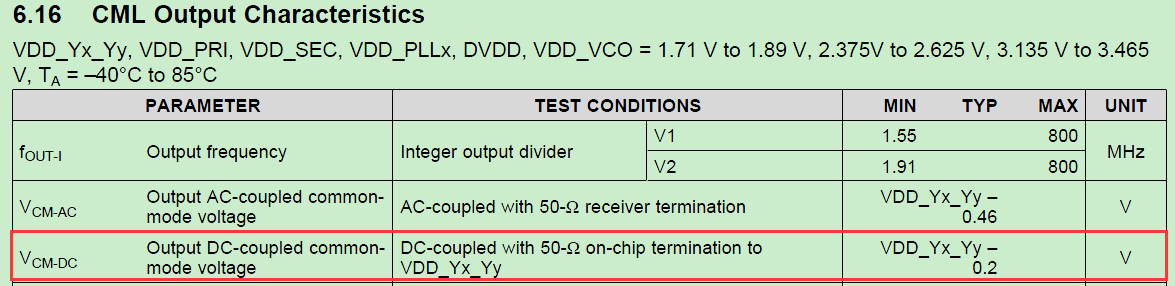
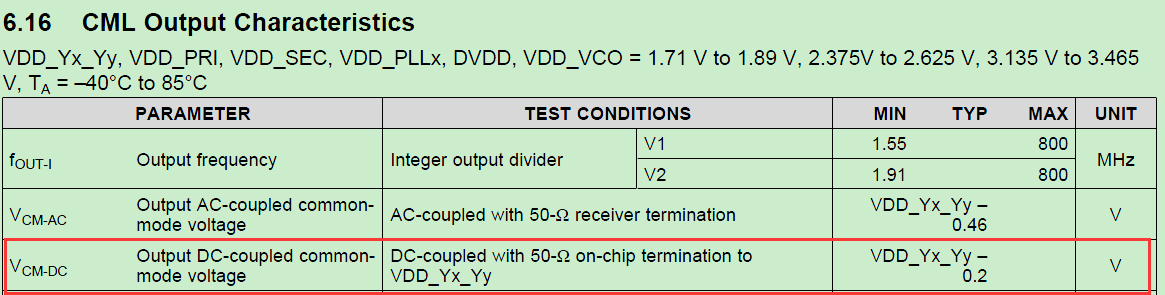
CML:
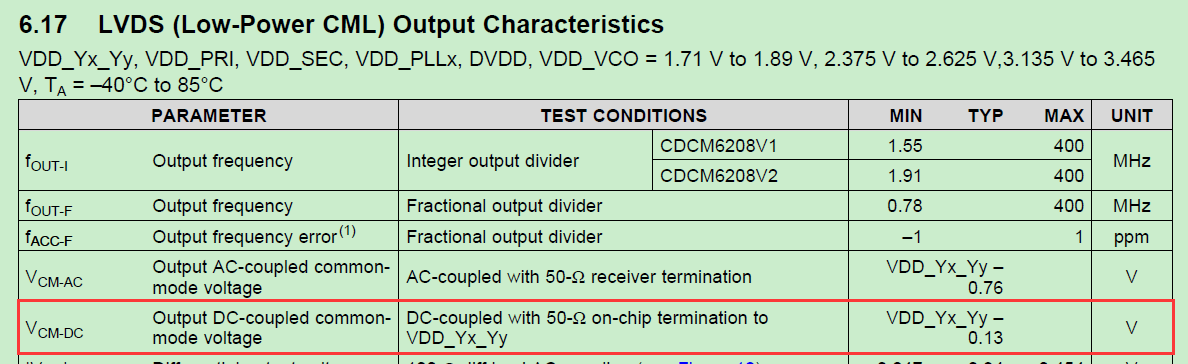
LVDS:
Can you tell me the actual model of DC couple? I want to know the test DC couple schemetic of CDCM6208's output,Thank you very much.
This thread has been locked.
If you have a related question, please click the "Ask a related question" button in the top right corner. The newly created question will be automatically linked to this question.
I find a strange description about the Vcm-DC of LVPECL/CML/LVDS from datasheet of CDCM6208:
LVPECL:
CML:
LVDS:
Can you tell me the actual model of DC couple? I want to know the test DC couple schemetic of CDCM6208's output,Thank you very much.
Reply to your explanation: CM-DC test condition is the same as CML driver: "DC coupled with 50 Ω on-chip termination to VDD_Yx_Yy",
But According to my calculations I think the real calculation is not the same as what datasheet. says
So can you give me a detailed process of analysis in the DC couple with LVDS like and LVPECL like?
Jianxin,
CDCM6208 LVDS-like type is a low power CML (lpcml) driver, LVPECL-like type is a high swing CML (hscml) driver. We recommended AC coupling for LVDS/ LVPECL receiver, then the unmatched Vcm from CDCM6208 could be ignored.
If you really need DC couple with load, a IBIS model simulation could help you.
Regards,
Shawn
Hello,
I think the Vcm-DC should be the open-circuit voltage, other than the coupled voltage. Because the DC--couple will add load after the CML output, then I think the Vcm-DC data is wrong.
The second reason is if Vcm-DC in the DC-coupled is min(Vref-0.13), considering the wave swing, the max voltage is bigger than Vref, Please give me an explaintion.
Hi Jiaxin,
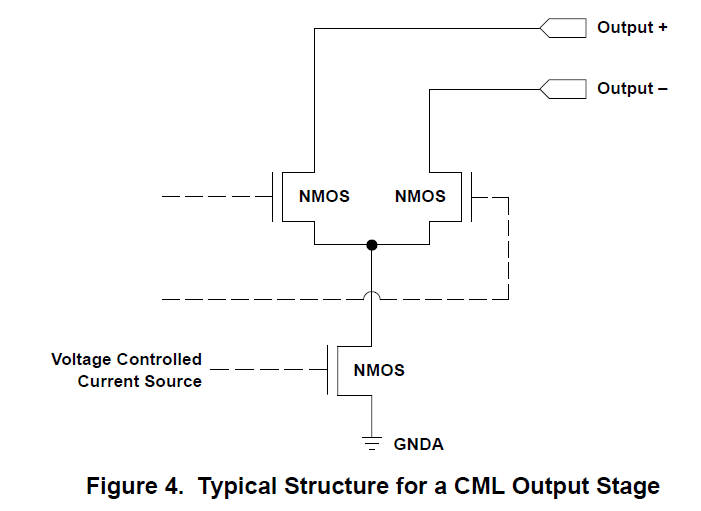
Standard CML drivers that are built from an open-drain differential pair. The outputs (Output+ and Output–) require pullup resistors to VDD because the NMOS transistor can drive only falling edges efficiently and needs the pullups to help drive rising edges.
VDD_Yx_Yy-0.13 is for typical value.
The spec swing Vod is measured by AC coupling,which can't be add on Vcm-DC directly.
If you are using LVDS or LVPECL receiver, please use AC coupling.
If you are using CML receiver, AC or DC coupling can be accepted.
Regards,
Shawn
The VCM-DC is the open circuit voltage and measurement is done at DC where Voh, Vol are measured with high impedance probe and then Vcm-dc is calculated.
So there are two questions which are needed to explain.
1) Output Matching impedance is integrated in the IC or not? According to the datasheet Fig12, I think it is in the IC output struction. But considering your pre-reply, you think there is no Output Matching impedance in the IC. So please give me a confirm.
2) VCM-DC's measurement method is which one? The first is your explain: open circuit voltage ( with Output Matching impedance is Not in the IC) The second is output struction (with Output Matching impedance in IC) DC coupled with post-circuit.At the same time, post-circuit must be DC matching . Which one is the actual way in datasheet.
Thank you for your reply. And I suggest TI's datasheet should be detailed in measurement method considering the majority of user.
You are correct. CDCM6208 output driver had integrated "50 Ω on-chip termination".
That's why the test condition is "DC coupled with 50 Ω on-chip termination to VDD_Yx_Yy".
For CML driver, the pull up termination is must have, which could be on-chip (internal) or external.
There are some confusion on "Open circuits" and "Open Drain" in this thread. The key is how to understand CML driver and receiver.
Below 2 application notes could help understand more.
Interfacing Between LVPECL, VML, CML and LVDS Levels
DC-Coupling Between Differential LVPECL, LVDS, HSTL, and CML