This thread has been locked.

If you have a related question, please click the "Ask a related question" button in the top right corner. The newly created question will be automatically linked to this question.

LMX2572: Phase Noise and Spur Issue

Part Number: LMX2572

Hello,

We intend to use LMX2572 in our VHF and UHF DMR projects. Now, we are trying to optimize the phase noise and spur performance of LMX2572. Reference frequency is a 48 MHz CMOS TCXO and other circuit elements are as you recommended. We have observed some phase noise and spur issues as you may see in Figure 1.1.

Figure 1.1

In Figure 1.1 carrier frequency is 351.275 MHz. We measured two different phase noise plots at that frequency.

-TICS Pro black trace paramaters are shown Figure 1.2 below.
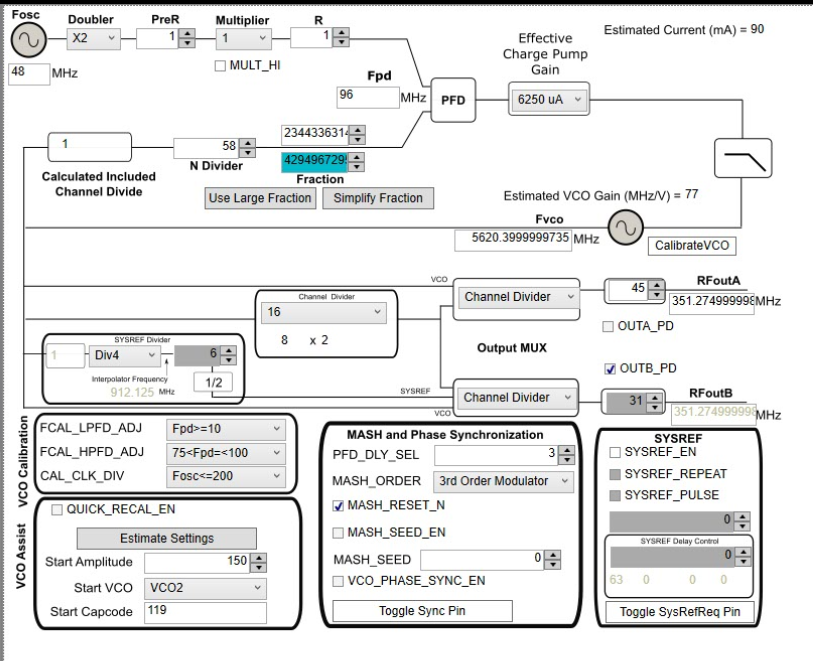
Figure 1.2

As shown in the Figure 1.2, Fractional Denominator is set its maximum value (2^32-1). For this reason, There is an little offset at RF Output and VCO Frequency. As a result, Phase Noise is degraded.

- TICS Pro green trace Parameters are shown in the Figure 1.3 below.
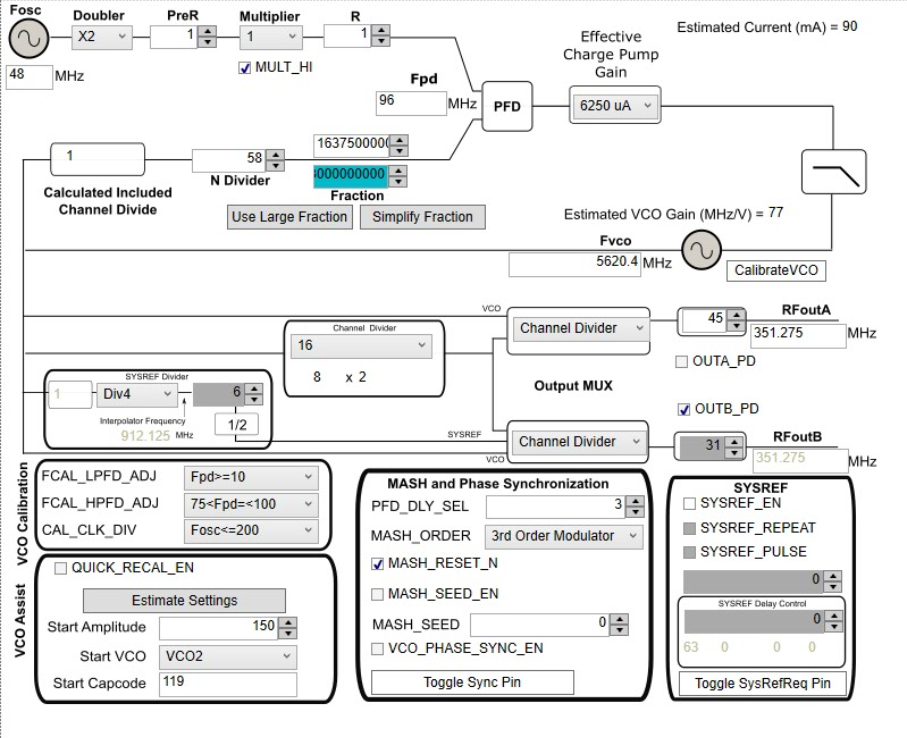
  
     Figure 1.3

 In this case, Fractional Denominator is set 3000000000, so there is no offset at the RF Output Frequency and VCO Frequency. Eventually, phase noise is not degraded. But, there are lots of spurs in this situation.

However, at some frequencies, we measure a good phase noise without any spurs.

As a conclusion, why does a small offset in VCO frequency cause a drastic effect in the phase noise, and how can we solve spur issues without any phase noise degradation at output frequency?

Best Regards,

Gündüz.


  • Hi Gunduz,

    In the second case, you've got "exact" frequency output. This is because you used a DEN value which is an integer multiple of 48MHz. Although the DEN is big, you can click the "Simplify Fraction" button and you will see that, in fact, the DEN can be simplified to 240. Since the DEN is not big, the mash (fractional) engine will create big spurs because the engine is trying to generate the fractional number with a limited combinations of "pattern".
    In the first case, the DEN is not an integer multiple of 48MHz and is not able to be simplified. As a result, the mash engine has a vast combinations of pattern to create the fractional number. So the spurs are randomized, their amplitudes are reduced and spread over the spectrum, which in turn increase the phase noise. This is more or less like the effect of spread spectrum technique.
    In this particular channel, the spurs are due to fpd. You can change the fpd to avoid the spurs. For example, disable the doubler. Set PreR=2, MULT=3. Then the spurs shall go away.
  • Hi Noel,

    Thanks a lot for your quick reply. This helpful for us.

    I have one more question about fractional engine spurs. In the datasheet, Register 40-41 field descriptions says "MASH_SEED sets initial state of the fractional engine. Useful producing a phase shift and fractional spur optimization.". However, there is no information about how MASH_SEED works for spur optimization. There is only "Phase Adjusment" mechanism at the MASH Seed part. Could you explain how MASH Seed mechanism works spur optimization.

  • Hi Gunduz,

    There are multiple spurs sources in a synthesizer, PLL is one of those.
    For example, when OSCin = fpd = 100MHz, VCO = fout = 10000.1MHz. Then the spurs frequency is 100kHz. In this case, the mash engine, crosstalk between fpd (or OSCin) and VCO, crosstalk between fpd (or OSCin) and fout produce spurs at 100kHz. If the phases of these spurs are aligned, the spurs level will be the highest.
    When we do some phase adjustment, we change the phases of these spurs and there is chance that the spurs level get reduced due to phase cancellation.
  • Hi Noel,

    Thanks a lot for your reply. You've been very helpful. We will take into consideration your suggestions.   

    Best regards,

    Gündüz